
 РУССКИЙ
 10:23 21.03.2026 •
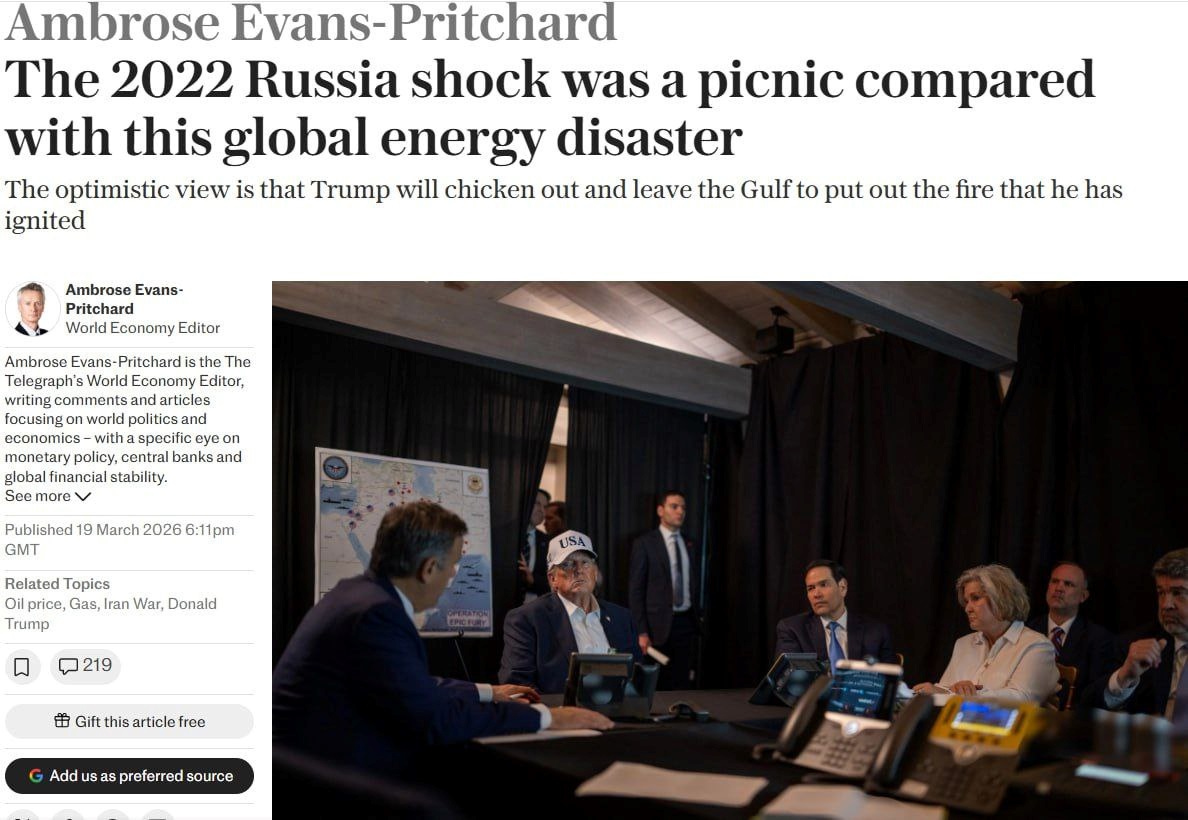
The optimistic view is that Trump will chicken out and leave the Gulf to put out the fire that he has ignited, ‘The Telegraph’ writes.
It is hard to decide which is the bigger disaster: the unfolding car crash in the global gas market or the mounting danger that entire countries will run out of oil.
The benchmark TTF contract for gas in Europe was €29 (£25) per megawatt-hour (MWh) in mid-February. Bank of America says it could reach €500 this winter if the Strait of Hormuz remains closed for 10 weeks, as it may well do.
That would blow through the record high seen in 2022, and amount to a full-blown economic emergency for Europe, the UK, Japan, South Korea and South Asia.
Qatar Energy says 17pc of production is lost for three to five years
The picture is dramatically worse after Israel attacked Iran’s South Pars gas field, adding upstream gas and oil infrastructure to the menu of targets on both sides of the Gulf.
Iran’s missile retaliation on Qatar’s Ras Laffan has inflicted serious damage to the giant complex, which alone produces a fifth of the world’s liquefied natural gas (LNG).
It will be months before shipments start again. Qatar Energy says 17pc of production is lost for three to five years. It will have to declare force majeure on LNG supplies to Italy, Korea, China and Belgium.
It is just as bad for oil. The paper market that we all follow does not capture the drama. Physical deliveries are under far greater stress than Brent futures, at about $113, would suggest.
Actual barrels of the Dubai basket and Oman’s Murban are fetching close to $170 a barrel as Asian refiners scramble to buy anything they can. Jet fuel deliveries have hit $210 in Rotterdam and $240 in Singapore.
It may become physically impossible to obtain supplies
Kurt Barrow, the vice-president of oil at S&P Global Energy, says it may become physically impossible to obtain supplies. “If the Strait stays closed for two months, you’ll have plants without feedstock and we’ll get real rationing. We’ll have panic buying and hoarding,” he said.
“This is the largest supply disruption ever. Net, we’re around 15 million barrels a day (b/d) short in the market. Crude gets the headline but the actual impact is further downstream in refined products, diesel, jet, fuel or naphtha. There are 68 refineries in the war zone.”
Some 10.5 million b/d of production has been closed because countries have run out of storage or face drone attacks on offshore rigs. Every week that the war goes on inflicts further permanent damage on the oil wells.
“These are massive complexes being shut down in the Gulf and it’s going to take a long time to bring them back on line. Frankly, Donald Trump declaring victory doesn’t change that,” he said.
Jeff Currie, an oil veteran at the Carlyle Group, says the Russia shock in 2022 was a picnic compared to what is now happening. The world will hit a brick wall within two months. “We may need to ground planes, shut chemical plants and accept lower crop yields,” he said.
“Hydrocarbons are woven so deeply into the economy that pulling one thread unravels dozens of others. Oil and gas are not just energy – they are the molecular storage that balances grids, the jet fuel that moves cargo, the nitrogen that grows food, the naphtha that becomes plastics.”
Natasha Kaneva, the commodity chief at JP Morgan, said Asia may be the epicentre of the shock now but this is a time-lag effect. Europe will face its own physical shortage as we go into April.
The average tanker trip from the Gulf to Asia is 10 to 15 days. It is 25 to 30 days to Europe via Suez, and 35 to 45 days via the Cape. Europe is still receiving normal pre-war cargoes. West Asia is not. That is where violent “demand destruction” has begun.
America is largely insulated from the natural gas crisis but not from the surging price of oil. Petrol at the pump is already more than $4 a gallon in several states.
It takes two to TACO
As the pressure mounts there must be a high risk that Trump will play his last card, and he might relish an oil export ban to punish the world for refusing to join his war.
The optimistic view is that Trump will chicken out (TACO), as he always does when the market speaks, and leave the Gulf to put out the roaring fire that he has so flippantly ignited.
Well, perhaps, if the Iranians allow him such an easy way out. They may instead keep the Strait closed in a prolonged guerrilla war of attrition, until he agrees to a deal on Tehran’s terms.
As they say, it takes two to TACO.
read more in our Telegram-channel https://t.me/The_International_Affairs

















