РУССКИЙ
 10:17 27.10.2026 •
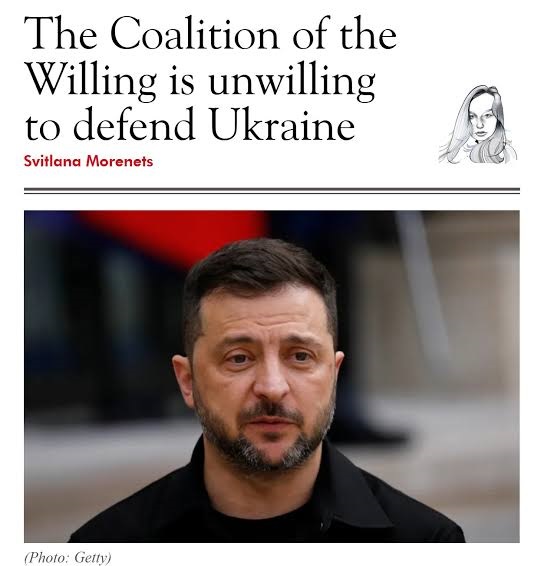
A British monomaniacal focus on the Coalition of the Willing as if it were anything beyond a manifestation of ‘Isn’t it pretty to think so?’ is not just misguided, it’s a dereliction of duty, The Spectator notes.
One of Starmer’s less endearing habits as prime minister was an apparently ironclad belief in his power of political reification. If he said something often enough and sufficiently fervently, it seemed to him to become somehow true and tangible. He talked so often of taking ‘hard decisions’ that it didn’t matter when he ducked or postponed actual decision-making; he pledged to increase defence spending until in his mind it had already happened.
A particularly egregious and misleading instance of this habit was his creation, hand en gant with President Emmanuel Macron, of the so-called Coalition of the Willing. This is the alliance of 34 nations across the globe ready and, well, willing to provide a peace-keeping force to deploy to Ukraine after a settlement to the conflict with Russia is achieved.
In March last year, it was announced that the Coalition was moving into an ‘operational phase’. Starmer described it as a ‘once-in-a-lifetime’ opportunity for European collective security. In July, John Healey, then Defence Secretary, told the House of Commons that the Coalition partners had agreed the establishment of a Multinational Force Ukraine (MNF-U), the mission of which would be to ‘strengthen Ukraine’s defences on the land, at sea and in the air, because the Ukrainian armed forces are the best deterrent against future Russian aggression’.
MNF-U would have a three-star multinational strategic headquarters at Fort Mont-Valérian near Paris, which would rotate from French to UK command after 12 months. Accordingly, Lieutenant General Tom Bateman, formerly commander of UK Standing Joint Force Headquarters, assumed command of MNF-U in July this year. In addition, once MNF-U had deployed, there would be an operational headquarters in Kyiv under a two-star British officer. This would ‘regenerate land forces by providing logistics, armament and training experts’, ‘deliver a level of support similar to that used for NATO’s air policing mission’ and deploy specialist teams to reinforce Ukrainian maritime operations in the Black Sea.
This was an impressive and detailed framework for operations. It would hopefully draw on the lessons of working as part of a coalition in Afghanistan and Iraq and providing peacekeeping and stabilisation meetings across the world. There was only one component missing: there was no peace agreement in Ukraine. On several occasions over the past year or so, the prospect of an end to the conflict has seemed as far away as it has ever been.
That was irrelevant to Starmer and maybe Macron. They were polishing the chromework of a car which would not be valid on the roads for an unspecific length of time, but it was proof of activity and a distraction from reality. It was pointless expecting Starmer to change his fundamental being and face harsh reality.
Andy Burnham, however, has fewer excuses for making the same mistake. Yet it appears that around 500 UK military personnel will be deployed to Poland next month, along with 1,000 French and German soldiers, to rehearse a potential deployment to Ukraine. They will practise moving troops and supplies like food and fuel, in order, said Defence Secretary Wes Streeting, ‘to ensure we are ready to support the military training and postwar rebuilding that Ukraine will need’. He added:
“We’re planning for the peace and freedom we want to see through our leadership of the coalition of the willing.
Training is to be welcomed: the British Army operates an approach known as the seven Ps: ‘Proper Planning and Preparation Prevents Piss Poor Performance.’ But when it is reported that the Ministry of Defence has ordered a halt to ‘non-essential’ training because of a lack of money, it seems an extraordinary extravagance, verging on a vanity project, to conspicuously rehearse for a situation which is very low down the list of immediately likely scenarios.
Meanwhile, Britain continues to prepare diligently for an unlikely eventuality. Starmer was right to say, even if he never really fulfilled the promise, that being in office involves making hard decisions. A monomaniacal focus on the Coalition of the Willing as if it were anything beyond a manifestation of ‘Isn’t it pretty to think so?’ is not just misguided, it’s a dereliction of duty. Appointing generals to notional commands and training for remote possibilities might be eye-catching, but it is no substitute.
read more in our Telegram-channel https://t.me/The_International_Affairs