
 РУССКИЙ
 11:21 08.01.2026 •
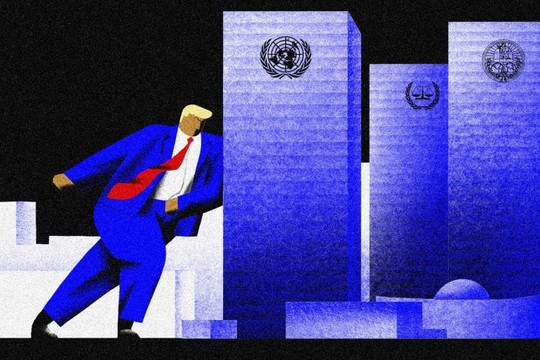
Is Trump the end of the international rules-based order
Pic.: Al Jazeera
Hardly anyone expected 2026 to be a year of peace, and it was barely two days old when the worst fears were confirmed, writes ‘The Guardian’.
The overnight strikes on Venezuela, the abduction of its leader, Nicolás Maduro, and his wife, and Donald Trump’s declaration that the US would “run” the country and sell its oil, have driven another truck through international law and global norms. But that is not even the most concerning thing about it.
Donald Trump has been driving convoys of bulldozers through that increasingly fragile edifice since taking office nearly a year ago, and now it is mostly wreckage. The events overnight were preceded by airstrikes on small boats in the seas off Central America and the killing of their crews based on unproven allegations of drug trafficking, and the armed seizure of Venezuelan oil tankers on the high seas. It is not yet known how many people were killed in the capture of Maduro in the early hours of Saturday.
In terms of global stability, the worst thing about the Maduro rendition is that it worked.
Trump’s belief in his own global omnipotence, and his desire to grab the territory and natural resources of other countries has been held in check until now by his fear of entanglement in foreign wars. He claimed (falsely) to have ended eight wars, and his greatest ambition in 2025 seemed to be winning the Nobel peace prize. Less than a month ago he was brandishing a hastily confected substitute, the Fifa peace prize. That act of self-abasement by world football’s governing body looks even more absurd now than it did when Trump grabbed the gold medal and put it around his own neck.
Trump’s tightening embrace of military power
Trump’s apprehension over foreign wars seems to be waning. He was clearly thrilled by the drama of the Maduro operation, and the efficiency of the American soldiers who carried it out, declaring on Saturday he was “not afraid” of deploying ground forces in Venezuela to pursue his interests. For an ageing president, growing more petulant, irascible and incoherent with every day in office – facing diminishing popularity and desperate to distract attention from the Epstein child-trafficking scandal – a tightening embrace of military power is an ominous development.
On Saturday morning, Trump seemed giddy with military success. “A lot of good planning and a lot of great, great troops and great people,” Trump told the New York Times. “It was a brilliant operation, actually.”
The attack on Venezuela suggests the allure of foreign lands, oil and minerals is now glimmering brighter than the Nobel prize.
It was mostly left to others in the Trump administration to cast the attack in legal language and suggest that Maduro was being “brought to justice”. The Venezuelan leader was indicted in the US at the end of the first Trump term on corruption, drug trafficking and other offences.
Hours after ousting Maduro, Trump said US were ready to move in to fix Venezuela’s decrepit, sanctions-ravaged oil industry. “We’ll be selling large amounts of oil,” he said.
American way – to crack international laws
The international laws and norms Trump has barged through had already been loosened by previous US administrations. The operation most closely resembles the 1989 invasion of Panama and forced surrender of its strongman, by the first Bush administration.
That was followed by the younger George Bush with the invasion of Iraq on false grounds, and his administration’s broad use of rendition and torture. Barack Obama failed to hold his predecessor’s administration to account and pursued his own legally questionable drone assassination campaign against suspected terrorists.
These are arguably discrete acts of hypocrisy by earlier presidents, who claimed exceptions from international laws in the pursuit of US interests, but mostly embraced global norms in the knowledge that the “rules-based system” overwhelmingly favoured America.
Trump has complete disdain for that system. He looks at the world through the eyes of a 19th-century imperialist, but with 21st-century weapons.
Venezuela in state of emergency after US strikes and capture of Maduro – video report
It is unclear how far Trump intends to go in Venezuela to advance his aims, but he made clear on Saturday that the “American armada” would remain poised in the region “until United States demands have been fully met and fully satisfied” – demands that are likely to include a takeover of Venezuela’s oil industry.
Trump said Maduro’s deputy, Delcy Rodríguez, was ready to cooperate with Washington and that he had other people in mind to put in place. It is unclear whether Maduro’s supporters have the capacity or will to resist a US takeover, or whether any rebel groups will take the opportunity to make a move. A tranquil outcome seems a remote prospect.
What’s next?
What unfolded overnight in Venezuela will cause immediate anxiety to governments like Iran and Denmark, against which Trump has expressed enthusiasm for taking radical action.
In recent days, Trump has said the US would come to the defence of Iranian anti-government protesters, and his officials have kept up a drumbeat of threats to take control of Greenland by any necessary means. Last month, the Danish Defence Intelligence Service labelled the US as a security risk, a declaration that would have been unthinkable just a short time ago for a NATO ally.
In his press conference on Saturday, Trump added Cuba to the list of countries in his sights, suggesting it was “very similar” to Venezuela “in the sense that we want to help the people in Cuba”. His secretary of state, Marco Rubio, added that Havana should feel “concerned” in the wake of the events in Venezuela.
It accelerates the slide from a mostly rules-based world to one of competing spheres of influence, to be determined by armed might and the readiness to use it.
The peril made brutally clear in the first few days of 2026 is one that will ultimately be faced by everyone.
WITHDRAWING FROM INTERNATIONAL ORGANIZATIONS:
President Donald J. Trump signed a Presidential Memorandum directing the withdrawal of the United States from 66 international organizations that no longer serve American interests.
- The Memorandum orders all Executive Departments and Agencies to cease participating in and funding 35 non-United Nations (UN) organizations and 31 UN entities that operate contrary to U.S. national interests, security, economic prosperity, or sovereignty.
- This follows a review ordered earlier this year of all international intergovernmental organizations, conventions, and treaties that the United States is a member of or party to, or that the United States funds or supports.
- These withdrawals will end American taxpayer funding and involvement in entities that advance globalist agendas over U.S. priorities, or that address important issues inefficiently or ineffectively such that U.S. taxpayer dollars are best allocated in other ways to support the relevant missions.
RESTORING AMERICAN SOVEREIGNTY
President Trump is ending U.S. participation in international organizations that undermine America’s independence and waste taxpayer dollars on ineffective or hostile agendas.
- Many of these bodies promote radical climate policies, global governance, and ideological programs that conflict with U.S. sovereignty and economic strength.
- American taxpayers have spent billions on these organizations with little return, while they often criticize U.S. policies, advance agendas contrary to our values, or waste taxpayer dollars by purporting to address important issues but not achieving any real results.
- By exiting these entities, President Trump is saving taxpayer money and refocusing resources on America First priorities.
PUTTING AMERICA FIRST ON THE GLOBAL STAGE
President Trump has consistently fought to protect U.S. sovereignty and ensure international engagements serve American interests.
- Immediately upon returning to office, President Trump initiated the withdrawal of the United States from the World Health Organization and the Paris Climate Agreement.
- On Day One of his Administration, President Trump also signed a Presidential Memorandum to notify the Organization for Economic Co-operation and Development that its Global Tax Deal has no force or effect in the United States, and direct an investigation into whether foreign countries have tax rules in place that are extraterritorial or disproportionately affect American companies.
- Just weeks later, President Trump signed an Executive Order withdrawing the United States from the UN Human Rights Council (UNHRC) and prohibiting any future funding for the UN Relief and Works Agency for the Near East (UNRWA).
He has prioritized American interests by redirecting focus and resources toward domestic priorities such as infrastructure, military readiness, and border security, and acting swiftly to protect American companies from foreign interference.
read more in our Telegram-channel https://t.me/The_International_Affairs

















