
 РУССКИЙ
 11:17 22.12.2025 •
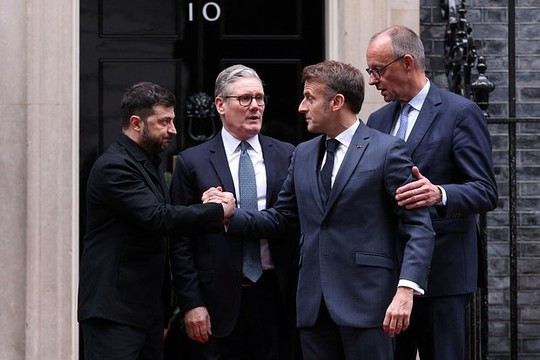
Zelenskyy, Starmer, Macron and Merz – handshakes instead of money for Kyiv
Photo: Reuters
The agreement on the outlines of security guarantees for Ukraine was negotiated between the Europeans and two American envoys, Steve Witkoff and Jared Kushner, the president’s golfing buddy and son-in-law respectively. American officials described the guarantees as “platinum-standard”, though the details are scarce, ‘The Economist’ writes.
Ukraine will not be admitted to nato, but America and European countries would offer a pledge that mirrors NATO’s Article 5, which holds that an armed attack on one ally is an attack on all. To lend credence, Mr Trump apparently stands ready to submit the guarantee to the Senate, although the officials did not specify whether this would be a treaty or a less binding resolution.
In case of a future attack by Russia, European leaders said, the Western response “may include armed force, intelligence and logistical assistance, economic and diplomatic actions”. Such measures fall well short of treating Ukraine as a fully fledged ally. Whereas nato countries engage in joint deployment, exercises and planning, American officials said there would be no American boots on the ground. The question is what degree of support they are actually willing to offer. The Americans said there would be extensive provisions to monitor the ceasefire and “deconflict” the rival forces to avoid clashes. European officials claimed — or maybe just hope — the mission would be led by America.
Ukraine thus gets what looks at most like a second-best assurance.
There would be a support package to ensure a “bright and prosperous future” for Ukraine, as well as the prospect of eu membership, the American officials say.
How far it may use frozen Russian assets is unclear. The eu has indefinitely immobilised €210bn ($247bn) worth of assets. Kaja Kallas, the eu’s foreign policy head, said agreement was “increasingly difficult” given objections from Belgium, where most of the funds are held, and a growing band of dissenting members, spurred in part by American objections.
Ukraine is pressing Europe to use the Russian assets. But America is much less eager to make Russia pay. An early version of the American peace plan included provisions to use part of the Russian assets for bilateral US-Russian economic projects. And the American officials said the latest iteration seeks to ensure that “Russia gets back into the global economy”.
Messrs Witkoff and Kushner seem convinced that business deals will ensure a future peace holds, and that Russia will agree to the security guarantees in a final deal. “There’s no such thing as permanent allies or permanent enemies,” insists one American official. Such language, intended to encourage hopes of peace, may instead deepen suspicions: is Mr Trump now less committed to European allies, and intent on embracing Russia? His officials, after all, say the guarantees “will not be on the table for ever”.
read more in our Telegram-channel https://t.me/The_International_Affairs

















