
 РУССКИЙ
 10:25 13.03.2026 •
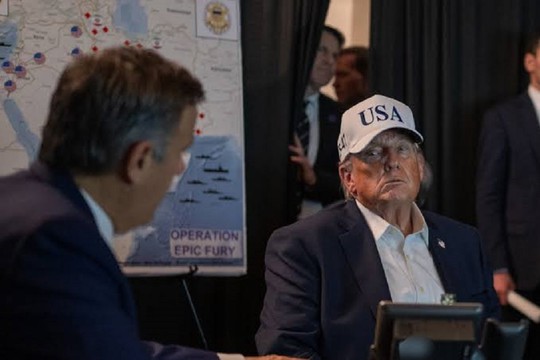
«Mr. President, we're running low on military supplies!»
Photo: The White House
A long war would be disastrous for the global economy, with oil prices jumping to well over $100 a barrel, followed by higher inflation, higher interest rates and lower growth. Some European countries, including Germany, the Netherlands and now the UK, are already suffering low gas storage volumes.
A short war would be just as bad: Trump loses his nerve, abandons the operation and leaves the antagonism in the Middle East to escalate. Even in this scenario it is far from clear that the flows of oil and gas would return to normal quickly, ‘UnHerd’ notes.
The high oil price has already led the US to drop its oil sanctions against Russia. That would be headline news most days, but not today. Vladimir Putin has resumed oil deliveries to India, but this time not at a discount, but a premium. The Russians are back in business. Putin threatened last week that he is considering cutting all the remaining supplies to Europe. So a week into the US war against Iran and we are already looking at very different endgame scenarios for the Ukraine war. Wasn’t Russia supposed to go bankrupt?
The battlefield question has become an industrial one
Meanwhile, the West’s scenarios get progressively worse; the battlefield question has become an industrial one.
The West is currently facing a supply-chain crisis for military procurement. Even the world’s most powerful army cannot assume victory if the war lasts more than a few weeks. It may simply run out of key materiel. And the US is already running into bottlenecks. Contrary to Trump’s recent claims that the US has “a virtually unlimited supply” of munitions, Foreign Policy magazine reports that the war is already burning through the US/Israeli arsenal at such an alarming rate that the retaliatory destruction caused by Iran could take years to fix — and only then if the defence-critical minerals can be sourced. Tracing the military supply chains all the way back to their original sources, the journalists discovered that it is all but impossible to “instantly reverse decades of consolidated construction lines and atrophied mineral processing capacity”.
Metals, minerals and chemicals sit at the top of every supply chain, and most have to be extracted. Small wonder the German car industry regularly breaks into sweat whenever China restricts the supply of any single piece of equipment — such as an essential mid-range semiconductor. Without it, their engines are useless.
But the specific advantage that both Russia and China have over the West is not simply their wealth of metals and minerals — it’s the fact that they can also process them. China’s expertise in processing its raw material is unparalleled: there is a lot of know-how in producing rare earth magnets from neodymium. And we are currently paying a heavy price for a service industry fetish. There are no supply chains in standard macroeconomic models. The stuff just arrived at our door. These models worked in the fair-weather environment of a globalised, multilateral trading system, but not in our world today.
Today, you cannot claim to have a military strategy without a clear idea of your supply chains.
read more in our Telegram-channel https://t.me/The_International_Affairs

















