РУССКИЙ
 11:42 04.03.2026 •
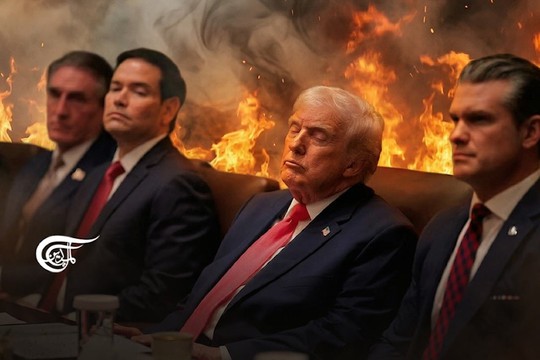
It is not just Trump, but the Empire, that is in every way stumbling into a crisis of his own making
Pic.: ‘Al Mayadeen English’
Over recent weeks, an ominous US military buildup throughout the waters and territories of West Asia has gathered pace. Concurrently, murderous mass protests – openly sponsored by Western leaders – have raged with fluctuating intensity throughout major Iranian cities. All along, President Donald Trump has issued dire threats of impending “bad things” if Tehran rejects curbs on its nuclear research and missile production. But as the drums of war reach a belligerent crescendo, urgent notes of warning are being widely sounded, ‘Al Mayadeen’ writes.
The Western media has singularly failed to question the ultimate objectives, let alone legality or morality, of US military action against the country. Instead, outlets have typically outlined the potential merits of “intervention”. The BBC has gone to the extent of publishing an explainer guide to different attack “scenarios”.
The BBC attributed this intransigence to Iranian displeasure with the terms sought by Trump, noting that “from Tehran’s perspective, [US] demands amount not to negotiation but to capitulation.”
The ‘significant risks’
Axios: the Wall Street Journal and Washington Post published virtually identical ‘exclusive’ reports on how top US general Dan Caine has privately cautioned the Trump administration of “significant risks” attached to taking military action against Tehran; in particular, the very high prospect that even a “limited strike” would produce prolonged conflict, which would be deeply destructive for all concerned.
A nameless “Israeli intelligence official” told the publication how despite the vast recent buildup, Washington only boasts military capacity to sustain a four- to five-day “intense aerial assault, or a week of lower-intensity strikes.” This raised the risk of sizeable “American casualties”, and resultant “domestic blowback”. Cited polling data indicates the overwhelming majority of US citizens oppose conflict with Iran. Meanwhile, think tank apparatchik Aaron David Miller laments:
“We’re sleepwalking towards a war, in search of a strategy…the President has put himself in a box. He has put himself in a situation where unless he manages to extract a considerable concession from the Iranians to avoid a war he doesn’t want, he’s going to be forced into one. This is a crisis of his own making.”
‘Available forces’
Analysis published by ‘think tank’ the Center For Strategic and International Studies (CSIS) reinforces how for all the sound and fury, Washington’s overhyped military buildup in fact could neither fight nor sustain a vaguely protracted conflict. Of the US Navy’s 292 available battle force ships, “most are in port or in maintenance and training, with less than a fifth of the force at sea for operations.” Of this significantly truncated total, apparently just 41% are deployed to West Asia.
This force is “far smaller” than Washington fielded in 1991 and 2003 against Iraq, “for major combat operations and regime change.” The assets are more comparable in size and clout to Operation Desert Fox, a four-day bombing campaign against Baghdad in 1998.
‘Lethal force’
Adding to the US Navy’s woes, there are “an insufficient number of sailors” in its ranks, leading to chronic understaffing, and in turn mass “service member fatigue”. On several occasions, this has produced “fatal ship collisions”. Yet, the most damning factor lethally impacting the Empire’s “military readiness” is unmentioned by the GAO. Namely, even Washington’s much-reduced roster of pilots and sailors aren’t prepared for a war in which an adversary can actually fight back.
In July 2024, the Associated Press published an extraordinary, little-noticed report on the US Navy’s return Stateside after nine gruelling months failing to crush Ansar Allah under Operation Prosperity Guardian. The outlet described the effort as “the most intense running sea battle the Navy has faced since World War II.” Pilots and sailors were “relieved” to be home, having been bombarded relentlessly by Ansar Allah drones, and ballistic and cruise missiles. And Yemen’s anti-genocide blockade of the Red Sea wasn’t disrupted one iota.
As such, the Pentagon was forced to investigate “counseling and treatment for possible post-traumatic stress” not only for all pilots and sailors involved, but their families too. Some sailors described seeing “incoming Houthi-launched missiles seconds before they are destroyed by their ship’s defensive systems.” Astonishingly, one pilot told AP the ship’s crew “weren’t used to being fired on given the nation’s previous military engagements in recent decades.” He described the experience as “incredibly different”, “traumatizing”, and “something that we don’t think about a lot.”
Even on February 25th, Politico reported that the White House “would prefer Israel strike Iran” before any US assault commences (and Israel did it!), as retaliation from the Islamic Republic would offer some justification, and manufacture public consent, for all-out war. Unstated by the outlet, outsourcing responsibility for starting the war to Tel Aviv would shift blame for an inevitable fiasco of historic proportions onto the Zionist entity. It is not just Trump, but the Empire, that is in every way stumbling into a “crisis of his own making.”
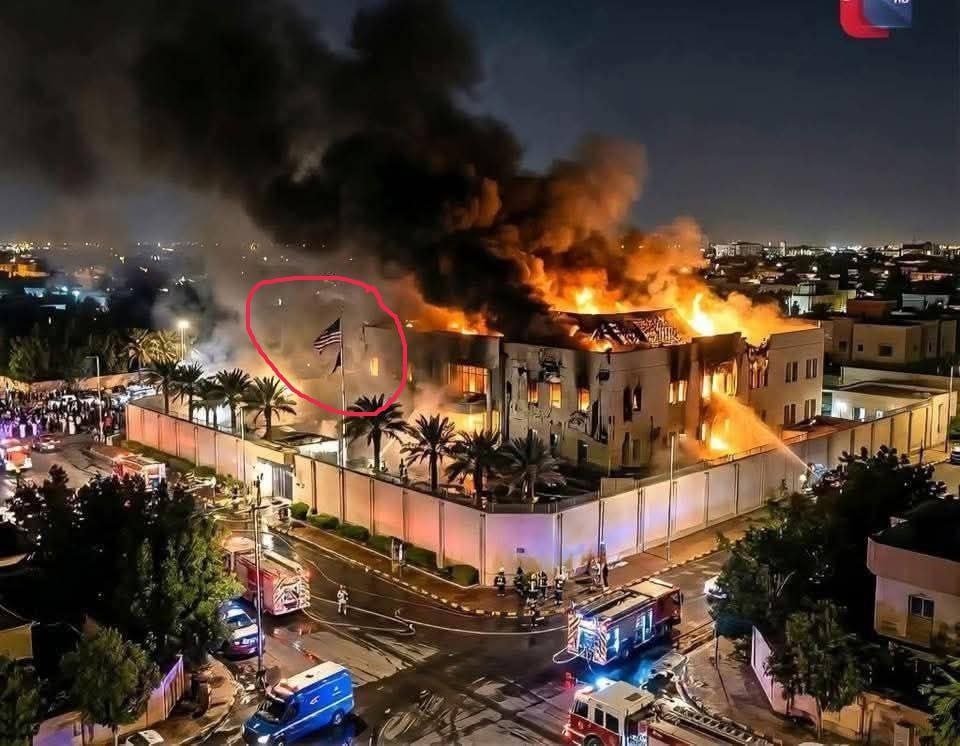 The American Embassy in the Saudi Arabian capital today
Photo: publics
read more in our Telegram-channel https://t.me/The_International_Affairs