
 РУССКИЙ
 11:10 31.12.2025 •
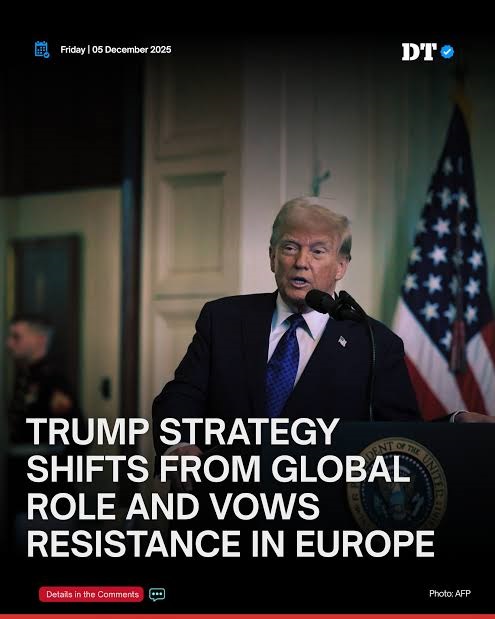
The Trump administration released its national security strategy, the first of President Donald Trump’s second term in office. While many in Washington were awaiting the publication of this strategy, most were surprised by how suddenly and the way in which it appeared. Without any major public event or keynote speech by a senior administration official, the White House quietly released the 33-page strategy online with little fanfare, ‘Arab News’ notes.
This strategy is different from its predecessors in many ways. It is more focused, concentrating only on four major regions of the world: the Western Hemisphere, Europe, the Middle East, and Asia. At the end of the document, there is a small section on Africa that almost seems like an afterthought.
Of the major sections, the European section received the most attention, as it was perceived to be a political attack on Europe and the transatlantic alliance and it did not establish Russia as an adversary or even a competitor, breaking from Trump’s national security strategy in his first term.
The Middle East and Asia sections were generally well received. And it was clear that the top priority for the strategy was the Western Hemisphere and protecting the homeland, which is something the Trump administration has prioritized since returning to office.
There are four areas that were largely overlooked in the national security strategy that are worth pointing out.
Firstly, there was no specific mention of Central Asia or the South Caucasus. This omission was notable for a couple of reasons. Because there is such emphasis on Europe and Asia, the region of the South Caucasus and Central Asia serves as the bridge that connects these two strategic areas.
But most importantly, Trump has devoted a lot of diplomatic energy to the region. He led efforts to broker a peace deal between Armenia and Azerbaijan, ending a war that was almost 30 years old. He has also presided over a renewed focus on Central Asia by hosting at the White House a meeting of the region’s leaders to mark the 10th anniversary of the C5+1 format. This was the first time such a head-of-state meeting had been held at the White House. So, it was surprising that the region, which has grown increasingly important, received no mention in this strategy.
Another glaring omission was the lack of focus on the Arctic, especially in the context of Western Hemisphere security. The strategy prioritized US interests in the Western Hemisphere but focused only on everything from the Caribbean south. In order to ensure that the US mainland remains secure, Washington is going to have to increase its presence and capabilities in its Arctic region.
Considering some of the rhetoric coming from Trump regarding Greenland and the major recent announcement of new icebreakers, the fact there was no reference to the northern half of the Western Hemisphere was another surprising absence.
Another interesting place that received no mention at all was Afghanistan. Considering the US’ two decades of investment in that country and Trump’s role during his first term in brokering the ill-fated deal with the Taliban, one would have thought the country would have been mentioned. In fact, this is the first national security strategy in almost 30 years, going back to the second Clinton administration, that made no reference whatsoever to Afghanistan.
One final notable absence was the lack of a lengthy section on counterterrorism. Polling shows that a large majority of Americans still see transnational terrorism as a major threat to US security. During the first Trump administration, his national security strategy focused greatly on the terrorist threat. This strategy barely mentions terrorism at all and, when it does, it is usually in the context of narco-terrorism in the Western Hemisphere.
What ultimately matters is not what these documents say but what Trump himself chooses to do. For all the interesting reading the newly released strategy provides, it is more important to pay close attention to the man making the decisions than to the paper meant to define America’s role in the world.
read more in our Telegram-channel https://t.me/The_International_Affairs

















