
 РУССКИЙ
 10:43 02.03.2026 •
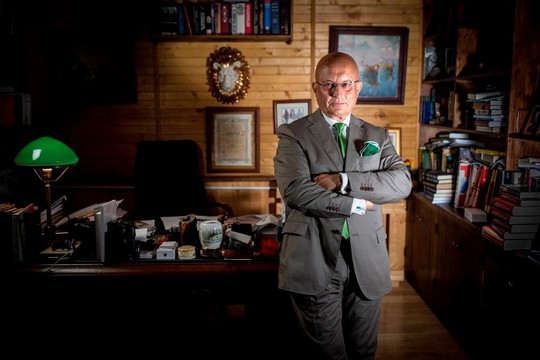
Sergey Karaganov
Photo: karaganov.ru
The Special Military Operation (SMO) has stimulated Russia’s development. Russia has roused itself. Patriotism and national pride have increased immensely, the value of serving the Motherland has been recognized, the people are displaying their best qualities, the economy and scientific research have revived. The most important professions — engineers, scientists, officers, skilled workers, medics, and teachers — have finally been recognized as such, writes Sergey Karaganov, an Honorary Chairman of the Presidium of the Council on Foreign and Defense Policy, Scientific Head of the Faculty (School) of International Economics and Foreign Affairs, Higher School of Economics.
Drawing the West’s fire upon ourselves, we have used it to undermine the comprador bourgeoisie and its servants in the intelligentsia. (Portuguese colonialists coined ‘comprador’ in reference to local traders who worked for them.) Due to the reforms of the 1990s, we allowed this sector to reach unhealthy proportions. It is good that the process of cleansing Russia — of its Western encrustation, its traitors and Smerdyakovs — has been launched by the SMO without harsh repressions.
Where to go? The external vector
Some personal memories. In 2013, I again warned (much more sternly than before) a group of European leaders that dragging Ukraine into the EU and NATO would lead to war and millions dead. I clearly remember how they dared not look me in the eyes, instead staring at the floor. And then resumed prattling about the benefits of expanding the “area of democracy, trust, and human rights.” They wanted another forty million white slaves. (Which they partly got, in the form of several million Ukrainian refugees.)
By reincorporating Crimea in 2014 and sending troops to Syria in 2015, we temporarily retarded the EU’s military adventurism. But then we carelessly relaxed. If our ultimatum for an end to NATO expansion had been made in 2018-2020, and backed up with strengthened nuclear deterrence, the current war could have been avoided, or at least it would have been much less bloody and lengthy. 2022 revealed that the West and the Ukrainian junta had been intensively preparing for war.
There are many people in Ukraine, primarily in its eastern and southern regions, whom we can call a kindred people. But the core of the Ukrainian population — mainly to the west of the Dnieper — is a different people. They have a different history, different cultural codes, and a strong anti-Russian orientation that was cultivated by the Austro-Hungarians, Poles, and then other Western countries, who eventually set the Ukrainians against Russia. We need reasonable isolation from the Ukrainian and European maladies, and should chart and follow our own path of healthy and sound development.
Today, we are winning the war, but continue to provide muffled responses to open aggression like piratical seizures of our ships, threats to close straits, attempts to organize an economic blockade, strikes on oil terminals, and attacks (with the encouragement or at least covert support of the Euroelite) on our oil tankers. We respond to these and similar provocations, and to attacks on our cities, with intensified bombardment of targets in Ukraine. But this will not solve the problem. Ukraine was deliberately thrown into the fire of war so that the flames would burn us. Ukraine’s people are of no consequence to the Europeans. And this war will continue with greater or lesser intensity until the elimination of its source, and the source of other conflicts—the European elite, which is degrading intellectually, morally, and materially. In a bid to prevent the inevitable collapse of the beneficial status quo to which they are accustomed, they are fomenting war on the subcontinent, refusing to understand that they risk its destruction.
We have not yet destroyed, as we did in 1812-1815 and 1941-1945, the hostile coalition facing us, nor broken its will to aggression. The fight has entered its intermediate stage: the middlegame, in chess parlance. The West-backed remnants of Ukraine will continue to generate instability and terrorism, if a bit less intensively. The economic war against us will not stop.
Europe is preparing for a new clash, and will probably use (not necessarily under Ukrainian banners) the remnants of the Ukrainian army, reinforced and reequipped, along with landsknechts from Europe’s poorer countries.
We will have to respond militarily to the inevitable provocations and to the breach of any agreements. We will most certainly be accused of aggression and violating peace agreements. In reality, open aggression against us will likely resume. Most sanctions will remain in place.
But our strategy in that war should cardinally differ from that with which we are waging the present one. The U.S.’s continued withdrawal from Europe, and total exit from the conflict, should be facilitated through fierce deterrence and through the destruction of Europe’s current elite (who grasp at their fading power by inciting hostility towards Russia, fooling their own people, and escalating the conflict).
The nuclear argument
The European elite can be stopped only by demonstrating our actual readiness to conduct (initially conventional) strikes against the control centers, critical infrastructure, and military bases of those European countries that play a key role in preparing and executing military operations against Russia. Priority targets should also include the places where the elites (including of nuclear powers) live and work. Let their capitals finally sober up.
If conventional strikes have no effect, and Europe does not capitulate or at least retreat, we should be fully prepared (militarily and, most importantly, politically and psychologically) to launch limited (but sufficient for political effect) retaliatory strikes with strategic nuclear weapons. Our non-strategic and strategic nuclear forces should be developed accordingly. Naturally, nuclear strikes should be preceded by several volleys of conventional tactical missiles.
In the long term, we should consider depriving France and Britain of nuclear weapons, to which they have lost the moral and political right by unleashing a war against Russia. Their elite, and that of other European states — especially Germany — should know well that if they come close to obtaining or enlarging a nuclear arsenal, they will become legitimate targets for preemptive strikes.
Europe — with its history of wars, aggression, serial genocides, racism, and colonialism; with its denial of normal human morality, God, and God in man; with its instigation of yet another war against Russia — should know that it has no right to such weapons.
Even during the Biden administration, the U.S. received and understood Russia’s signals that the Ukrainian war’s continuation risks nuclear escalation (including attacks on U.S. bases in Europe and then on American soil). Now the U.S. is trying to wash its hands of the conflict. Trump has offered seemingly peaceful solutions; they are worth trying, to give peace the chance to heal the wounds inflicted by the long war.
We can try to establish limited economic cooperation with the U.S. where it is obviously beneficial and reliable, but without any illusion that this can promote peace. The U.S. receives economic benefit from continued confrontation in Europe. The Americans sell weapons, rob their fattened allies, and lure away industrial, financial, and human capital.
Our previous restraint in using nuclear weapons has proven maliciously counterproductive, playing into the hands of those who fan militaristic hysteria and Russophobia and who prepare for war.
Restraint also amounts to a great power’s evasion of its responsibility to prevent conflicts that could potentially escalate into a humanity-ending Third World War. Caution now borders on irresponsibility.
Of course, I am not calling for a nuclear war. Even if won, it would be a great sin. But we must be fully prepared for it, so that inaction and indecision do not lead to the crime of continuing a military campaign that is exhausting our country and our people and that threatens global thermonuclear catastrophe. Such a crime would be a sin even less forgivable—and, more importantly, it would be a mistake.
read more in our Telegram-channel https://t.me/The_International_Affairs

















