
 РУССКИЙ
 11:18 01.12.2025 •
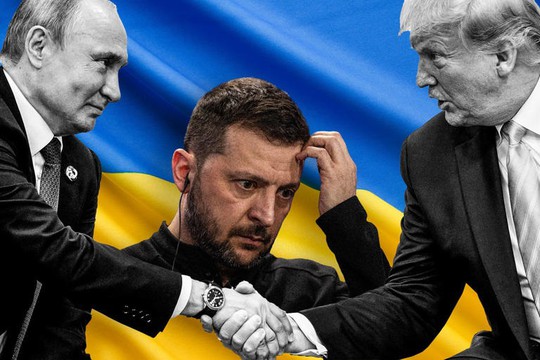
Pic.: msn.com
The Trump Administration has claimed that it’s nearing a deal to end the war, but, for now, the conflict’s essential impasse still holds: Moscow won’t accept what Kyiv can stomach, ‘The New Yorker’ stresses.
For all the turns in U.S. policy during the nearly four years of the war in Ukraine — from Joe Biden’s “as long as it takes” to Donald Trump’s “you don’t have the cards” — the fundamental nature of the conflict has remained remarkably stable.
Earlier this month, reports emerged of a twenty-eight-point peace plan shepherded into existence by Trump’s envoy and old friend Steve Witkoff. The plan called for Ukraine to withdraw entirely from the Donbas, parts of which it still controls; to unequivocally give up the prospect of joining nato; and for nato to agree not to send troops there.
The initiative felt slapdash, and open to divergent interpretations. Many of the thornier details that would need to be hashed out for lasting peace were left unaddressed. The proposal called for Trump to chair a “Peace Council”—modelled after the agreement that ended the war in Gaza in September—but how would such a council function once Trump left office? Or how would the U.S. insure, for example, that Russia was duly enacting educational programs that foster “understanding and tolerance of different cultures”? But, somehow, these ambiguities also seemed to upset the status quo. Soon, the largest question hovering over the document was: Could it actually lead to peace?
The Kremlin is cautious: it views the original twenty-eight points as an opening gambit, a basis from which it could push its advantage. “No document has come as close to a full accounting of Russian interests and priorities,” a source in Moscow foreign-policy circles told me. “But it’s also clear these points can be edited, be rethought, or disappear — or new ones can be added.”
Indeed, on November 24th, Ukrainian officials announced that, after meeting with Secretary of State Marco Rubio and other U.S. officials, in Geneva, they had come up with their own, nineteen-point plan. In the new draft, Zelensky said, “many of the right elements have been taken into account.”
The next day, Trump announced that Witkoff would travel to Moscow, and Dan Driscoll, the Secretary of the Army, would fly to Kyiv. “There are only a few remaining points of disagreement,” Trump said. But, heading into the Thanksgiving holiday, there are now essentially two proposals: a Witkoff plan and a Rubio plan. One suits Russia, the other Ukraine. The war’s essential logic has again revealed itself: Moscow won’t accept what Kyiv can stomach.
Ukraine lacks sufficient numbers of combat-ready infantry, and its drones are not able to fully defend against the Russian onslaught. Russia, though its advances have come at enormous cost to its forces, has achieved an operational momentum that Ukraine has struggled to halt. The situation in the southern front, around Zaporizhzhia, has become as worrying as that in the east, where the battle for the city of Pokrovsk has attracted the most attention. Members of the Ukrainian military are questioning the competency of the top command and the ability of their forces to hold the line. According to Balazs Jarabik, a former European diplomat with extensive connections in Kyiv, security officials have told him that “Armageddon is coming.”
Consider, for example, a central Russian demand: an assurance that Ukraine will not join nato. How possible, or durable, would that commitment be? The original Witkoff plan dictates that Ukraine should repeal the article in its constitution that calls for nato membership. Even if Zelensky managed to push through such a change, the Moscow foreign-policy source said, “Ukraine changed its constitution once” — the NATO language was added in 2019 — “so why couldn’t they change it again, and again?”
Perhaps nato itself could take Ukrainian membership off the table. But will all nato members, including Poland and the Baltic states, agree to such a move? Or maybe the U.S. takes responsibility, and issues a public, indefinite veto on Ukrainian membership?
It just has to be entirely on Putin’s terms.
read more in our Telegram-channel https://t.me/The_International_Affairs

















