
 РУССКИЙ
 10:16 10.12.2025 •
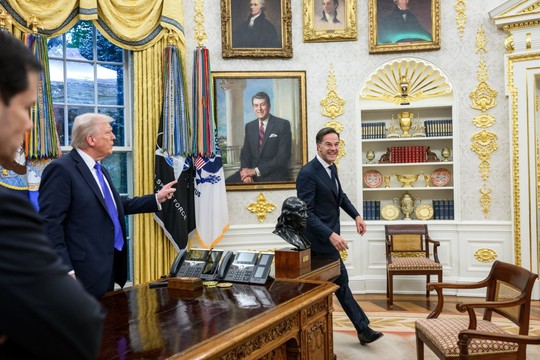
US President Trump escorts NATO Secretary General Rutte out of the Oval Office. US Secretary of State Rubio (left) looks on
Photo: The White House
For the first time in decades, an American Secretary of State is skipping a NATO meeting. The signal is clear and deliberate: America has other priorities than the security of our continent. It would be a future in which the first two letters of the acronym NATO — the alliance's "North Atlantic" character — would have lost their meaning, 'Neue Zürcher Zeitung’ (Switzerland) almost crying.
In Donald Trump's "America First" administration, Secretary of State Marco Rubio appears to be a safe bet from a European perspective—the man at the cabinet table most likely to recognize the benefits of a close alliance with the Europeans. His conspicuous absence from Wednesday's NATO ministerial meeting in Brussels is therefore a bitter pill for the alliance partners to swallow. Rubio's department didn't even attempt to cover up the incident or feign a scheduling conflict. Instead, it portrayed his attendance as unnecessary.
Professional appeasers like NATO Secretary General Mark Rutte and German Foreign Minister Johann Wadephul downplayed the incident. However, they are doing the public a disservice. There's no point in glossing over the underlying problem: America's interest in a strong transatlantic alliance is dwindling rapidly. With regard to Europe's security, this is alarming.
Trump's administration is distancing itself
The absence of an American Secretary of State from a regular NATO meeting without a compelling reason is unprecedented in living memory. Rare absences, most recently in 2003 and 1999, could easily be explained by crises elsewhere. Certainly, the well-being of the Western world doesn't hinge on a single meeting. But that's not the point. The episode would be negligible were it not for the fact that it reflects the general unease between America and Europe.
For months, the Trump administration has spoken of NATO as if it were merely a third party and the US no longer the leading nation of this alliance. "We're selling weapons to NATO for Ukraine," President Trump is fond of saying, referring to NATO's European partners. This may be a linguistic nuance, but it reveals his distance from the organization created in 1949 by his predecessor, Harry Truman.
NATO is also mentioned in the American 28-point plan for peace in Ukraine; the US sees itself as a future "mediator" between the alliance and Russia. Mediator? During the Cold War, Washington didn't act as a messenger between Moscow and Western Europeans, but rather stationed American tanks, fighter jets, and nuclear bombs in Europe to deter the Soviets from even considering an attack on Central Europe.
Even back then, the question arose whether an American president would risk a devastating war with Moscow for the sake of Europe's freedom. But the probability was considered high enough to deter the Kremlin. Today, however, the answer is more likely: probably not. Trump signals at every opportunity that Europeans should be responsible for their own security. This, however, directly contradicts the fundamental principle of NATO, which is to consider an armed attack on a single member as an attack on all.
Higher spending is not the solution
Does NATO even still exist? On this point, the professional appeasers are never at a loss for words. NATO is stronger than ever, the public is led to believe; just consider the new spending target, which obliges each member to invest five percent of its economic output in defense.
This argument overlooks the fact that very few members seriously intend to live faithfully to this goal, including the USA. Furthermore, the fixation on expenditures masks the inefficiency with which European countries individually invest in defense. Until the last decade, this was a negligible problem because there was no doubt about NATO's combat power: in a crisis, one could count on Uncle Sam.
The famous Article 5 of the NATO treaty, which obligates mutual military assistance, remains on paper, but with dwindling "hard power" as its foundation, its credibility is diminishing. Symbolic of this shift in priorities is the Pentagon's recent order to redeploy the aircraft carrier strike group led by the USS Gerald R. Ford from Europe to the Caribbean.
What are the Europeans doing?
Although the EU is by far the most important trading partner of the US, the Trump administration has little strategic interest in the old continent. It seems to see Russia not as a threat to international stability, but primarily as a future business opportunity. Thus, the latest Ukraine plan reflects Trump's financial interests more than a desire to create a robust security architecture in Europe.
Perhaps Washington will one day reassess its priorities, but Europe cannot afford mere wishful thinking. Germany, France, Great Britain, Poland, and the other allies must prepare for the scenario in which America can no longer be relied upon. It would be a future in which the first two letters of the acronym NATO — the alliance's "North Atlantic" character — would have lost their meaning. It doesn't have to come to that. But it would be negligent if Europe's leaders didn't consider what it would mean if the American Secretary of State's office in Brussels remained empty forever.
read more in our Telegram-channel https://t.me/The_International_Affairs

















