РУССКИЙ
 11:22 24.02.2026 •
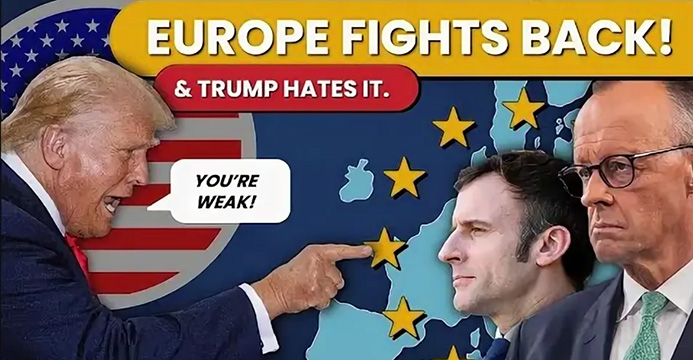 Pic.: You Tube
There is a kind of romantic streak to U.S. relations with Europe in the Trump era, ‘National Review’ notes.
There is something surprising about American-European relations. Donald Trump has, more than any other recent president, emphasized the transactional nature of politics, even international politics. Sure, presidents going back to Eisenhower and Obama have complained to Europe about its free-riding on the United States security umbrella, and prophesying that one day the American people would no longer put up with it. But Trump has been by far the most direct. Either up your defense spending to an acceptable level of GDP, he warned, or he would “encourage Russia to do whatever the hell they want.”
And yet, underneath the Trump administration there is a kind of romantic streak to American relations with Europe. Oddly, although America is clearly the stronger partner, it is the one more aggressively playing the game. It began at last year’s Munich Security Conference with a speech from JD Vance that sounded a little like an ultimatum. He asked the conference participants to reflect on what they are fighting for. And then, in the parlance of pickup artists, he “negged” them. He pointed out the ways in which Europe is falling short on democratic norms. People were being arrested for praying in the United Kingdom. An election was canceled in Romania on a flimsy pretext. Criticism of immigration was being suppressed.
The critical side was made more explicit in the National Security Strategy that the Pentagon released late last year:
The larger issues facing Europe
Continental Europe has been losing share of global GDP — down from 25 percent in 1990 to 14 percent today — partly owing to national and transnational regulations that undermine creativity and industriousness. But this economic decline is eclipsed by the real and more stark prospect of civilizational erasure.
The larger issues facing Europe include activities of the European Union and other transnational bodies that undermine political liberty and sovereignty, migration policies that are transforming the continent and creating strife, censorship of free speech and suppression of political opposition, cratering birthrates, and loss of national identities and self-confidence. Should present trends continue, the continent will be unrecognizable in 20 years or less.
And despite this weakness, “Europe remains strategically and culturally vital to the United States.” So, the document concludes, “Our goal should be to help Europe correct its current trajectory.”
At this year’s Munich Security Conference, Undersecretary of Defense for Policy Elbridge Colby and Secretary of State Marco Rubio outlined the total result in two separate speeches. Colby’s speech focused on brass tacks. What the U.S. proposes is that Europe use its wealth and resources to rebuild its capabilities. “Europe must assume primary responsibility for its own conventional defense,” he said at the top. “A strategy that pretends the United States can indefinitely serve as the primary conventional defender of Europe while also carrying the decisive burden everywhere else is neither sustainable nor prudent,” he explained. “It is an aspiration divorced from resources. It is a strategy that serves neither regular Americans nor, I must stress, Europeans.”
“The op-eds from Dublin to Berlin complain that the man courting them is a racist lout”
At first blush it seems clearly in line with so much of the foot-stamping in Europe, from Emmanuel Macron in France to Radek Sikorski in Poland, that Europe needs to step up. This is a request to be a valuable partner that is largely self-sufficient. In reality it is a return to the roots of NATO, during the Cold War, when European contributions of men and matériel were assumed.
Rubio then tied the bow on this vision. This is a proposition for joining together in defense of a shared civilization.
Under Trump, America has proposed a cross-Atlantic romance story. We want to get frisky with a shared military-industrial project. But, for now, the op-eds from Dublin to Berlin complain that the man courting them is a racist lout.
Europe’s political class wants to curl up with its glass of white wine and its bureaucratic comfort blanket and is making an appointment to freeze its eggs, hoping that the U.S. will return in a few years as a less demanding, less offensive caretaker.
read more in our Telegram-channel https://t.me/The_International_Affairs