
 РУССКИЙ
 10:02 17.01.2026 •
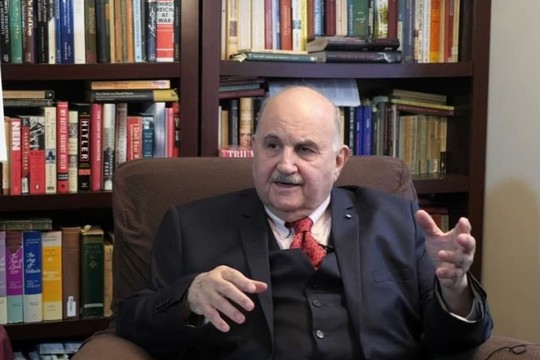
Stephen Bryen
Photo: Marker.sk
On January 3rd Jonathan McCormick published an interview with Stephen Bryen that appeared in ‘The Marker’. ‘Marker.sk’ is an independent Slovak online news and analysis platform focusing on politics, society, and culture, known for its independent stance, commitment to truth, and reader-funded model. It was founded by former journalists from the Štandard newspaper in 2025 emphasizing freedom and sovereignty.
Stephen Bryen is an American weapons and security expert with over 50 years experience in government and industry. Among other senior positions, he has served on Capitol Hill as a senior staff director of the U.S. Senate Foreign Relations Committee, at the Pentagon as Deputy Under Secretary of Defense for Trade Security Policy, and in the private sector as the president of a multinational defence and technology company. He’s currently a Senior Fellow at the Center for Security Policy, a non-profit think tank in Washington DC, and writes for Asia Times.
The article below is a provided translation on key points of the interview.
What sort of security guarantees have the US negotiators offered to Ukraine in the recent talks in Berlin? And why do you think this represents such a dangerous situation?
Well, the details of these talks are not known. We only have press reports and judicious leaks as to what was discussed and what the US tabled. But there seems to be a general view that the US has offered security guarantees, including the positioning of troops in Ukraine to secure a deal. And that’s a very tricky business. First of all constitutionally, because any such guarantee would require a treaty that has to be ratified by the Senate. But more importantly, the whole idea of the US committing itself to providing a security guarantee with troops, with weapons, with capabilities, is an extremely dangerous thing. Because this is a very volatile situation. And the Ukrainians are dying to get us into the war. They see us as saving them from defeat. So they very much want the United States in Ukraine.
But do you think Trump would ever go along with that?
He’s talking about stationing American soldiers and other forces there. The Ukrainians want the US Army in Ukraine. Because they want to get the US committed to the war – because their only hope of winning is having the US fight for them. And now they’re talking about British and French and other soldiers in Ukraine, too. If this happens, and if there’s a provocation of any kind by either side – and there will be – we’re going to be at war.
But I thought the whole point of these negotiations is to find a solution that the Russians can agree to as well.
The Russians are not going to agree to this. But that doesn’t mean the US won’t do it.
You think they might actually put soldiers there, even without a deal with the Russians?
Right.
And that’s what they’re offering to Ukraine now?
I don’t think they’ve got as far as a formal offer. But once you say: We’ll do security guarantees – we’ll put 10,000 troops in Kiev or wherever – you’ve created all the conditions for a war.
I actually don’t understand why they would even be considering this and discussing it in Berlin, when it’s clear that the Russians will never agree to it.
I can’t imagine they would. Whatever the Russian end strategy is, the absolute minimum is they want a guarantee that there will be no NATO forces there. They also want a reduction in the size of Ukraine’s army by a large number. And they want a more friendly government in Ukraine. So, those are kind of minimal from the Russian point of view. And we’re talking about security guarantees with US troops? And now British and French and German troops? Give me a break. I mean, it gets worse and worse.
Some say the reason they’re discussing this even though they know the Russians won’t agree to it, is precisely because they know they won’t agree to it. Then they can point the finger and say: The Russians don’t want peace.
Well, that’s inevitable in this sort of thing. If you want to trash negotiations, that’s the easiest, quickest way to success. I read the Russian press. But even so, you get a sense of what the thinking is. And my feeling is that they think the Americans just flip flop. Putin wants to continue negotiations, otherwise there wouldn’t be any. But he feels it’s important for the credibility of Russia. The point he’s trying to make – which is completely rejected by the Europeans, or most of them anyway – is that Russia is not a threat to Europe. Russia has no designs on any European territory or anything like that. But he doesn’t want NATO expansion. And by the way, Ukraine is not the only candidate for NATO expansion. There’s Georgia, there’s Moldova, there are other places. And there may even be an attempt to do it in the ’Stans – Kazakhstan, Uzbekistan, Tajikistan and so on. So I think that’s the game. And Putin wants to put an end to that. He wants to stop any NATO expansion.
Hasn’t the Trump administration more or less agreed in principle to stopping NATO expansion?
Well, theoretically, in some of the leaks, Washington has said: No, there won’t be any more NATO expansion. But I think that’s not credible. It’s not credible because the US and its allies, especially the British, are working full time to try and make it happen in Moldova. They’ve been trying in Georgia, but I think that’s failing. And they’ve been working on the ’Stans. They’re even working on Armenia.
Department and elsewhere. Do you know all this from your personal contacts there?
Yes, and also from reports from the field that we’re seeing. Let’s take Armenia, just as an example. Armenia has been sort of a Russian client – to say the least. Its military is armed with Russian equipment, they have a nuclear power plant from the Russians, the economy is very much tied to Russia. Now, all of a sudden, the US is in there doing deals, offering a nuclear power plant, the whole nine yards. That’s just on the economics side. Politically, they’ve been backing up Pashinyan and all those people, trying to make them American allies. There’s no doubt about what’s going on. And the British have been working through various intelligence operations, trying to stir up support for that sort of thing within the country and elsewhere. Even in Russia itself – Russia is not immune to these activities. The NGOs that are supported by – what shall we call it – secret intelligence sources, have been a pain in their butt. And they’re reacting to it now. So I mean, this is a big game.
So what’s the point of all this continued NATO expansion? I thought by now we would have learnt our lesson.
I think we’re not at a point where we’ve really come to grips with what we want, and why we want it. Why do we want these countries in NATO? What’s the benefit to Europe of having, potentially, all these volatile clients? Unstable, inherently repressive – because they’re all repressing people who object. And by the way, this even occurs in EU countries, in Eastern Europe. Romania, for example, got rid of candidates for president that they didn’t like. And now there are all these undemocratic, high risk potential NATO acquisitions, which could get us into a war on any day of the week. And I think the people who are doing this don’t realise the implications. They’re trying to stick it to Putin, but what they’ll end up doing is sticking it to themselves. Because they’re going to end up in a mess that will be hard to untangle and unscramble – very hard – and will cost a lot of lives.
So your view is that even if this NATO expansion were successful, this would really be a liability to NATO more than a benefit?
Absolutely. Just like security guarantees are a liability to NATO. Because if you end up going to war over Ukraine – well, if that’s what you mean to do, do it now. Why just put a fuse there and light it, and wait and see what happens? No, it’s not good policy. It’s not sound geopolitics. It’s not sound strategy. It’s very high risk. And it’s an unnecessary risk, because there’s no benefit. What do you get out of running Armenia, for God’s sake? Another war in Nagorno-Karabakh? This also, by the way, creates huge tension with Turkey, because Turkey is a big backer of Azerbaijan – a very big backer. They supply a lot of the armaments. And they’re going to have a fit – and they’re in NATO! So you’re going to run a stick right up the middle of NATO. Why would you do that? What’s the sense of it? It makes no sense. It’s completely uncalled for.
Just to focus on Ukraine – hasn’t Trump and his people said they’re ready to agree that there will be no NATO in Ukraine?
Yeah, but it’s a fake. Because if you’re going to put US troops in Ukraine, the US is a NATO country. It’s the leading NATO country. Of course NATO is there. The Russians understand that. They’re not stupid.
So let’s say there’s some sort of ceasefire, American troops are positioned in Ukraine, and then the fighting breaks out again. What happens next?
This is why this sort of security guarantee is actually worse than putting Ukraine in NATO. NATO can only act by consensus. If someone is attacked in NATO, then you invoke Article 5 – which means all the members have to agree unanimously in order to take action. If somebody objects, then you can’t. But if you put this kind of rump force – which is effectively a NATO force – into Ukraine, with a guarantee, now you’re under a legal obligation to go to war, and at the same time you get around the need for any consensual agreement by the other NATO players. Like Turkey, like Hungary, just to name a couple of obvious ones that don’t like what’s going on. So you are, I think, destroying NATO as an alliance. You have cheated on the meaning of Article 5 and you have committed to getting into a war, without consensus.
Okay, but in that case you’re not committing all of NATO to a war, only the Americans – correct? And maybe a couple of other NATO countries that commit to this.
Let’s be serious. If you have the British and the French and the United States and maybe the Germans, what do you need the rest of NATO for? It’s meaningless. And there’s one further implication. The Russians aren’t going to be so nice to say: Well, Poland’s not included, so we won’t bother with that. Of course they’ll bother with that. They’re not going to stop, because if they’re attacked by this force that’s sitting in Ukraine and they get into a fight with them, they’re going to go after the bases that supply those forces. Most of those are in Poland.
And why do you think they haven’t already done this, when Polish bases are already supplying Ukrainian forces?
Because Putin doesn’t want an expanded war. He’s been restraining his forces, particularly on that issue. He’s very adamant on it. But of course the Europeans, they’re trying to make him out as a predator who’s going to take over Europe. I don’t think that’s his intention.
Do you think there would be all this now fighting now if we hadn’t encouraged Ukraine with promises of military support and NATO membership?
No, I don’t think so. I think that the Ukrainians thought we would have their back.
It seems clear there were people in the US government who were telling them that – and that US troops would ultimately come and save them if needed.
Absolutely. And we were engineering the removal of pro-Russian politicians in Ukraine and replacing them with rabid Ukrainian nationalists. This was Victoria Nuland and her gang. And that was really dangerous stuff. No, we don’t belong there. It’s not our problem – that’s the point. I don’t think it’s Europe’s problem either. What the hell is Europe doing there? Can anybody explain that to me?
So let’s talk about what would happen if there actually was, God forbid, a European war between NATO and Russia – let’s say without the Americans. How would that go?
Let’s remember – everyone keeps trying to forget – that Russia is a nuclear power. Not a little nuclear power – a really big nuclear power. Any decision maker has to worry about that. The Europeans don’t have nuclear weapons, other than the French and the British. The British are mostly controlled by us. The French are mostly independent – you know, the Force de frappe. But France is not going to use a nuclear weapon against Russia because it would be destroyed. It would disappear from the world. So I think it’s craziness. Europe does not have the assets to carry on a war today. It lacks manpower. It lacks armour. It lacks air defences. It has a paltry naval capability – which doesn’t matter anyway in a land war.
Ours is also a lot more expensive – and we’re already so deep in debt. Doesn’t that impede our ability to amp up production?
There are some things we could do. The problem we have, is that things like missiles take a couple of years or more to build. Even proven designs. And some of the stuff that we’ve been using in Ukraine – for example the ATACMS and the HIMARS and all that stuff – the Russians have figured that out. They know how to deal with it now. So the effectiveness of some of these systems is less than what we would hope for. And we’re working on newer missiles, but we don’t have them yet. So, no, we’re not ready.
I know there are a lot of hardliners in Russia that think Putin is too cautious and going too slow. They want him to quit playing around and get this war over with. Do you think that’s even a possible option for Putin, or is the Russian military already going as fast as it can go?
Well, at this point they’ve almost completely devastated the energy system in Ukraine. I understand that in Kyiv, right now, you get four hours of power a day – if you’re lucky – on a rotating basis. It’s cold there and it’s winter. So they’ve done a big job on that. I don’t know that they would add very much to it. I think they’re going to start concentrating on other targets. The biggest one is Odessa.
And do you think they’ll want to actually take Odessa?
No, I think what they’re trying to do is to isolate Odessa, to encircle it eventually. They’re not there yet. That’s what this fighting in Zaporizhzhia is all about. And they still have a ways to go there. But in the months ahead, I think the idea would be to force a capitulation of Odessa, simply because they will have no ports, no supplies, no food and no power, that kind of thing.
Well, I think what would happen is they would throw out the current mayor and get a new one who would say, more or less: “We welcome our Russian comrades.”
So getting back to these negotiations – do you envision any kind of peace plan that Russia would agree to, that Ukraine and the West could also agree to? I mean, somebody like John Mearsheimer has been saying all along that there is no possible peace agreement to be had – and that until Ukraine gets to the point where they’re ready to capitulate, this won’t change. What do you think?
Well, he’s got a good argument. I guess what Putin is probably thinking is this: What can he get out of a peace plan that would be worth getting? And one thing he will get from Trump, of course, is the lifting of sanctions. He will get investments, significant investments in Russia. And he will get a broader strategic arrangement with the United States, which he wants.
The Russians are much stronger than they were four years ago. So maybe it’s time now to reorient and rethink strategically. If we do that – and that’s what Putin wants, I think – I don’t know if Trump wants it or not, I think he might – then the question is: Can they get there? Well, Ukraine is in the way. Right at the moment. But things can change in Ukraine very rapidly. Zelensky could get chucked out. The regime could fragment. There could be elections. Who knows? There are many possibilities that would open the door to a strategic dialogue between Russia and the US – one that would put Ukraine to the side. And that, I think, is what the Russians want.
But they also want what you referred to a moment ago, some sort of strategic security agreement between Europe and Russia. They’ve been talking about it for years. Won’t there be problems now getting the Europeans to agree to anything like that?
Yes, the Europeans will have trouble with it. And I think it will force changes in Europe – and in NATO. Look, we have a NATO Director General who’s a warmonger – Mark Rutte. And he has to be replaced. But I think all this is possible – if that’s what the US wants. Right now, we don’t know what the US wants, exactly. But Trump and his people have been hinting for a long time that they would like to have a strategic relationship with Russia. It’s in the new 2025 National Security Strategy that they just put out. It’s openly in there. So it’s not just about whether the war in Ukraine will continue. There may in fact be an agreement, but it may be quite different from what’s on the table now.
For example?
I think it could very well be something much more strategic. And the only thing that worries me on that score, is that this takes a lot of planning and a lot of knowledge. And I don’t see any of our better thinkers – strategic thinkers, either in the government or outside of it – actually openly talking about that. I remember in the ’80s, when we were involved in intense negotiations – the Intermediate-Range Nuclear Forces Treaty and so on – all these things took a tremendous amount of technical and strategic work to come up with the right formulations. I don’t know that any of that’s going on right now. But I think that’s the name of the real game for the future. If we want to avoid war, and I think we do; if we want to stabilize Europe, which I think we do; if we want to have normality, then I think we need overarching security arrangements between the US and Russia, and probably between NATO and Russia. And that’s not going to be easy to achieve, but it has to be done.
I think it’s difficult in the current political environment in Europe for people even to speak openly about this.
Well, I think the political environment’s on the precipice of change. I mean the British government is, how shall we say – iffy? The French government? Iffy. The German government? The German economy is going to hell in a handbasket. The only strong leader in Europe at the moment is Maloni, in Italy. So I think there could be many very big changes in the next year. Because Europe can’t keep doing what it’s doing. And there are rising politicians in France and the UK, the AfD in Germany, and so on, that have popular backing – significant popular backing. So I think the freedom of action of the anti-Russia crowd is going to go down the drain.
You mentioned that you’re not sure if the Americans know what they want. And Trump seems to be flip-flopping all the time – you never know where he’s going to end up. Do you see any chance of that improving in some way?
I can’t really answer that because I don’t know. He climbs up the mountain, then he climbs down. And that makes it tricky. But look, he really wants an agreement on Ukraine – he’s seized with that idea. His NSC [National Security Council], which is essentially now run by Marco Rubio, wants that too. But what they’re really aiming at is a new strategic relationship with Russia. That’s what they really want. Now, that hasn’t shown up too much in Trump’s rhetoric yet. So it’s hard to estimate what he really thinks about it. But it’s there in the Strategy – prominently. But like I said, I’m somewhat optimistic that if we could start some real strategic conversations with the Russians, we would be a lot better off. Because I think we have to. And I think Europe has to as well. And if we don’t, then we’re going to end up in a black hole, where I’m really afraid of what might happen.
read more in our Telegram-channel https://t.me/The_International_Affairs

















