
 РУССКИЙ
 11:33 16.02.2026 •
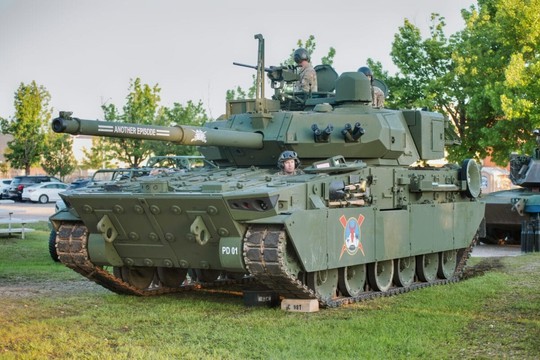
M10 Booker
Photo: U.S.Army
The U.S. defense acquisition system is currently suffering from a “perfection trap,” where the desire for revolutionary leaps forward leads to catastrophic program delays and failures, a military ‘19fortyfive’ side writes.
The “Perfection trap”: Why the U.S. military’s best gear keeps failing in 2026
Across almost every U.S. military service, new equipment takes too long to develop, costs far more than expected, and often enters service with compromised capabilities or trade-offs.
Recent examples of this pattern include the Army’s M10 Booker light tank, the Navy’s Littoral Combat Ship, and the Zumwalt-class destroyer.
There have also been challenges with upgrades such as the M1 Abrams SEP v4 and the fully cancelled Future Combat Systems program. These struggles are not isolated failures, but rather characteristic of problems that plague large platform acquisitions for the Pentagon.
The modern battlefield is indeed changing quickly—but that alone does not explain the difficulty. A mix of risk aversion, bureaucratic complexity, industrial base fragility, and unrealistic expectations have doomed or delayed too many programs.
It is also difficult to rapidly integrate next-generation technologies or innovations into a mass-producable platform.
Technological ambition can generate developmental challenges, a dynamic that held back the development of the USS Gerald R. Ford (CVN-79). One of the core issues is that U.S. military programs are often expected to do too much at once. New platforms are rarely designed to fill a narrow role.
Instead, they are asked to be revolutionary leaps forward, replacing multiple systems while anticipating threats years into the future.
What happened to LCS & Zumwalt
The Littoral Combat Ship (LCS) is a classic example. The LCS was intended to be fast, modular, affordable, and adaptable to missions ranging from mine warfare to anti-submarine combat. In practice, it struggled to do any of these well.
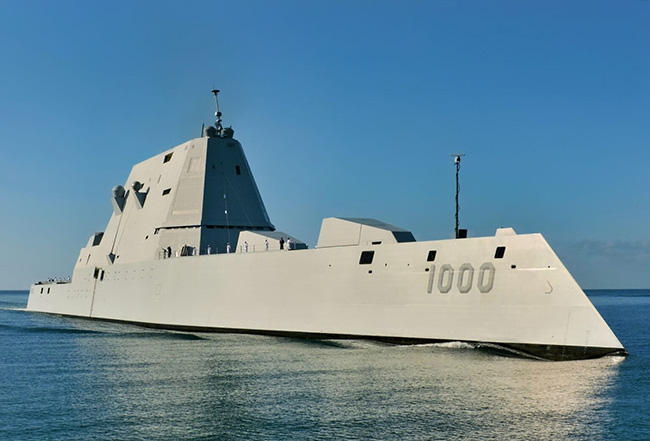 Zumwalt-Class Destroyer U.S. Navy
Photo: Creative Commons
Modular mission packages proved difficult to swap quickly, survivability was questioned, and costs ballooned. The desire for flexibility ended up producing fragility.
The same logic affected the Zumwalt-class destroyer, which attempted to combine stealth, land-attack dominance, advanced power systems, and a revolutionary gun system. When the ammunition for those guns became unaffordable, the ship was left without a primary mission.
Industrial base
Another underappreciated factor is the erosion of the U.S. defense industrial base. During the Cold War, the U.S. maintained multiple competing manufacturers for tanks, ships, aircraft, and subsystems. Today, consolidation has left only a handful of prime contractors in each sector.
At the same time, modern military systems depend on commercial electronics, which evolve on civilian timelines that do not align with decades-long military programs. By the time hardware is certified for military use, it may already be obsolete or discontinued in the civilian market.
Pace of threat
The problem is not that tanks, ships, or aircraft are suddenly irrelevant.
It is that warfare is becoming more transparent, networked, and lethal. It is driven by drones, sensors, electronic warfare, and long-range precision weapons. Survivability now depends as much on software, data fusion, and integration as on armor or firepower.
Traditional acquisition programs struggle with this reality because they treat platforms as static objects rather than evolving systems.
Time to take risks
The U.S. military’s difficulty in building new gear is not simply a failure of engineering or foresight.
It is the result of a system designed for an earlier era—one during which threats evolved slowly, budgets grew predictably, and technological leaps could be planned decades in advance.
Today’s battlefield rewards adaptability, iteration, and speed, but U.S. acquisition has historically been too averse to risk-taking and too afraid of the kind of short-term failure that can result.

Since the end of the Cold War over 30 years ago, the U.S. has let its ability to manufacture munitions, weapons, aircraft, ships and submarines deteriorate to ominous levels. Don’t think our adversaries haven’t noticed.
The crisis is all too real. For example, for the first time since World War I, a country — in this case China — has more combatant ships than the U.S. Their fleet is expanding while ours is shrinking.
Russia’s war machine is revving up. The Kremlin is now producing almost three times as many artillery rounds as the U.S. and NATO combined. Yet, in violation of the most fundamental task of a government — security — the Administration has repeatedly tried to cut inflation-adjusted defense spending.
read more in our Telegram-channel https://t.me/The_International_Affairs

















