
 РУССКИЙ
 12:34 09.02.2026 •
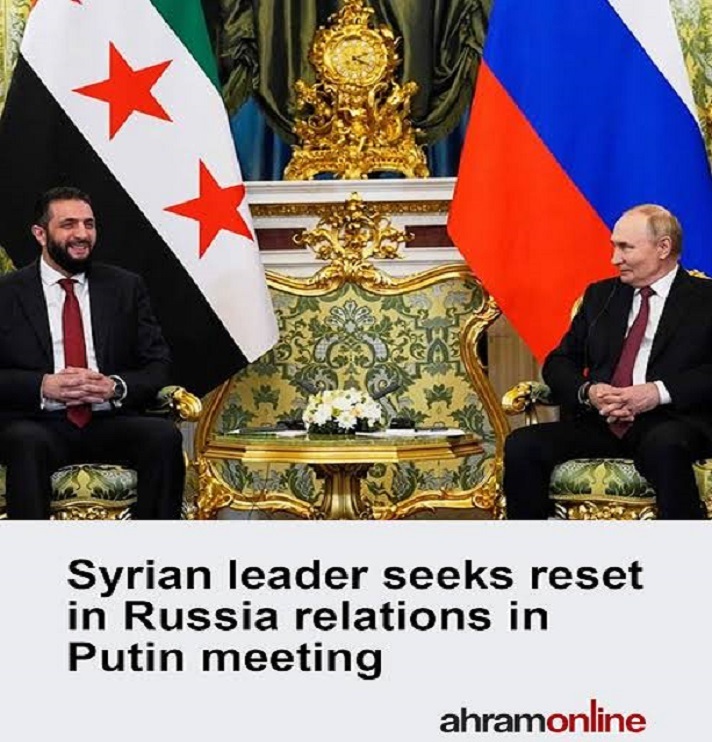
Damascus needs Moscow just as much as Moscow needs Damascus, ‘The Responsible Statecraft’ stresses.
Late last month, Syrian President Ahmad al-Sharaa visited Moscow, for the second time since assuming office.
“I saw a lot of snow on the way and recalled a story,” he said to President Putin in the Kremlin. “I recalled how many military powers tried to reach Moscow, but failed due to the courage of Russian soldiers, and also because nature itself helped to protect this blessed land.”
Bashar al-Assad’s downfall was a blow for the Kremlin, but it did take it on the chin. Now, the relationship needs to be rebuilt on a new basis, on an equal footing. Russia is a part of the new Syrian government’s diversification agenda: Syria needs all the friends it can get, but without becoming a pawn in somebody else’s geopolitical game. Moscow, for now, seems happy to offer that.
The situation in Syria is not ideal
For Syria, pragmatic reasons lay on the surface. Moscow is a long-term military partner. Most of its weapons come from Russia, and Syrian personnel are trained to use them. Syria needs a helping hand with efforts to maintain the peace, and the Russian Military Police officers, effective in the past and acceptable to the local population, man eight observation points between Quneitra and the Golan Heights. Damascus has been in talks with Moscow to deploy Russian monitoring forces to stabilize Southern Syria, for which discussions with Israel are ongoing.
Damascus seeks to open the country to the world, but Syria has few ready offers, while the Kremlin is prepared to deliver economic assistance and grain shipments to show goodwill as it continues negotiations over its military bases there. Notably, Russia holds around US$ 20 billion in investments across productive sectors in Syria, encompassing energy, infrastructure and industrial facilities, which serve the country's long-term needs.
The international equation is also in Moscow’s favour. Russia’s permanent seat at the United Nations Security Council gives it leverage to support the new government, and it remains influential in regional affairs. The U.S. and Russia no longer play against each other, and their interests in Syria have become congruent, while the end of the Iranian presence was a relief for both.
There are other reasons that are less obvious. During al-Sharaa’s first visit to Moscow in 2025, one member of his delegation did not wear a beard, which was unusual in the Islamist-led government. This was the President’s older brother, Maher al-Sharaa, who holds the most trusted position of Syria’s Secretary-General of the Presidency (head of the Presidential Office). Until 2022, while Ahmad led the holy war in the Middle East, Maher worked as a women’s doctor in Russia’s Voronezh, and was married to a Russian.
Thus, reaching out to the new leadership was possible due to deep-running personal connections, and Maher al-Sharaa was put in charge of building relations with Moscow.
Moreover, the leaders’ political instincts coincide. The situation in Syria is not ideal, but al-Sharaa knows that Moscow is not going to lecture him on democratic deficit and human rights. What matters most is that Syria has a stable government that controls the country and fights the Islamic State (banned in Russia), and that its leadership is driven by national interest.
Moscow has security concerns of its own. In the 2010s, at least 5,500 Muslim fighters from Russia went to Syria to join Salafi-jihadi groups.
Moscow prefers the fighters from Russia to integrate in Syria rather than attempt to return to their homeland, join IS or fight for third countries, particularly Ukraine.
Culture is important for both nations
Long-term investment in human capital through culture, education, and mobility to Russia has also fostered social integration. At least 35,000 graduates of Soviet and Russian universities entered the Syrian professional class during Assad’s reign. After a brief hiatus, in 2025, Moscow restarted the allocation of student scholarships.
Culture is important for both nations, especially since Syrians are painfully aware of the heritage lost during the war. Here, rehabilitation efforts in Palmyra through a partnership with the Russian State Hermitage in St. Petersburg and the Russian Institute of the History of Material Culture have been appreciated. Even more illustrative was the January 2025 reopening of the Opera House in Damascus, with Tchaikovsky’s pieces played at the inaugural concert. Classical music may not be for everybody, but a critical mass exists who feel that string concerts of Syrian musicians trained in Moscow and St. Petersburg are an integral part of Damascene city life, as well as art exhibitions, and performative displays by the Russian-educated artists.
In total, multiple assets in Syria provide Moscow with a foundation for developing a new policy built on shared interests rather than Damascus serving as a supplicant. There are many moving parts, but, if effective, it could be more enduring and mutually beneficial than the old Assad arrangements of the past.
read more in our Telegram-channel https://t.me/The_International_Affairs

















