
 РУССКИЙ
 22:26 05.03.2026 •
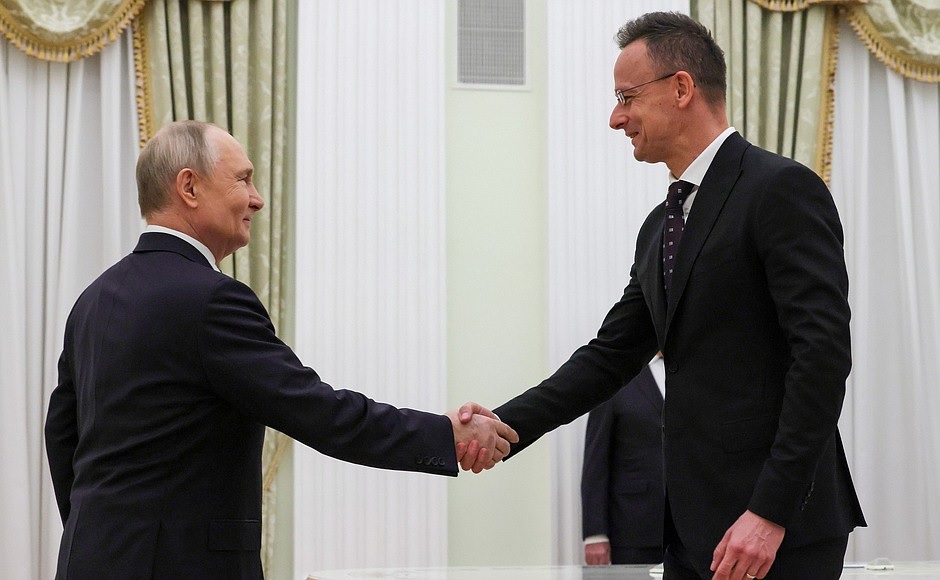 Vladimir Putin with Minister of Foreign Affairs and Trade of Hungary Peter Szijjarto
Photo: Kremlin.ru
On the Russian side, the meeting was attended by Minister of Foreign Affairs Sergei Lavrov, First Deputy Prime Minister Denis Manturov, and Presidential Aide Yury Ushakov. On the Hungarian side, the meeting was also attended by Hungary’s Ambassador Extraordinary and Plenipotentiary to Russia Norbert Konkoly, Kremlin informs.
President of Russia Vladimir Putin:
Mr Minister, Mr Ambassador,
I am very pleased to see you.
(Addressing.) You chair the intergovernmental commission on the Hungarian side, and it is working actively. You visit Russia frequently. I am aware of your efforts to maintain the momentum in our relations, despite the well-known challenge, though we will not dwell on that now.
Unfortunately, our trade turnover has declined somewhat: last year, I believe, it decreased by 13 percent. Nevertheless, overall, our relations remain stable and are developing positively. I am referring, in particular, to energy policy issues, including hydrocarbons and our flagship project – the Paks Nuclear Power Plant.
Regarding hydrocarbons, I understand that this must concern you, primarily oil supplies. We see what is happening now in global gas markets, including in European gas markets. We will be happy to discuss all these matters. Whatever depends on us – we have always fulfilled all our obligations – and, of course, we intend and are prepared to continue doing so.
Not everything depends on us, but, I reiterate, we have always been reliable suppliers. You are aware of this, and I have noted your public statements on the matter. Just yesterday, I spoke with [Hungary’s] Prime Minister Viktor Orbán about certain issues.
I am really glad to see you.
Peter Szijjarto (retranslated):
Mr President, colleagues,
Thank you for the opportunity to meet with you. I understand that we are going through a very tense time on the international stage.
We, Hungarians, are concerned about every war and every conflict. Our country’s energy security is of paramount importance, and therefore we do not want to be drawn into war, armed confrontation, or an energy war.
As you, Mr President, and you, Mr Minister, know, Ukraine has been blocking supplies through the Druzhba pipeline to Hungary for several weeks. The oil shipments have been halted as a result of this political decision. That is why we are interested in ensuring that gas and other hydrocarbon supplies continue reliably and steadily, as they have until now.
As you have mentioned, I have come to obtain assurances and confirmation that even in these difficult and conflict-ridden times, the hydrocarbons, natural gas, and oil that Hungary needs will remain available and will continue to be delivered to our country.
This is utterly important for Hungary, because access to oil and natural gas allows us to keep utility costs low. This issues is of critical importance for us.
If oil and natural gas are not supplied to Hungary, utility prices will go up significantly. Therefore, the Druzhba pipeline and other gas and oil supply routes are crucial to us.
The war in Ukraine has now lasted four years. The conflict has also led to the mobilisation of Hungarian citizens. Many are missing, and some have been taken captive. We would therefore like to ask whether you could consider releasing certain Hungarian prisoners of war currently held by Russian forces.
Thank you very much for your patience and attention.
Vladimir Putin: Mr Minister, during our telephone conversation yesterday, Prime Minister Viktor Orbán also raised this issue and asked me to consider releasing Hungarian citizens held by the Russian army. These individuals hold dual citizenship – Ukrainian and Hungarian – and were forcibly conscripted.
I have decided to release two individuals. As the Prime Minister requested, you may take them with you on the aircraft in which you arrived and will return to Budapest.
Peter Szijjarto (in Russian): Thank you very much. Thank you.
After his meeting with Foreign Minister of Hungary Peter Szijjarto, the President answered questions from journalist Pavel Zarubin: “Could it be that we could benefit from cutting short our supplies to the European market right away?”
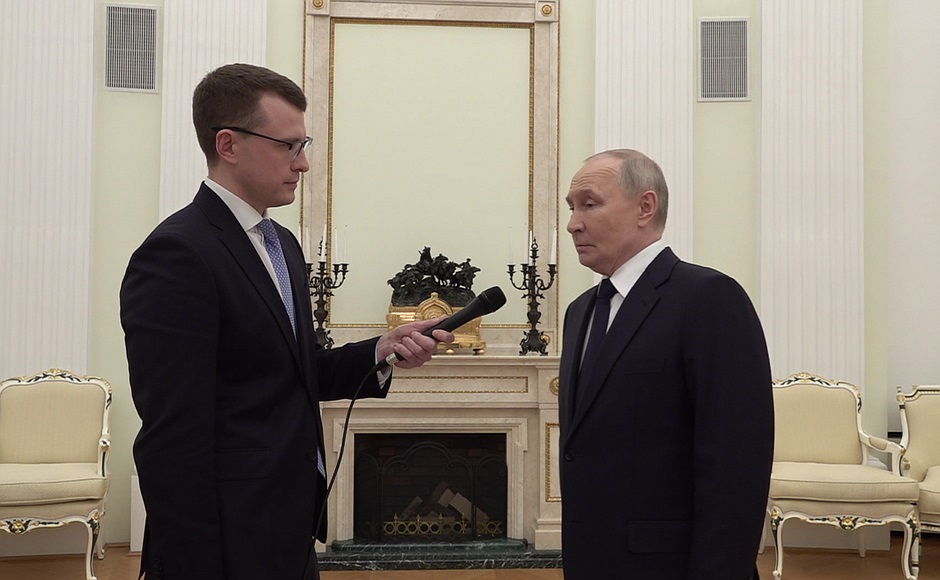 Answers to questions from Pavel Zarubin
Pavel Zarubin: We watched your meeting. Could you answer a few questions now?
President of Russia Vladimir Putin: Go ahead, please.
Pavel Zarubin: You just mentioned the situation on the global gas markets. Many countries are panicking over the current events. Prices have soared, and it is unclear what will happen with prices and deliveries next.
Of course, this makes one recall that Europe has repeatedly prohibited our gas imports. A new ban, this time on Russian LNG imports under short-term contracts, will come into force as soon as April…
Vladimir Putin: Yes, under contracts that were signed last summer.
Pavel Zarubin: Yes, and there were more bans. They are saying now that the deadline for the bans should be revised in light of the current global developments.
Vladimir Putin: To begin with, Russia has always been and remains a reliable supplier of energy resources to all its partners, including in Europe. We will continue working in this way with those partners who are themselves reliable counterparties, such as Slovakia and Hungary in Eastern Europe.
We are supplying our energy resources there, including oil and gas, and we intend to continue doing this if these countries’ authorities carry on with their policy, that is, if they remain our reliable partners.
As for Europe, the current developments in the European markets are primarily a result of the European authorities’ flawed energy policy, misuse of the green agenda, and the use of all these instruments for internal political purposes, for attaining party or group objectives. This policy has nothing in common with the interests of these countries’ peoples.
Oil and gas prices have increased now. This is understandable with regard to oil and is connected, in part, with restrictions on Russian oil imports. But this situation has been compounded by the developments in the Middle East caused by the aggression against Iran, which has produced a complicated and undeniably unpleasant result for consumers.
As for natural gas, in the current environment there was no immediate link between the surge in prices on the European market and the restricted supplies. After all, the main suppliers have not reduced their deliveries. Who are these main suppliers? They include Algeria, the United States, Norway, and, to an extent, Russia. None of them have reduced their shipments, but this did not prevent prices from going all the way up to $700. Why did this happen?
This results from the overall situation on the global markets, including the oil markets, and in this case, the gas market. Again, this is attributable to the overall situation because there are customers who are ready to buy this natural gas at a higher price. In this case, this results from the developments in the Middle East and the closing of the Strait of Hormuz, and so on. Once you have these premium buyers on the market, this means, and I really believe that this is the case, that some suppliers who have been serving the European market for quite some time now, for example, the United States and US companies, will definitely switch to the highest bidder. This is quite natural and is devoid of any political agenda. This is just business as usual, and nothing else.
For this reason, let me reiterate that this stems from the misguided policies of the European governments. Moreover, they have been following this path for many years. Here is what I think in this connection. They have recently announced plans to restrict Russian gas imports in a month, so that the 24th would be the last day before these restrictions are enacted on the 25th. In a year, in 2027, they want to introduce further restrictions up to a blanket ban. But there are other markets which are opening up. Could it be that we could benefit from cutting short our supplies to the European market right away? We could switch to these emerging markets and consolidate our positions there.
On this topic, I would like to make it clear that this is not a matter of politics. If we are set to lose access to their market anyway in a month or two, it could make sense for us to stop supplying them right away and turn to countries which have been our reliable partners in order to get a foothold in their markets. However, this is not a done deal. In this case, I am just thinking aloud, as they say. I will certainly instruct the Government to work this matter through with our companies.
Pavel Zarubin: There was another important news story today about an attack against a Russian gas carrier in the Mediterranean. It sustained serious damage. What would be your comment regarding these developments?
Vladimir Putin: This is a terrorist attack. We have faced incidents of this kind before, so the only surprising thing about it is that it aggravates the situation on the global energy markets, including the gas market, first and foremost for Europe. Consequently, the Kiev regime is actually biting the hand that feeds it, i.e., the European Union’s hand. The European Union has provided the Kiev regime with a boundless stream of aid, including weapons and funding, while the Kiev regime creates one problem after another for the European Union.
As for this behaviour of the Kiev regime in general, it has been quite aggressive and very dangerous. As I have already said, according to information from our intelligence agencies, Kiev is getting ready to bomb the Blue Stream and TurkStream pipelines with the support of certain Western special services, just as they bombed the Nord Stream pipelines some time ago. We have informed our Turkish friends about it. We will see what happens, but this is a very dangerous game, especially today.
read more in our Telegram-channel https://t.me/The_International_Affairs

















