
 РУССКИЙ
 22:55 04.12.2025 •
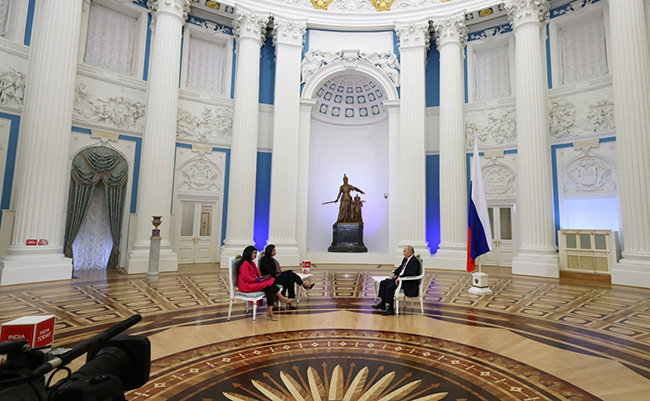 Vladimir Putin answers questions from anchors of Aaj Tak and India Today TV channels
Photo: Kremlin.ru
Vladimir Putin arrived in India on a state visit. The President of Russia was welcomed at the steps of his plane by Prime Minister of India Narendra Modi.
Ahead of his state visit to India, Vladimir Putin answered questions from anchors of Aaj Tak and India Today TV channels.
The Kremlin, Moscow, December 4, 2025
Anjana Om Kashyap: Dear viewers,
Hello and a very warm welcome. You are watching India Today, and I'm Anjana Om Kashyap and we're at the Kremlin today and you're about to witness history: a very historic moment.
It is said that when two old friends meet, they have their private jokes, they have a lot of fun and they have a bond of camaraderie but the others in the room might feel a little uncomfortable. And why do I say this – I say this because as the President of the Russian Federation Vladimir Putin meets Prime Minister Narendra Modi in New Delhi, the world will be watching very very closely.
Vladimir Putin is undoubtedly one of the most influential politicians of the world, whose decisions don't just affect Russia, but numerous nations across the world. He is a very compelling and enigmatic figure on the world stage and it just doesn’t get more exciting than this.
Geeta Mohan: Yes, Anjana.
Hello and welcome, I’m Geeta Mohan. We have with us the man who is known to be one of the world longest serving leaders. He has seen it all – through wars and economic recessions, from disintegration of countries to a changed world order, from Boris Yeltsin to Donald Trump, from Atal Bihari Vajpaee to Manmohan Singh and to Narendra Modi. He's seen the world change right in front of him and he is taking Russia through very turbulent times and yet has cemented his position as a force to reckon with.
Thank you so much, Mr President, for doing this for us, you are in conversation with India Today and Aaj Tak, and that’s the President of the Russian Federation for you.
Thank you so much for joining us on our network.
How are you doing?
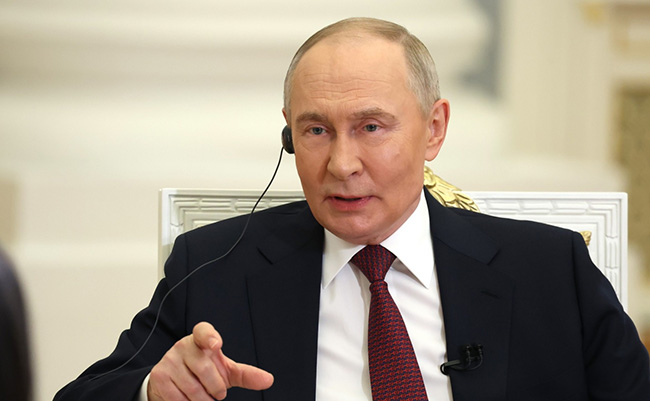 Photo: Kremlin.ru
President of Russia Vladimir Putin: I hope you'll enjoy your stay in Russia. Hope that you like Moscow and the Kremlin where we are currently collaborating together.
As you see, everything is going on as planned. On the whole, we are satisfied with the current economic situation.
Most importantly, I am delighted to be meeting, as you've mentioned, my friend Prime Minister Modi. We have made a specific arrangement to do so in India because there are numerous topics on which we need to talk, and our collaboration with India spans an extensive array – and, of course, the unique nature of our relationship adds another layer of significance.
I also want to highlight that India's progress over the past 77 years since gaining independence – an extremely brief span in historical terms – has been substantial indeed, and India has truly come a long way in development. I will discuss this further below.
You know, as we go about our daily lives, we often fail to notice the changes happening right before our eyes; we scarcely ever take note of them. Yet if you glance even slightly into the past and reflect on what has occurred in India – it's almost like a miracle. For example, few people recognise that life expectancy in India has nearly doubled during this period.
Geeta Mohan: We will talk about longevity in some time from now.
Vladimir Putin: We will definitely discuss that. Anyway, our relationship with India is advancing in numerous fields. It's a pleasure to meet Prime Minister Modi again, with whom we have both a professional and a personal, friendly relationship.
Anjana Om Kashyap: May I ask you a question?
You just talked about the Indian-Russian ties. It all dates back to almost more than seven decades, this dostee, this druzhba in Russian, this friendship dates back to more than seven decades.
My question is, how do you assess the strength of this friendship in today's time and what would you say about Prime Minister Narendra Modi and to Prime Minister Narendra Modi whom you call your dost?
Vladimir Putin: About the Prime Minister?
Anjana Om Kashyap: Yes. And to him.
Vladimir Putin: You know, the world is evolving rapidly – and this pace keeps getting faster, which is plainly visible to all. The global configuration is changing, with new centres of power emerging, and the global power landscape is changing too. Therefore, it's crucial to ensure stability among major nations, since this forms the groundwork for gradual progress in both bilateral and international relations.
In this context, our collaborative endeavours with Prime Minister Modi carry significant weight because they transcend our mutual ties. Given its direct relevance to both nations, ensuring stability in key areas of engagement is crucial, as it helps secure the fulfilment of our objectives. Prime Minister Modi sets very challenging tasks for the country – and for himself in the first place, then for the administration, and eventually for the nation.
Take, for example, his famous pitch, “Make in India.” It has a practical dimension, including for our bilateral relations. When we meet, he always says, “Let's do this, let’s do that, let’s look at this area and that.” I can list them all. Therefore, we have a lot of practical areas of cooperation.
Anjana Om Kashyap: Before Geeta takes on to the next question, one little, small very interesting question, because when you met Prime Minister Modi at the SCO there was this picture and video of you and him going in a car. And we are showing it to our viewers right now how you were traveling in a car with him – was it preplanned or how did it go about, how did it happen? And what did you discuss in the car?
Vladimir Putin: We have just gone over the current topics. This wasn't prearranged; we simply stepped out, and my car was waiting. I asked, ”Would you like to come along?“ That's all there is to it – a gesture of human solidarity, camaraderie, and friendship. No hidden scheme was involved. We climbed into the car like old friends and talked en route. We always have things to discuss.
What’s more, we continued our conversation and just remained in the car. Eventually, I suggested: ”Let's go, they are already waiting for us. “ There is nothing special here; it simply indicates that we have matters to discuss and those matters are very important to us.
Geeta Mohan: Thank you, Mr President. The fact that you are going to India. You just said that both leaders are going to cement the guarantees that you give each other. What are the kind of announcements that we can expect? We've heard about technology transfer, we've heard about trade enhancement. What are the solid announcements during this visit? And I ask you this, because the world – and you know who I mean – would be watching.
Vladimir Putin: The world would be watching our visit – there's no big deal here. India is an enormous country, home to one-and-a-half billion people, boasting a growing economy with a seven-percent annual growth rate, leading among major global powers. After all, Mr Modi has made this possible. It's something both the Indian nation and Prime Minister Modi himself can rightfully claim as their achievement. Naturally, there will always be critics who think that improvements could have been more significant. But that's an achievement.
We've laid out an ambitious plan for our collaboration in key domains. The most critical areas are indeed forward-looking. I'm referring specifically to high technology. Our partnership with India encompasses such fields as space exploration, energy (notably nuclear power, exemplified by the prominent Kudankulam Nuclear Power Plant project), shipbuilding, and aviation.
There are many interesting areas for cooperation that are looking to the future. Take, for example, artificial intelligence. We'll likely discuss it further down the line. AI represents a crucial technology shaping the future, rapidly transforming the world, amplifying possibilities exponentially while simultaneously presenting certain challenges.
These are the matters we will discuss, choosing the ones that are the most significant for us, as both Prime Minister Modi and I believe. That’s what we will focus on and what we will work on.
 Photo: Kremlin.ru
Geeta Mohan: Are there any specific agreements?
Vladimir Putin: Well, of course. However, perhaps we shouldn't reveal them just yet; we will do that during the visit, when we can unveil everything publicly. Then, our colleagues will first share with us all the documents they have prepared, and it would require our final approval.
Geeta Mohan: I suggest we switch to the energy sector. Just talking about sustainability and trade. There's immense pressure on India and on Russia when it comes to oil. India has suffered in terms of the kind of pressure that we're seeing from West. How can both countries handle this Western pressure and sanctions?
Vladimir Putin: The issue here is that the pressure you have referred to typically involves employing political instruments to influence normal competition.
Our energy cooperation with India remains unaffected by current conditions, fleeting political swings, or indeed the tragic events in Ukraine.
Regarding hydrocarbons: well before the Ukrainian situation, our business entities had already built a solid and efficient commercial relationship that is based on mutual trust.
It's widely known that one of our leading companies acquired an oil refinery in India – this investment represented one of the largest foreign inflows into the Indian economy, totalling more than US$20 billion. Our company has been continuously expanding operations of this refinery, working with its partners, operating successfully year after year. As a result, India has become one of the major refined product suppliers to Europe – not just because it buys our oil with a discount. It took years to achieve and is in no way connected to the current economic environment.
Certain actors clearly dislike India's growing role in international markets owing to its ties with Russia. Consequently, they're seeking means to constrain India's influence for political reasons by imposing artificial obstacles.
Anjana Om Kashyap: Economy is a very important point, but my question to you now would be about defence. India continues to be the biggest defence buyer, roughly 38% of the market from Russia is bought by India.
My question is in view of the sanctions by the US or the load they have laid on India, the arm-twisting methods that are being adopted – and I name, it's America – how do you plan to circumvent all this? Will you pull back or push harder?
Vladimir Putin: It appears that both India and the world recognise that India cannot continue to be treated the way it was treated 77 years ago. India is a major global player, not a British colony, and everyone must accept this reality.
Furthermore, Prime Minister Modi is not someone who succumbs to pressure easily. The Indian people can certainly take pride in their leader. This is absolutely obvious. His stance is unwavering and straightforward, without being confrontational. Our goal is not to provoke conflict; rather, we aim to protect our lawful rights. India does the same.
What are the obstacles? Obstacles in settlements. However, over 90% of our transactions are already conducted in national currencies. While some complications arise due to the presence of numerous intermediaries, there are also solutions: we can switch to the existing systems for exchanging electronic messages on financial transactions of the Bank of Russia and of our partners in India.
These efforts are ongoing and advancing. Those who attempt to hinder economic ties with third countries ultimately encounter difficulties and suffer losses. I am confident that once this perspective becomes firmly established, such tactics of applying external pressures will fade away.
Anjana Om Kashyap: Three specific questions, Sir.
Number one: because during Operation Sindoor the weapons we had acquired from Russia have proved to be very crucial in our victory. That is why I would like to ask you specifically about S400, the air defence system, the five S400 that are awaited – by when can we expect that?
The second question is on S500, an even more advanced air defence system.
And the third question is about the fifth generation fighter jet Su-57. How are you going to push for this and what are the updates?
Vladimir Putin: You seem to be an expert on the issue, as if we are engaged in negotiations on military-technical cooperation.
If we delve into the substance, India stands out as one of our reliable and privileged partners in this area. We are not merely selling something to India and India isn’t merely buying something from us in the sphere of defence and security. No. It is a different level, a different quality of relations we have with India, and we value this. We see how India values this relationship too.
Why? Allow me to emphasise again: we are not simply selling technology – we are sharing it, and it is a very rare thing to see in the sphere of military-technical cooperation. It speaks to the level of trust between the two countries and the level of trust between the two peoples, I would put it this way. We have a broad portfolio indeed, including naval construction, rocket and missile engineering, and aircraft engineering.
You just mentioned the Su-57 aircraft. India operates several other Russian-made aircraft too. And there’s the production of armoured vehicles. India is manufacturing our renowned T-90 tanks. Trust me when I tell you that these tanks rank among the best in the world. Moreover, the famous BrahMos missile – a joint venture between Russia and India – is manufactured primarily at Indian facilities.
Therefore, Prime Minister Modi's “Make in India” initiative should be implemented in this area as well.
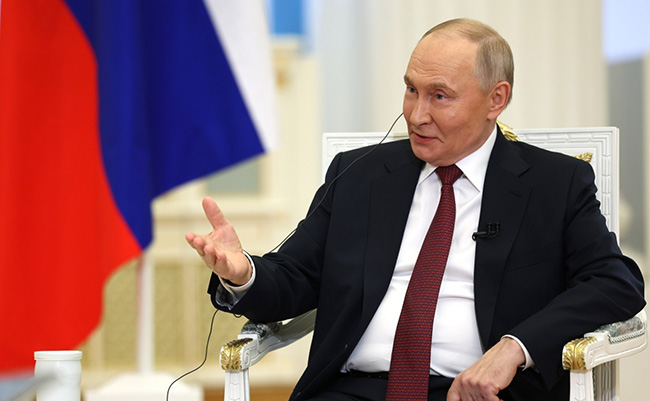 Photo: Kremlin.ru
Geeta Mohan: And the Kalashnikovs.
Vladimir Putin: The Kalashnikov is certainly an important weapon. But we have been discussing high, one might even say cutting-edge technologies. Given the combat experience in using certain types of weapons, their value has multiplied manyfold.
Now, Indian military specialists – thanks to their strong ties with our military – understand clearly how and in what circumstances a particular weapon performs best, and where and when it should be deployed. This is an extremely important understanding, which is shared by both the Indian and Russian sides.
Geeta Mohan: Mr President, I have to go back to your oil question, because you spoke about strategic autonomy, which is what India has been talking about. Strategic autonomy decides for India's interests, but has India reduced Russian intake of oil after pressure from the West?
Vladimir Putin: Well, there is a certain decline in overall trade turnover during the first nine months of this year. This is just a minor adjustment. Overall, our trade turnover stands almost at the same level as before.
I can’t give you exact monthly figures right now, but trade in petroleum products and crude oil, as well as the production of petroleum products for consumers of oil, Russian oil, is running smoothly in India. I know the sentiment of Russian partners, of Russian companies: they believe their Indian counterparts are reliable and very serious people.
Geeta Mohan: The other important aspect in terms of cooperation between India and Russia is the nuclear front. Russia has been one of the biggest movers when it comes to nuclear facilities in India. Are we looking at important announcements on the nuclear front? Nuclear today is a sensitive issue for Russia.
Vladimir Putin: Yes, of course we have some announcements to make.
We are indeed one of the biggest ”movers,“ as you have noted. Speaking seriously, we are not ”movers,“ we are producers of the world’s most advanced and reliable equipment for nuclear power plants. The Russian company Rosatom builds and operates more nuclear reactors for nuclear power plants abroad than any other company in the world – 22 nuclear units. The well‑known facility and our joint project, the Kudankulam plant, is one of the leaders in this regard.
These are large units, they operate efficiently and, I reiterate, have proven to be very useful.
There are some announcements you have just asked about. What is it about? The news is that Russia is probably the only country in the world today capable of building – and actually does build – small nuclear power plants. Such plants are already operational in Russia, and we can make them either floating or ground-based. It’s an excellent option for specific regions where big power stations are not needed or where connecting electricity grids between generators and end-users isn’t feasible. These compact nuclear power modules can thus be deployed in isolated and hard-to-access locations.
Geeta Mohan: That's a lot of collaboration and cooperation. You're talking about ”Make in India, Make With Russia.“ How do you think President Trump is going to react to all of this?
Vladimir Putin: You know, neither me nor Prime Minister Modi, despite certain external pressure we face, have ever – and I want to emphasise this, I want you to hear it – approached our collaboration to work against someone.
President Trump has his own agenda, his own goals, whereas we focus on ours – not against anyone, but rather aimed at safeguarding our respective interests, India's and Russia's interests. In our dealings, we cause no harm to others, and I believe that leaders from other countries should appreciate this.
Anjana Om Kashyap: With regard to Mr Donald Trump. My second question is also about him, because recently he said that if you are buying oil from Russia, – about India – you are funding the Russian-Ukrainian war.
How would you characterise Mr Donald Trump, the President of the United States of America?
Vladimir Putin: You know, I never give character assessments about my colleagues – neither those I’ve worked with in the past nor current leaders of individual states. These assessments should be made by citizens who vote for their leader during elections.
As for India's purchases or purchase of energy resources from Russia… Well, I would like to note and have already mentioned this publicly once – the United States itself still buys nuclear fuel from us for its own nuclear power plants. That is also fuel – uranium for the reactors operating in the United States. If the US has the right to buy our fuel, why shouldn't India have the same privilege? This question deserves thorough examination, and we stand ready to discuss it, including with President Trump.
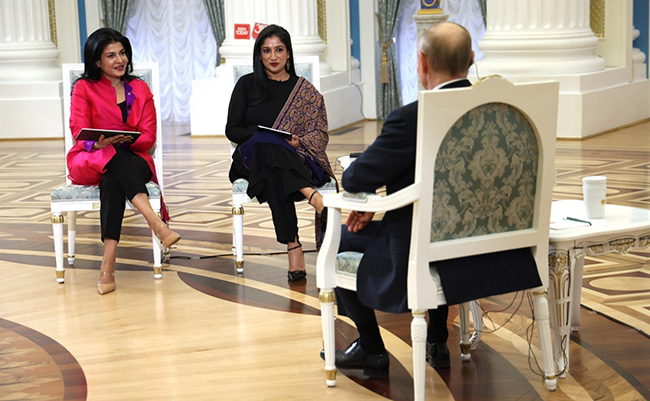 Photo: Kremlin.ru
Geeta Mohan: You are being very kind, you say you are not characterising Trump, but he certainly does that with regard to you. Having said this, he has weaponised tariffs. And he has weaponised it against India. How do you think the two countries should be handling Donald Trump and the US administration?
Vladimir Putin: You know, he pursues his own policy, and he has advisors – his decisions aren't made out of thin air. He has advisors who believe that implementing such tariff policies, involving the imposition of additional duties on trade partners, ultimately benefits the US economy. He is acting in good faith, I presume. Our experts believe there are risks involved, but it is the choice of each country and its leadership to decide which economic policy to adopt.
We have never engaged in such practices, do not do so now, and have no intention of doing so in the future. Our economy is open. We hope that, in the end, all violations of World Trade Organisation regulations will be rectified.
Geeta Mohan: Mr President, things have changed a little between the US and Russia. The fact that America is engaging you, we would have loved to be a fly on the wall when you were meeting with Jared Kushner and Steve Witkoff. That was an important meeting. Were there red lines that Russia reiterated? What really happened?
Vladimir Putin: It's premature to discuss that now. I doubt it would interest you to hear about it, as it lasted five hours. Frankly, even I grew weary of it – five hours is too much. However, it was necessary because…
Anjana Om Kashyap: Five hours! Witkoff and Kushner?
Vladimir Putin: Yes, and I was alone. Can you imagine it?
But speaking seriously, it was a very productive conversation, as what our American colleagues presented was, in one way or another, based on our prior agreements made before my meeting with President Trump in Alaska. We had discussed these very issues, to some extent, at the meeting in Anchorage. However, what the Americans brought us this time was truly new; we hadn't seen it before. Therefore, we had to go through practically every point, which is why it took so much time. So it was a meaningful, highly specific, and substantive conversation.
Anjana Om Kashyap: Were there certain specific points of disagreement?
Vladimir Putin: Yes, such issues were raised, we discussed them. But this is a complex task and a challenging mission that President Trump took upon himself – fair enough, I say without irony, because achieving consensus among conflicting parties is no easy task. But President Trump, truly, I believe, he sincerely tries to do this.
We went through each point again, let me reiterate this. Sometimes we said, “yes, we can discuss this, but with that one we cannot agree.” That was how the work proceeded. To say now what exactly doesn't suit us or where we could possibly agree seems premature, since it might disrupt the very mode of operation that President Trump is trying to establish.
But that's what they do – shuttle diplomacy. They spoke with Ukrainian representatives, then with Europeans, came here, had another meeting with Ukrainians and Europeans. I think we should engage in this effort rather than obstruct it.
Geeta Mohan: You are saying that the 28 points peace proposal is not on the table?
Vladimir Putin: They're discussing – that's what they're discussing right now. They simply broke down those 28 points, then 27, into four packages and proposed discussing these four packages. But essentially, it's still just the same old 27 points.
Anjana Om Kashyap: We will go back to that and try to understand how it's going forward.
What happened in Alaska? You met President Trump and it was all about the peace deal, right? What happened? Did you actually have sense of or see a sincere intent?
Vladimir Putin: Yes, there was indeed a sense – no, more than just a sense, I have absolutely no doubt that President Trump had genuine intentions (we won't discuss here what caused them or why they appeared, but they're definitely present). Both the United States and President Trump likely have their own understanding of why this needs to be resolved quickly.
Moreover, by the way, on humanitarian grounds too. I truly believe that is one of the motives behind President Trump's actions regarding this matter because he constantly speaks about his wish to minimise losses, and I'm confident that his sincerity is genuine. He undoubtedly considers these humanitarian concerns when formulating his decisions.
However, other factors also come into play: political considerations and economic interests. Therefore, I believe that the US is actively seeking a solution to this problem.
Geeta Mohan: Yes, he has spoken about intentions, you're right about. He claimed he would end wars and conflicts – causing consternation in India when he claimed that he had brought peace between India and Pakistan, now he's looking at Russia and Ukraine. Do you really think he's a peacemaker?
Vladimir Putin: Regarding the situation in Ukraine – yes, let me repeat once again, I am absolutely certain, with no doubt at all, he sincerely aims for a peaceful resolution.
Let me stress once again: the United States may have various reasons for this – humanitarian ones personally for Trump because he genuinely wants to end hostilities and prevent further loss of life, but there could also be political interests tied to ending the confrontation between Russia and Ukraine, or economic motives too. By the way, they can be in the energy area and in other areas. There are numerous areas where restoring economic relations between the US and Russia would benefit both sides.
I showed you some letters – I won't go into this now – large US companies sent to us. We should remember this.
Comment: Really?
Vladimir Putin: Of course. About their existence. They’re waiting until all problems are solved, and they’re ready to return to us, they want this, asking us not to forget about them. The letters are there.
Comment: It’s surprising.
Vladimir Putin: What’s so surprising about that? Many want to return. So, of course, the Indian government is saying right: “Why should we leave…?”
Geeta Mohan: They arrived with letters from companies – quite astonishingly unexpected indeed.
Vladimir Putin: No, I believe there has been a misunderstanding. We have letters from American companies – letters they have sent us, where they urge us not to forget about their existence. These are our former partners, who did not leave by choice. They express a clear desire to resume cooperation and are waiting, among other things, for a corresponding political signal.
Anjana Om Kashyap: This conversation is becoming very interesting because there are so many highlights of understanding and it is really pleasant to see you, and your sense of humour, and how you are putting things forth.
But now we are going to go into a very serious matter – and that is the Russia-Ukraine war. So what, in your view, would constitute a victory for Russia in the Russia-Ukraine war? What are the red lines? Because you have, and I quote you, you have said very clearly that Russia will lay down arms only if Kiev's troops withdraw from the territories claimed by Russia, which parts would that be?
Vladimir Putin: You know, it's not about victory, like you have said. The point is that Russia is determined – and will certainly do so – to protect its interests. Protect its people living there, protect our traditional values, Russian language, and so on. Protection, by the way, of religion that has been cultivated on these lands for centuries. Yet you know that the Russian Orthodox Church in Ukraine is almost banned: they seize churches, drive people out of temples, etc. – it is a problem. And I'm not even mentioning the ban on the Russian language, etc. It is all part of a big set of issues.
Let me remind you: we were not the ones to start this war. The West egged Ukraine on and supported the events, orchestrating a coup d'état. That was the point that triggered the events in Crimea, followed by developments in southeastern Ukraine, in Donbass.
They don't even mention it – we've tried to resolve these issues peacefully for eight years, signed the Minsk agreements, hoping that they could be resolved through peaceful means. But Western leaders openly admitted later that they never intended to honour those agreements, signing them merely to allow Ukraine to arm itself and continue fighting against us. After eight years of relentless violence against our citizens of Donbass – something the West hasn't uttered a word about – we were forced to recognise these republics first, and secondly, provide support. Our special military operation isn't the start of a war, but rather an attempt to end one that the West ignited using Ukrainian nationalists. That's what is really happening now. That’s the crux of the problem.
We will finish it when we achieve the goals set at the beginning of the special military operation – when we free these territories. That's all.
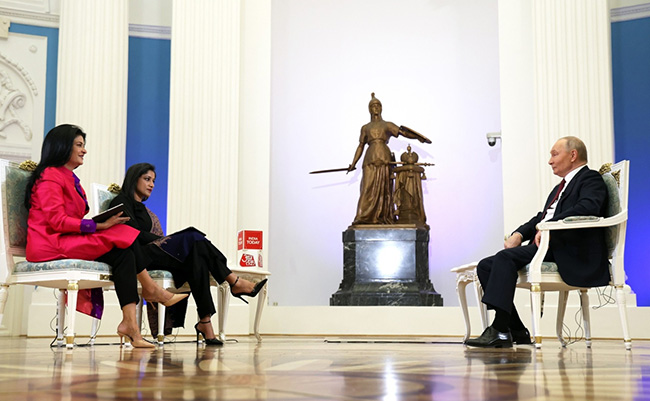 Photo: Kremlin.ru
Anjana Om Kashyap: What is the end gain for Vladimir Putin in Ukraine?
Vladimir Putin: I have said that already. Listen, we didn't recognise these self-proclaimed republics for eight years. Eight years. They declared independence, while we were trying to establish relations between the rest of Ukraine and those republics. But when we realised this was impossible, that they were simply being destroyed, we had no choice but to recognise them – and not just their existence on part of the territory, but within administrative boundaries established during Soviet times, then later under independent Ukraine after its independence, still within those administrative borders.
And right away we told Ukraine, the Ukrainian troops: ”People don't want to live with you anymore. They voted in a referendum for independence. Withdraw your troops from there, and there won't be any military actions.“ No, they chose to fight instead.
Now they have pretty much fought themselves into a corner, all this boils down to one thing: either we take back these territories by force, or eventually Ukrainian troops withdraw and stop killing people there.
Anjana Om Kashyap: Before we move to the other one, just one last question. On March 8, 2014, during the annexation of Crimea, you were addressing the Federation Council and you said, ”Kiev is the mother of all Russian cities.“ What did you mean?
Vladimir Putin: Here I haven't made up anything – historically this is how it was said. Originally, the Russian state was formed from several centres. The first capital, according to history, was in Novgorod in the northwest. Later the federal status moved to the city of Veliky Novgorod, and then it moved to Kiev. This was Ancient Rus. And since then, Kiev has been known as the ”mother of all Russian cities.“
Later, historical events unfolded in such a way that the ancient Russian state split into two parts. One part began developing with Moscow as its centre, while another part fell under other countries. For instance, the part with Kiev, along with some other lands, these parts first formed a state with Lithuania, subsequently merged with Poland, forming the Polish-Lithuanian Commonwealth. Thus, this part of the ancient Russian state ended up in Poland, and by the seventeenth century, it sought to return back to Russia.
Geeta Mohan: The fact that you know, you were mentioning the history and it brings me to what I did when the conflict was underway. I had travelled to Donetsk, I had travelled to Lugansk, Zaporozhye, Kherson, and most of the people there are Russian-speaking, they speak Russian language. They were very disappointed that Kiev had banned that language in eastern Ukraine. But they were also a little shocked at how Putin is doing this to us, we are his people. A lot of women I spoke to were in shock. So, what do you have to say to people in eastern Ukraine who actually have families in Russia, who, on a daily basis, move from Ukraine to Russia. What do you have to say to them?
Vladimir Putin: I didn't understand the question. What exactly shocked them?
Geeta Mohan: They were shocked that there was an operation that happened, and their homes were destroyed, because they lived in eastern Ukraine. And they have love for Russia and the Russian people, and they are Russian-speaking themselves.
Vladimir Putin: The answer is quite straightforward. These individuals presumably resided in those parts of Ukraine – specifically, in the areas of the Lugansk or Donetsk region – that remained under the control of the Kiev authorities at the time. Meanwhile, that part of the Lugansk or Donetsk region outside their control was being subjected to intense military action by the Kiev authorities. We were consequently forced to extend support to those areas that had declared independence. That is the first point.
Secondly, we provided people with an opportunity to express their will in an open referendum. Those who believed it was in their interest to join Russia voted accordingly. Those who did not were free to leave unhindered for other parts of the Ukrainian state. We have never placed any obstacles in the way of that choice.
Geeta Mohan: What do you make of President Zelensky? He was promised NATO, the European Union promised him the EU. But nothing really happened. Was NATO ever on the table for Ukraine?
Vladimir Putin: When this gentleman came to power, he declared that he would pursue peace at all costs, using every means possible, without sparing even his career. But now we see things differently. He follows the same pattern as his predecessors – putting the interests of a narrow nationalist group, particularly radical nationalists, ahead of those of the people. Essentially, he is addressing their concerns rather than those of the nation.
This regime’s mindset truly resembles a neo-Nazi regime because extreme nationalism and neo-Nazism are almost indistinguishable concepts. Today, undeniably, military action dominates their approach. However, they haven’t achieved much success here either.
I have already said before that what matters most for them is realising that the best way to resolve the problems is through peaceful negotiations, and we attempted to negotiate with them back in 2022. What exactly they plan to do remains to be asked from them directly.
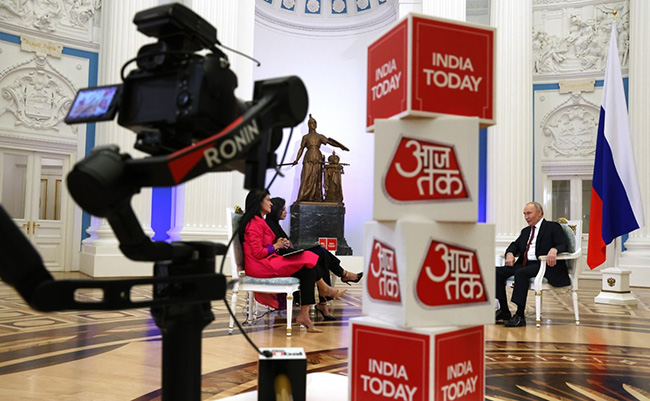 Photo: Kremlin.ru
Anjana Om Kashyap: That would be interesting to see what they have to say on that, and how this peace process goes forward.
But you have always said that the eastward expansion of NATO is your real concern. Ukraine has not got this NATO membership as of now. My question to you – is NATO expansion a real threat or just a pretext for what you think is a part of Ukraine which is probably you want control over? Or you think that injustice is being done, the Russian language is being banned – these are the real issues?
Vladimir Putin: Listen, NATO is another matter altogether. The Russian language, Russian culture, religion, and even territorial issues – these are very important topics, one subject. NATO is something entirely different. We don't demand anything exclusive for ourselves here.
First of all, there are general agreements that the security of one state cannot be guaranteed by undermining the security of others. This idea might seem somewhat obscure, but I'll explain it simply. Each country, including Ukraine, has the right to choose its own means of defence and ensure its own safety. Correct? Absolutely correct. Do we deny Ukraine this? No. But it's not acceptable if done at Russia's expense. Ukraine believes it would benefit from joining NATO. And we say: that threatens our security, let's find a way to secure yours without threatening us.
Secondly, we are not asking for anything unusual or unexpected, nothing falling from the sky. We are just insisting on fulfilling the promises already made to us. These weren't invented yesterday. They were pledged to Russia back in the '90s: no expansion eastward—this was stated publicly. Since then, several waves of expansion took place, culminating with Ukraine being drawn into NATO. This completely displeases us and poses a serious threat. Let’s remember that NATO is a military-political alliance, and Article Five of the Washington Treaty establishing NATO hasn't been repealed. It's a threat to us. Nobody bothers to take us seriously.
Lastly, when Ukraine became independent, few people recall this: what was the first document ratifying independence? It was the Declaration of State Sovereignty, Independence of Ukraine. That forms the foundation of Ukrainian sovereignty and modern statehood. And it clearly states that Ukraine is a neutral state.
Geeta Mohan: Was that also the basis for what happened when you decided to annex Crimea, you only seized the water port, a very important strategic port for Russia? And then Russia was no longer part of the G8. Today, the West claims, or says, that you actions in the recent past are the reason for, and I quote-unquote, the isolation of Russia.
Vladimir Putin: We didn't need to seize that important port in Crimea because it was ours already – our Navy had been stationed there under the agreement with Ukraine, which is a fact. After the collapse of the Soviet Union, our fleet remained there regardless. The matter isn't about that, though it's significant, but that's not what we're talking about here.
And we did not annex Crimea, I want to emphasise this point. We simply came to help people who didn't want their lives or fate tied to those who staged a coup in Ukraine. They said: “Hey, nationalist extremists took over in Kiev. Did anyone ask us? Ok, we ended up as part of independent Ukraine after the dissolution of the USSR. So be it, history happened like that. Fine, ok, now we'll live that way. But we believe that we exist in a democratic state. And if coups happen here with unknown consequences, then we won't accept that, we don't want to live like that.” There was a threat not just of pressure, but of outright violence against the Crimeans. Russia stepped in to help them. How could we do otherwise? If someone believes differently, thinking that Russia would act differently, they’re deeply mistaken. We'll always defend our interests and our people.
Geeta Mohan: One brief question before we move on to the other part. Dou you want to go back to being a part of the G8, because there are a lot of reports on that. Is that something Russia is looking at?
Vladimir Putin: No.
Anjana Om Kashyap: Interesting answer. You are clear about that?
Vladimir Putin: Yes. The fact of the matter is that I myself, at a certain point – such were the circumstances, I won’t go into details now – I stopped attending those meetings. This is the first point.
The second thing is that as I have said before, it’s not entirely clear why the countries that form the G7, call themselves the ”Big seven“? What’s so big about them? In terms of purchasing power parity, India’s economy is the third largest in the world. And where are the countries like the United Kingdom in terms of purchasing power parity? What is their ranking now, tenth or thereabouts?
Of course, these are all countries with advanced, high-tech economies; a robust foundation exists, it hasn’t gone anywhere, although their share in the global economy is shrinking year after year, like a piece of Shagreen leather. This is an obvious fact, we all see it.
The trend is obvious, and it will keep going like that, as far as can be seen, among other things, due to what I would cautiously call the deeply flawed economic policies pursued by the leadership of many of those countries. A recession in Germany is evident, for the third year in a row; France is in a difficult situation, also on the brink of recession, as are other leading European nations. Nevertheless, it is an important platform; they do work there, they do make decisions, they do discuss matters among themselves, and so may they all be healthy by God's grace. This is a good story as such.
But I will say it again, at a certain moment I simply stopped going there. And this was not connected to the events in Ukraine, but to some other events; I won’t go into details now. Incidentally, we informed our American partners about this.
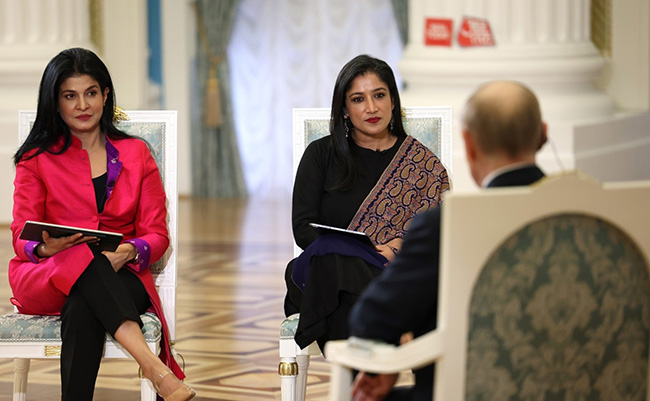 Photo: Kremlin.ru
Geeta Mohan: You informed them during this meeting?
Vladimir Putin: Yes, during this meeting as well.
Anjana Om Kashyap: With Mr Witkoff?
Vladimir Putin: Yes, we discussed this topic among others.
Anjana Om Kashyap: That's a very important aspect…
Vladimir Putin: You think so? I don't believe it's that significant. But if you feel that way, okay.
Anjana Om Kashyap: So, coming back to…No, I just wanted to put it in perspective before we go ahead. So, you are just telling us that in your recent meeting with Mr Witkoff it was offered to you that you could make it back to G8 and you categorically said that you are not interested?
Vladimir Putin: No, this topic just came up on its own.
I explained to Mr Witkoff why I stopped attending those events long time ago. It wasn't a suggestion or even a question, nothing like that. We just mentioned that subject. I recalled when I stopped going there – it was in 2012 after the Russian presidential elections. Then I seemed to come back there, then stopped coming again – and anyway, that's no longer important now. But the platform still exists, I wish them to continue their job and Lord give them all the best. But other major international alliances are forming now -such as the Shanghai Cooperation Organization (SCO), BRICS, and the G20. We're involved everywhere, and we definitely have a completely non-confrontational approach.
However, there's another aspect here. Look at the current relationship between Russia and European countries. These relationships are far from being called normal. How do you imagine that I come to the G8 meeting, how would I talk to its members if they don't want to talk to me? What am I supposed to do there then? Well, if they do want to talk about it, fine – we can come back to this topic later.
Anjana Om Kashyap: You said that countries like India whose gross trade is far exceeding a lot of European countries need to just calm down and understand some things. The other thing you say is that organisations like probably G7 are losing their relevance and what would I do if they don’t want to talk to me.
But the third thing you mentioned was BRICS, and so there is my question to you: is there a new world order falling in place, because you are not going to G7, but you just visited China, and you are about to visit India. Russia, India, China. RIC. BRICS. SCO. Global South. What do you see as a new power centre in the multi-polar world?
Vladimir Putin: You asked whether the world is changing, and a new order is forming? The world changes constantly – everything flows, cuncta fluunt. The pace of change varies, but the world always evolves.
Nowadays, this rate of change is fast, indeed very high. We can see it, we can feel it, I’ve already said that. And primarily, we’re witnessing the global economic processes unfolding. These processes aren’t linked to events in Ukraine or other hotspots – they’re just happening generally. We could talk about this for hours, and I’d be happy to discuss it with you, but our viewers might grow tired from such discussions.
One fact remains, however: new centres of growth are emerging of rapid, strong growth. These include countries of the Global South, notably South Asia, India, and Indonesia, which has nearly 300 million people and is rising quickly. Of course, it’s not one and a half billion people living there, like in India, but still these are very rapidly developing countries. Let me say it again: Africa is already advancing swiftly and will accelerate even more. With its young population, these countries would be our future. They’ll strive toward higher living standards, which is inevitable. In the future, rates of change in the global economy will continue to accelerate steadily and significantly.
By the way, we often hear that Russia recently recalibrated its relationships with the Global South and Asia. That's not true, because we’ve been doing so since the early 2000s.
Anjana Om Kashyap: Actually this picture ruffled a lot of feathers across the world. Vladimir Putin, Xi Jinping and Narendra Modi. Three nation heads together. And people were going all over social media and America.
Geeta Mohan: But even if you’d look at that picture, how do you have these alternative blocs and how can they become a real force, if there are fundamental unresolved issues between key member states in that bloc?
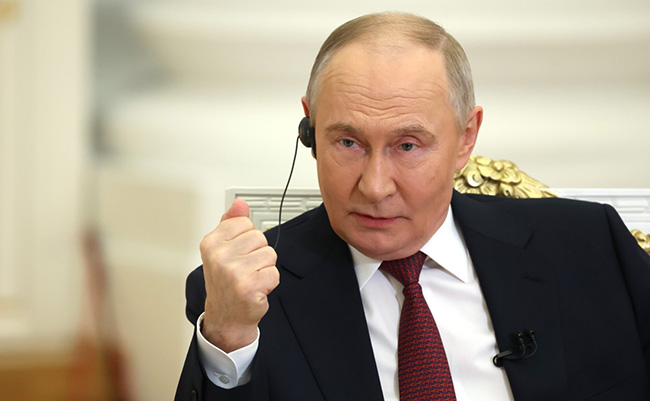 Photo: Kremlin.ru
Vladimir Putin: You know, conflicts always exist. But tell me what period of history there was no conflict at all? Let's take a look at the historical development of major world centres or regions – wherever we point our finger in time, we will always find a conflict somewhere.
Though the point is elsewhere: it's about finding solutions to these conflicts, seeking most effective ways to resolve them. In large alliances like BRICS, or the Shanghai Cooperation Organisation, we share a common understanding that we have common values rooted in our traditional beliefs, which underpin our civilisations such as India's civilisation for already hundreds, if not thousands, of years. Drawing on this heritage of the past, we work together instead of suppressing opportunities. When efforts are combined, the resulting synergy turns out unexpectedly strong and high.
We never set out to come up with ways to deceive, outsmart, or hinder someone's development. Nothing like that has ever happened. We always focus only on positive agendas. I believe that's important.
Geeta Mohan: That’s an important answer.
But are there alternatives? Because the biggest thing when you have these blocs is how do you make it economically viable. Are we looking at alternative payment systems? Is there going to be a BRICS currency? Or are we looking at alternative payments in terms of national currencies, rupee or ruble? Moving towards de-dollarisation basically.
Vladimir Putin: You know, there's no rush in this, festina lente and you'll avoid big mistakes.
For instance, we were talking about Europe. They set up the euro system and dragged in there certain countries that weren't economically ready for one single strong currency. And now they're dealing with some difficult social matters. There's more than just playing around with inflation there, right? This question is far more complex than just tinkering with inflation a little bit and calling it done. Their entire economy is tied to just one stable currency, therefor social problems arise and budgetary issues emerge.
Right now we don't aim at having a single currency within BRICS. In this process, there's no rush anywhere, and we aren't rushing either. There is a need to expand the use of national currencies, you've mentioned this already. We must make better use of the BRICS New Development Bank's opportunities.
For example, we propose creating a new investment platform using electronic payments (with an initial capital of 100 billion dollars) to encourage joint investments both in our economies and those of developing nations in the Global South. I believe this could be very appealing option, because these investments would help us, and they would also benefit the recipient countries, since together we would produce high-quality goods at reasonable prices. These products could help the countries of the South to develop further, while also advancing our own growth.
There will be more and more tools like this. Modern payment systems and digital money exist already and they are evolving rapidly. And for us, this is definitely not about working against anyone – we see it more as refining tools that are already widely used worldwide.
Geeta Mohan: Rupee and ruble payment then?
Vladimir Putin: There are no obstacles here. These are purely economic issues. We fully understand and realise that we do have a certain trade imbalance. However, India's government does not impose restrictions on our mutual trade. Why? Because they need both oil and petroleum products. The Indian government needs to expand its purchases of Russian fertilisers because these are crucial for Indian farmers, and Prime Minister Modi constantly raises this issue: ”Please increase the volume of deliveries.“
The issue is entirely different. It's not about rupees; it's about what those rupees can buy respectively for our companies. We're also thinking about this, not only the Indian government, but we also do. And we agree that this disparity must be addressed, but not through bans, rather by finding areas beneficial for both sides.
Therefore, during my visit and at our initiative, there will be an exhibition showcasing our importers from India. I want to share with you something completely candidly: this was my direct instruction to the Government of Russia, which is to consider what else we could purchase from India. We're considering this matter together, including from the perspective of the Russian Federation.
 Photo: Kremlin.ru
Anjana Om Kashyap: My next question before we move to other issues is – how do you balance – I’m going to ask that directly – how do you balance India and China? Because it is very clear that you are keen on good relations with both these countries. How do you balance them, seeing some tensions between us.
Vladimir Putin: We know this very well. India and China are our closest friends – we treasure that relationship deeply, and I do not believe we have the right to interfere in your bilateral relations. But I know that both Prime Minister Modi and President Xi Jinping are committed to finding solutions to all issues, even to the most complex interstate problems.
I know about it because both Prime Minister Modi and President Xi Jinping see that some specific tension is rising, and they both try to find solutions to these issues, exerting maximum effort – I know this well and can see it clearly. And the key reason why they would succeed would be their wisdom, which we appreciate immensely. At the same time Russia does not feel entitled to intervene, because these are your bilateral affairs.
Anjana Om Kashyap: The next important issue with regard to India is terrorism. We faced two major terrorist attacks, one in Pahalgam and then one in Delhi. My question to you is that we see a dual ideology on terror in the world from different countries. What is the solution in your eyes? Because Russia also faces terrorism, India faces it. What in your eyes is the solution to your terrorist – my – freedom – fighter ideology?
Vladimir Putin: It’s very simple. To achieve freedom, we must use lawful means only. Any actions involving criminal methods or those harming people cannot be supported – this has been decided long ago. As you've correctly noted, Russia has repeatedly faced acts of extreme terrorism throughout its recent history. In these matters, India is our full ally, and we completely support India's fight against terrorism.
Geeta Mohan: But there’s another country in the neighbourhood, very important – important to Russia, important to India: Afghanistan. You are a very rare country to have recognised the Taliban regime. What really made you look at that as a strategic interest – to recognize the Taliban at the time, when the world is still saying “they have not given equal rights to women,” when there are still a lot of issues with Afghanistan actually becoming a country that holds women and men equally. And there are many other human rights issues there.
Vladimir Putin: In every country there are enough problems. And Afghanistan is not an exception, considering that for decades this country has been embroiled in a civil war. It's just horrible. But the Taliban clearly controls the situation in Afghanistan and this is evident. Here's what needs to be said first, and you have to accept it because it's reality.
Secondly, what’s important to note is that the Afghan government takes many actions to combat terrorism and various terrorist organisations, including ISIL and others like them. This we also know very well.
Afghan authorities have significantly reduced opium production in their country and are actively addressing drug threats from within its borders.
There are several other important issues here. The main point is that in order to influence events happening in the country, you must stay in contact with current leadership there – exactly what we’re doing.
Geeta Mohan: Afghanistan’s Taliban minister Muttaqi was in India, and we weren’t allowed – women weren’t allowed to attend the press conference, and we fought back, and then he had to hold a press conference with women as part of that entire violation. Isn’t it interesting? I was just sharing it with you.
Vladimir Putin: There’s truth in what you say, but on the other hand, if he hadn’t come here, you wouldn’t have had any chance to influence these events at all. And now you’ve got both connections and the minister who has arrived. You were able to express your reaction to what happened. How do we measure whether that’s little or much? It seems to me that at least this is part of your influence and your partners’ influence on the situation.
But imagine there were no contacts at all. Then what? Everything remains exactly as before. And nobody, including yourself, would influence anything, or express any opinion about this. In contrast, now such an opportunity is available to you. Contacts are better than no contacts at all.
Anjana Om Kashyap: The other flash point is Gaza. And it is now being known that you, Sir, Vladimir Putin, have a new peace plan for Gaza. Trump also has one. What is your Gaza peace plan? What do you propose, Sir?
Vladimir Putin: We don't offer any special plan. We've always believed that the only way to solve the Palestinian problem is by implementing the solutions adopted and considered by the United Nations over many years. And the most important one is establishing an independent Palestinian state. That’s the key to resolving all issues.
Geeta Mohan: The other important issue when you talk about Israel and Gaza that Anjana just did is the fact that the Arab world when it comes to the issue of Gaza and Palestine did not do as much as your ally, your friend Iran did. How do you look at this entire scenario? Well, this is a changed world order. We never thought that Iran would fight back for Palestinians more than the Arab world.
Vladimir Putin: Each of these countries in its way is concerned about Palestine and the Palestinian people, worrying for them. And each of them tries to contribute in resolving the situation. Some things are obvious, others remain hidden in the shadows. But it doesn't mean that no one is doing anything. This is a complex issue that no one has managed to resolve over the years. Hence, it can't be fixed in just a few months by clicking a button. However, we should aim precisely at achieving this goal: establishing a Palestinian state.
What has been done until now was done by President Trump. Naturally, primarily the return of Israeli hostages and Hamas took this step. I think, frankly speaking, this was the most important thing that was done as part of the latest steps for the settlement in Gaza. I believe it would be correct, perhaps, to think about the possibility of organising the governance in such a way as to transfer all authority to the Palestinians. There are such options. They are being discussed both by Arab countries and the neighbours, and beyond it. It’s being discussed in the United States as well, I know it. As part of the United Nations, we have always taken part in this process. We will continue to do that with our friends.
Geeta Mohan:Well. President Putin, we have discussed a lot of geopolitics, we’ve stick to it for a while.
Let’s talk about your journey. You are a man from the intelligence community. How would you rate intelligence agencies today? Which one, do you think, is the best? I am sure you will say Russia but I am still saying, which one is the second best then? And how does the CIA fair?
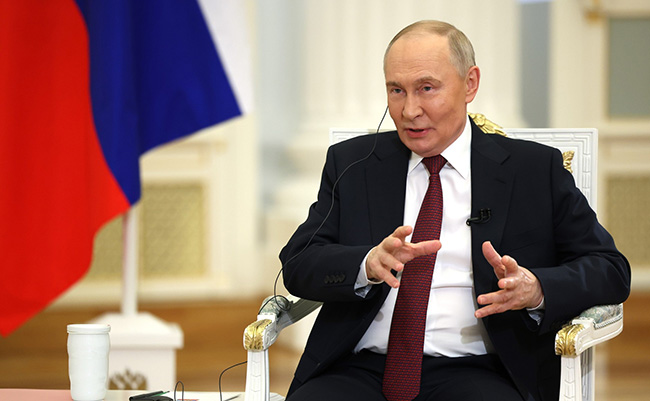 Photo: Kremlin.ru
Vladimir Putin: Well, there are several powerful intelligence services in the world. There is CIA and our, Soviet and Russian intelligence. There is, as it is well-known, a very efficient service Mossad, Israeli intelligence. Many countries of the world have tradition of intelligence services.
You know, I think it is better not to give evaluation to the efficiency of other peoples’ intelligence. I am happy with the quality of work of our intelligence service.
Anjana Om Kashyap: Fair enough. So we would like to because this is a rare opportunity we get to interact with you. We want to understand what shaped Vladimir Putin and as we peep into your early years, we’ve read a little about your KGB days when you were working in Germany and then you moved on to Saint Petersburg and then Moscow, you worked with Mr. Yeltsin.
What actually shaped the man you are today, the leader you are today? Which what it is?
Vladimir Putin: My family, the family that I lived in and that I was born into, my parents, my closest people. I think that everyone is shaped, primarily, by our closest surroundings. Naturally, the social situation around, the colleagues and as you have fairly noted that work in the intelligence service because it has strict discipline, strict ideology that primarily has to do with the defence of the interests of Motherland and that was the entire point of the intelligence service of the Soviet Union and I lived in that system for many years.
Anjana Om Kashyap: I watched in your interview when I think you were interacting with schoolchildren and one of the children asked you, a girl, I think, asked you what has been the most shattering experience of your life has been. And you said the disintegration of USSR. How did that affect you? And what is your vision of Russia?
Vladimir Putin: It had an impact in a sense that we always need to very carefully look at our every step and we need to understand the consequences of that. That’s number one.
Number two. It is very important not only for the former Soviet Union but it applies also to Russia. What was the conclusion that I came to? It is that the Soviet Union at a certain point of time was in such a state that its leadership and possibly even ordinary citizens always believed that it was so big, so great that nothing, ever, under any circumstances would happen to it. And this idea of gr