
 РУССКИЙ
 14:59 22.01.2026 •
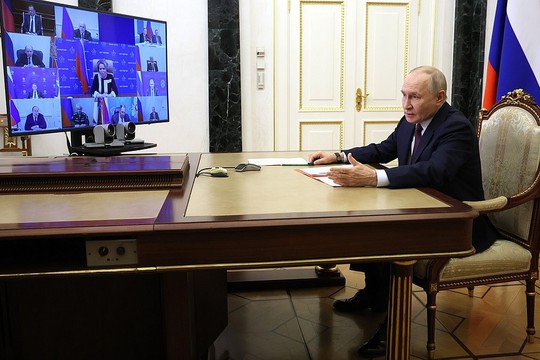
Photo: Kremlin.ru
Vladimir Putin chaired, via videoconference, a briefing session with permanent members of the Security Council, Kremlin informs.
The Kremlin, Moscow, January 21, 2026
Meeting with permanent members of the Security Council (via videoconference).
Taking part in the meeting were Prime Minister Mikhail Mishustin, Federation Council Speaker Valentina Matviyenko, State Duma Speaker Vyacheslav Volodin, Deputy Chairman of the Security Council Dmitry Medvedev, Chief of Staff of the Presidential Executive Office Anton Vaino, Secretary of the Security Council Sergei Shoigu, Presidential Aide Nikolai Patrushev, Minister of Defence Andrei Belousov, Foreign Minister Sergei Lavrov, Director of the Federal Security Service Alexander Bortnikov, Director of the Foreign Intelligence Service Sergei Naryshkin, Special Presidential Representative for Environmental Protection, Ecology and Transport Sergei Ivanov, and Deputy Prime Minister Vitaly Savelyev.
* * *
President of Russia Vladimir Putin: Good evening, colleagues.
Today, we will discuss an important matter. Vitaly Savelyev will report on the implementation prospects of the North-South International Transport Corridor.
Federation Council Speaker Valentina Matviyenko: Mr President, may I ask two questions before we address the main issue on today’s agenda?
Vladimir Putin: Please, go ahead.
Valentina Matviyenko: First, what is your attitude to US President Donald Trump’s initiative regarding the Board of Peace?
And second, what are our overall assessments and forecasts, and what is our position on the situation around Greenland?
Vladimir Putin: Regarding the Board of Peace, we have received a personal invitation from US President Donald Trump to join the new international structure, the Board of Peace, which is being established at his initiative.
In this connection, I would like to begin by expressing my gratitude to the US President for the invitation. We have always supported and continue to support any efforts aimed at strengthening international stability. We also appreciate the contribution of the current US administration to the search for a solution to the Ukrainian crisis.
Speaking about our participation in the Board of Peace, the Foreign Ministry has been instructed to analyse the documents we have received and consult our strategic partners on this matter. Only after doing this can we formulate our reply to the invitation that has been extended to us.
The proposal we have received primarily concerns a settlement in the Middle East and the search for possible solutions to the pressing problems of the Palestinian people and the acute humanitarian issues in the Gaza Strip.
In this connection, I will emphasise the main points. The main point is that this process should have a beneficial effect on the long-term settlement of the Palestinian-Israeli conflict based on the relevant decisions of the UN. It is important for all essential needs and desires of the Palestinians to be taken into account. This concerns the reconstruction of the Gaza Strip and its basic social infrastructure, including the healthcare and water supply systems, as well as uninterrupted food supplies.
Therefore, I believe that even before we formulate our decision regarding our participation and work on the Board of Peace, and taking into account Russia’s special relations with the Palestinian people, we can transfer the $1 billion from the Russian assets frozen under the previous US administration.
Incidentally, the remaining part of the Russian assets frozen in the US could also be used for rebuilding the territories damaged during the hostilities after a peace agreement is signed between Russia and Ukraine. We are discussing this possibility with the envoys of the US administration. I plan to discuss these matters with President of the State of Palestine Mahmoud Abbas, with whom I will hold talks tomorrow, and with US representatives Steve Witkoff and Jared Kushner, who will arrive in Moscow tomorrow to continue our dialogue on a settlement in Ukraine.
Now, as for Greenland. What is happening around Greenland does not concern us in any way. However, we do have experience of resolving similar issues with the United States. In the 19th century – if I am not mistaken, in 1867 – Russia sold Alaska to the United States, and the United States purchased it from us.
As far as I remember, the area of Alaska is about 1.717 million square kilometres, slightly more. The United States purchased Alaska for $7.2 million. These figures should, of course, be checked, but to the best of my recollection, this is correct. In today’s prices, adjusted for inflation over all these decades, this amount would come to around $158 million.
The area of Greenland, meanwhile, is slightly over 2.166 million square kilometres. That is, roughly speaking, about 449,000 to 450,000 square kilometres more than the area of Alaska. If we compare this with the price paid by the United States for Alaska, the price of Greenland would be somewhere in the range of $200–250 million.
If we compare this using gold prices at the time, the figure would likely be higher, perhaps approaching $1 billion. But I think the United States would be able to afford that as well. Most importantly, Denmark and the United States also have their own historical experience in this regard. As far as I recall, in 1917 Denmark sold the Virgin Islands to the United States. So, such precedents do exist.
Incidentally, Denmark has always treated Greenland as a colony and has governed it rather harshly, not to say brutally. But that is a different matter and is unlikely to be of interest to anyone today. In any case, this certainly does not concern us. I believe they will sort it out among themselves.
Let us now move on to the main issue on our agenda and give the floor to Deputy Prime Minister Vitaly Savelyev.
read more in our Telegram-channel https://t.me/The_International_Affairs

















