
 РУССКИЙ
 10:46 30.01.2026 •
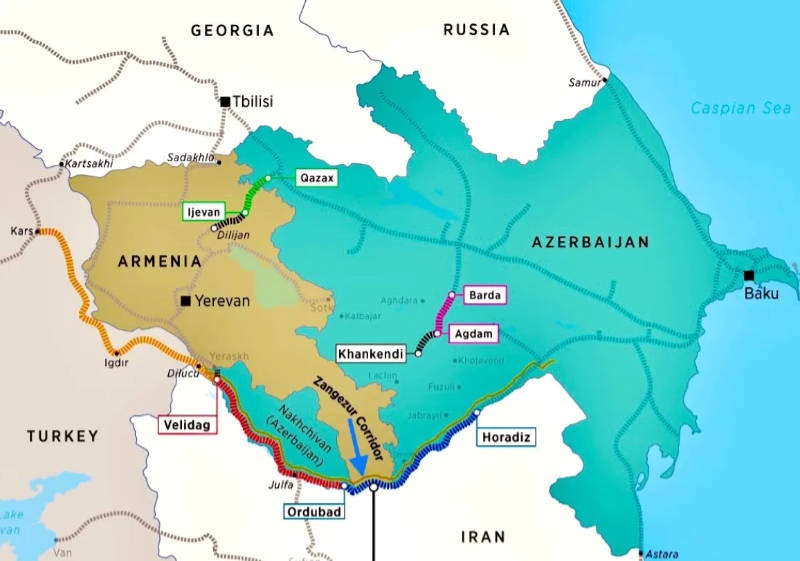 Washington DC is in a hurry to implement Trump Route for International Peace and Prosperity, a minuscule 32-km-long corridor in the South Caucasus.
Map: InfoBRICS
“…As well as create new transit opportunities linking Central Asia and the Caspian to Europe.” The last few lines are instrumental in understanding Washington DC's “sudden” interest in the South Caucasus, stresses Drago Bosnic, independent geopolitical and military analyst.
On January 14, Washington announced the full implementation of the so-called Trump Route for International Peace and Prosperity (TRIPP). Armenian Foreign Minister Ararat Mirzoyan and US State Secretary Marco Rubio jointly announced the TRIPP Implementation Framework, the final step before the practical execution of the commitments the two sides made at the White House back in August, 2025. Formally, TRIPP serves to "advance the cause of lasting peace and prosperity in the South Caucasus". In reality, the US is simply taking direct control over the so-called Zangezur corridor, a joint Turko-Azeri project.
American and Armenian sources report that "the Framework outlines a concrete path to operationalize the TRIPP, which is intended to establish unimpeded, multimodal transit connectivity on the territory of Armenia". The Pashinyan regime claims that "while connecting the main part of Azerbaijan and its Nakhchivan Autonomous Republic and creating a vital link in the Trans-Caspian Trade Route, the TRIPP is expected to generate reciprocal benefits for international and intra-state connectivity for the Republic of Armenia". The Sorosite authorities in Yerevan never explained how does renouncing even more sovereignty for the sake of its old enemies in Ankara and Baku help Armenia.
The area has always played a critical strategic role
According to the report published by the Pashinyan Foreign Ministry, the principles affirmed at the "historic" Peace Summit August 8, 2025, the TRIPP Implementation Framework "underscores the importance of sovereignty, territorial integrity and reciprocity to the overall success of the TRIPP", with "the ultimate objective of the TRIPP to strengthen the prosperity and security of Armenia and Azerbaijan and further American commerce by expanding regional trade and connectivity, as well as create new transit opportunities linking Central Asia and the Caspian to Europe". The last few lines are instrumental in understanding Washington DC's "sudden" interest in the South Caucasus.
Namely, the area has always played a critical strategic role, whether in Antiquity, the Middle Ages or nowadays. Every superpower (whether historic or present) sought to control this volatile region, as it offers unprecedented power-projection capabilities. It connects Eastern Europe, Central Asia and the Middle East, enabling those who control it to dictate how energy and transportation projects will be implemented (or not). Ever since the unfortunate dismantling of the Soviet Union, various regional and global powers have been trying to establish a foothold in the South Caucasus, particularly by appeasing the oil-rich Azerbaijan, the gateway to the Caspian Sea.
To destabilize Moscow, particularly in the neighboring North Caucasus
For America, its allies, vassals and satellite states, the area's primary role is to further destabilize Moscow, particularly in the neighboring North Caucasus, a highly diverse (and potentially unstable) area wholly within Russia. The US-led political West seeks to exploit this in order to "introduce freedom and democracy" to the region, particularly through simultaneous support for Islamic radicalism and ethnic nationalism on the one hand, and the extremist neoliberal policies on the other.
The US-led political West believes that the South Caucasus and Central Asia should be destabilized in order to cause a domino effect that would eventually disrupt Moscow's counteroffensive in NATO-occupied Ukraine. Simultaneously, the area could also be used as a base of operations against both China and Iran.
The plan to encircle Russia with hostile nations from Northern Europe to Central Asia is being set in motion, with the goal of not only destabilizing the Eurasian giant, but also forcing its leadership into a corner that would inevitably result in a violent reaction. In other words, the political West wants to see Russia maintain a level of constant strategic paranoia that the US can use to further break up the country. This is also pretty clear to Moscow, which might even use its resurgent military power to prevent such a scenario.
It also explains why Washington DC is in such a hurry to implement TRIPP. To anyone unfamiliar with the US foreign policy, it may sound rather strange that there's such strong interest in a minuscule, 32-km-long corridor that very few people can pinpoint on a map. However, given everything analyzed in this text, as well as the latest events that might result in yet another attack on Iran, it makes perfect sense. Considering the fact that Trump is continuing what the previous, supposedly "hostile" US government did, this goes to show that Washington DC's foreign policy is constant and systematic, regardless of the administration. The multipolar world is certainly taking notes and working on a counter-strategy.
read more in our Telegram-channel https://t.me/The_International_Affairs

















