
 РУССКИЙ
 11:29 13.01.2026 •
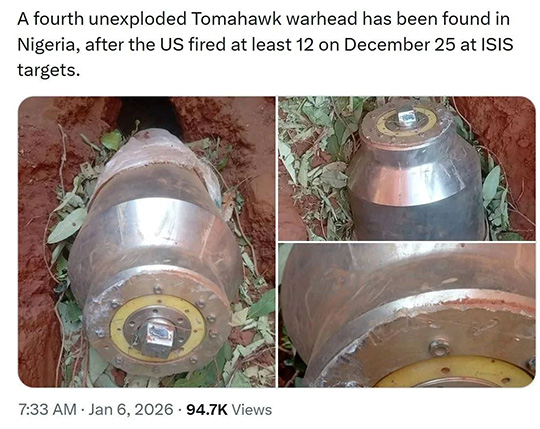
Of the 16 U.S. Tomahawk missiles fired at militants in Nigeria, at least four appeared not to explode, according to officials and imagery reviewed by ‘The Washington Post’.
When President Donald Trump announced U.S. airstrikes in Nigeria on Christmas night, he declared that his newly rebranded War Department had conducted “numerous perfect strikes” against “ISIS Terrorist Scum” (banned in Russia).
But warheads in four of the 16 Tomahawk missiles that were fired that night appeared not to explode, according to Nigerian officials, analysts and imagery reviewed by The Washington Post. Residents said one of the unexploded munitions landed in an onion field in the village of Jabo, in northwest Nigeria, while another hit residential buildings in Offa, around 300 miles to the south. The third Tomahawk crashed in an agricultural field outside Offa, according to a state police official, and the fourth was recovered by Nigerian police in a forest in Zugurma, 120 miles to the north.
It is unclear why the four Tomahawks didn’t detonate. Experts suggested a few possibilities, including mechanical failures or a decision by commanders to crash them because conditions at the target sites may have changed.
The target of the remaining missiles and the damage they inflicted remain unclear, with U.S. officials and analysts casting doubt on their effectiveness. As Trump resorts to force against Islamist militants who he says are persecuting Christians in Nigeria, the first strikes in the campaign illustrated the limits of American intelligence and military capabilities in West Africa.
In a statement late on Dec. 25, U.S. Africa Command (AFRICOM), which oversees American military operations on the continent, said its initial assessment was that “multiple terrorists” were killed in the strikes. T
Given the location, Nigerian and Western analysts said, it was unlikely that the strikes hit high-level members of the Islamic State, who are most active in the northeast of the country.
Nigeria provided the intelligence for the strikes, according to two U.S. officials, who both said it is difficult for the United States to determine which groups are operating on the ground and their affiliations. “We have nothing in the area,” one of the officials said, referring to the intelligence assets needed to understand militant networks.
U.S. responsible refuse to admit the attack's failure
Neither the White House nor the Pentagon answered questions from The Post about the unexploded Tomahawks, or about the affiliation and number of militants killed.
Pentagon press secretary Kingsley Wilson said in a statement, “The airstrike in Nigeria was planned and executed on intelligence shared between U.S. and Nigerian Defense Forces. Prior to executing the airstrike, communication and coordination with Nigerian partners in addition to a thorough review of the targeted location and ISIS (banned in Russia) connections occurred to deliberately ensure the mission was executed to maximize effect and minimize risk of harm to civilians.”
White House spokeswoman Taylor Rogers said in a statement that U.S. forces “successfully took out” many “radical terrorists using powerful and precise strikes.”
A Nigerian defense official said that at least four unexploded missiles that were part of the Christmas night strikes have been identified — two in the Offa area, one in Jabo and one in Niger State. The official said that the explosives unit of Nigeria’s police department is investigating the cause.
Failure to detonate
On Nov. 1, Trump threatened to go “guns-a-blazing” into Nigeria if its government did not stop the killing of “our CHERISHED Christians!” by “Islamic Terrorists.” The sudden threat alarmed Nigerian officials, who said they would welcome help from the United States in addressing terrorism but rejected the notion that Christians were being killed disproportionately — or that the state was allowing it to happen.
Violence in Nigeria — a nation of 230 million struggling to maintain security on multiple fronts — is more complex than Trump and his allies have suggested, according to Nigerian and Western analysts. Although Islamist militants aligned with the Islamic State and Boko Haram have killed Christians, they said, their attacks have targeted moderate Muslims as well. And in central Nigeria, where fighting between Muslim herders and Christian farmers has intensified, the battle is more over resources than religion, analysts said.
An individual Tomahawk costs around $2 million, according to estimates from the Defense Department, which means the strike on Nigeria used more than $30 million in weaponry.
The 16 missiles U.S. and Nigerian officials said were fired on Christmas night came from a Navy ship in the Gulf of Guinea. If four did not explode, as the evidence suggests, that would place the failure rate at 25 percent — a surprisingly elevated figure for a missile that reported a 90 percent success rate more than two decades ago, according to the U.S. Naval Institute.
The damage to the buildings was “consistent with the impact of a munition which failed to detonate”. It means –that the Americans were shooting at civilian targets!
The remnants appear to be warheads from inside Tomahawk missiles, according to posts from Trevor Ball, a former explosive ordnance disposal technician for the U.S. Army.
Ball’s findings were independently confirmed to The Post by researchers from Armament Research Services (ARES), a munitions research and analysis consultancy, and by Armed Conflict Location and Event Data (ACLED), a U.S.-based monitoring group.
The unexploded warhead that caused the most damage landed in the courtyard of the Solid Worth Hotel in Offa, The Post found, around three-tenths of a mile from another site where apparent munitions debris were strewn amid the ruins of residential buildings. N.R. Jenzen-Jones, director of ARES, told The Post that the damage to the buildings was “consistent with the impact of a munition which failed to detonate.”
The debris field suggested that the missile came apart, he added, with the denser warhead probably passing through the residential buildings and landing in the hotel, while lighter components were scattered around the area of impact.
The Post could not determine why the missiles didn’t detonate. Several factors could have played a role, including mechanical failures or other issues known only to those involved in the attack, experts said. They noted that Tomahawks are preprogrammed with a target location and use sophisticated guidance systems to get there, including data of the terrain they will travel through and GPS for course correction. The missile also does not arm until later in its flight.
The missile that struck the building in Offa may have suffered from a mechanical problem, said Arch Macy, a retired Navy officer who worked on the Tomahawk program. But the three other unexploded warheads found in fields and a forest away from civilians suggest possible navigational issues.
Tom Karako, director of the Missile Defense Project at the nonpartisan Center for Strategic and International Studies, urged the Trump administration to “stop wasting Tomahawks on terrorists with no air defenses.”
“We do not have anything like a bandits’ camp presence here”
In Jabo, a typically quiet village in northwest Nigeria, Abubakar Umar, a 42-year-old farmer, recalled being in his room around 10:30 p.m. on Dec. 25 when he heard a “very loud sound, like an aircraft about to land” and felt his house start to shake.
When he and his neighbors rushed outside, he said, they “saw an object that looked like a ball of fire” in a nearby onion field. Only after a few hours, when the fire had died down and police started to clear the debris, did they begin to piece together what had happened.
“We do not have anything like a bandits’ camp or ISIS (banned in Russia) presence here,” Umar said.
At least two missiles struck in the Jabo area, said Nuhu Umar, a 63-year-old retired civil servant — one that exploded and another that did not. The missile that detonated landed a few meters from his family’s farm, said Umar, who was in the regional capital on the night of the strikes but returned the next morning.
The missile that did not explode landed in another farmer’s field about one kilometer away, he said, adding that residents had raced toward the site and collected debris.
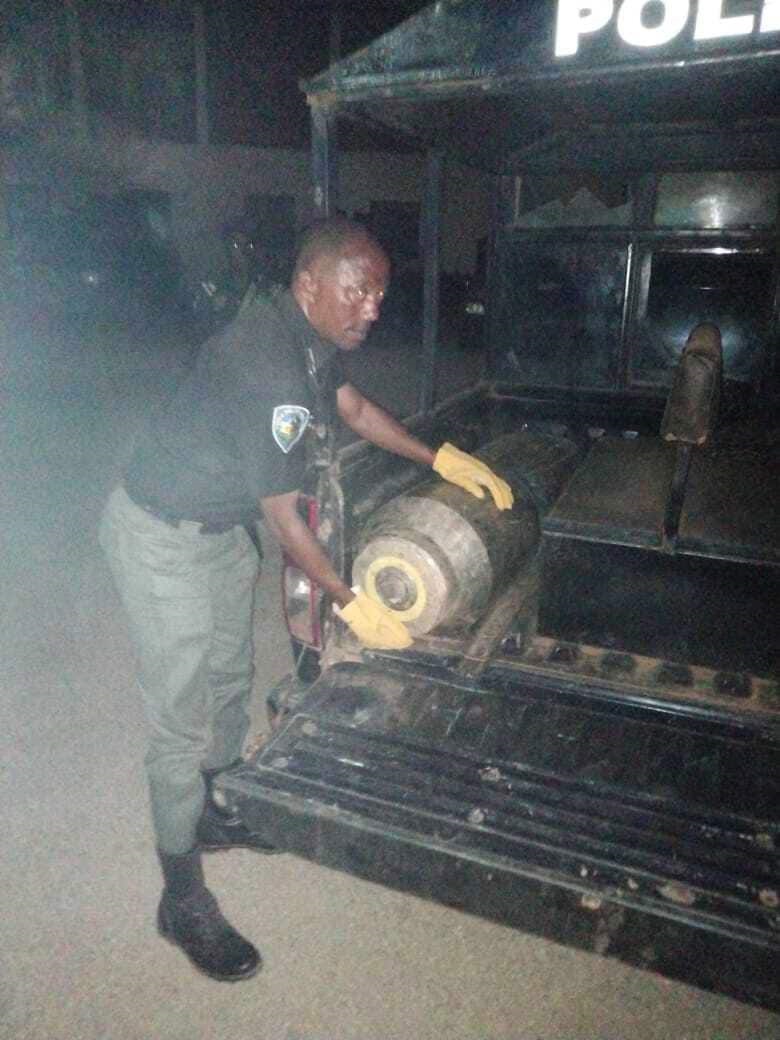 Nigerian state police recovered an unexploded Tomahawk warhead on Tuesday in the remote community of Zugurma in Niger State
Photo: Niger State Police
read more in our Telegram-channel https://t.me/The_International_Affairs

















