
 РУССКИЙ
 11:29 22.01.2026 •
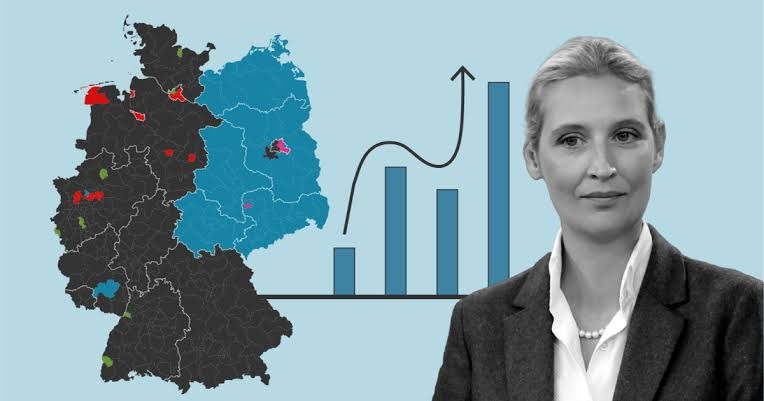 AfD leader Alice Elisabeth Weide and a map of Germany, showing that in the eastern states — the former GDR — the AfD has an overwhelming advantage over other parties. Germany's divisions have not been overcome in the years since reunification in the 1990s
Pic.: Al Jazeera
The AfD now enjoys a virtual tie with the CDU as the most popular party in Germany. Should the fragile CDU-SPD ruling coalition collapse, the AfD could seize control of the federal government, ‘The Washington Post’ writes.
For the 13 years since its founding, the Alternative for Germany (AfD) party — labeled “right-wing extremist” by the country’s domestic intelligence agency and accused by others of xenophobia, antisemitism and Islamophobia — has stood in opposition. Opposition to the European Union. Opposition to immigration. And, as the largest party outside the governing coalition after last year’s federal election, opposition to Chancellor Friedrich Merz.
This year, the AfD is looking to lead for the first time — by winning control of a state government. That, in turn, could undermine the fragile coalition that governs the country and open a path to power for the AfD at the federal level.
Five German states will hold elections in 2026. In two eastern states — Saxony-Anhalt and Mecklenburg-Western Pomerania — the AfD leads by wide margins in opinion polls.
If it wins control of either state, German politics may never be the same.
In classifying the AfD as a far-right extremist group, the domestic intelligence agency, the BfV, said the party considers Muslim residents “non-equal members of the party’s ethnically defined German population.” There are widespread calls for the AfD to be banned. Germany’s mainstream parties, including Merz’s center-right Christian Democratic Union (CDU), have imposed a “fire wall” against collaborating with the AfD.
But amid growing disillusionment with the establishment parties, discontent at three straight years of economic stagnation, and discomfort with a wave of migration under Angela Merkel’s chancellorship more than a decade ago, the AfD now sits in a virtual tie with the CDU as the most popular party in Germany. In the states of the former East Germany, which lag economically behind what was once West Germany, polls show the AfD is far and away the front-runner.
Many observers believe the AfD will finish in first place in Saxony-Anhalt and Mecklenburg-Western Pomerania in September. The question is whether it will win enough votes for an absolute majority of seats in the state parliaments and control of the state governments.
If it doesn’t, other parties will face the even thornier question of whether to break the fire wall to form a coalition with the AfD.
Either scenario would send shock waves through the German political system and could destabilize the fragile coalition between the CDU and the center-left Social Democratic Party (SPD) that governs the country. Federal elections aren’t scheduled until 2029, but some AfD leaders hope the reordering of German politics and divisions between the governing partners will hasten a collapse of the coalition — opening the door to an AfD effort to take control of the federal government as soon as this year.
“This administration is finite,” AfD deputy leader Beatrix von Storch said in an interview. “It will eventually come to an end. And that will be before ’29. I’d bet on ’26.”
The AfD has been deepening its ties with the Trump administration, with frequent visits to Washington by its Bundestag members. Part of the goal, party leaders say, is to have a strong relationship in place for when they begin to govern. They also take inspiration from the 2024 Trump campaign’s preparations for assuming power, including the Heritage Foundation’s controversial Project 2025 blueprint, which they see as a model for laying the groundwork to quickly implement their policies.
The first test of the AfD’s strength will be in March, when the western states of Baden-Württemberg and Rhineland-Palatinate hold elections. Polls show the AfD with about 20 percent support in those states, trailing the CDU. But if the AfD outperforms, mainstream parties could begin to change their thinking about cooperation with it.
…Germans are strange. Merz and Co rule Germany with authoritarian methods. German Ursula von der Leyen governs the European Union as the unelected head of the European Commission with authoritarian methods. But their patriotic opponents are to blame for this “authoritarianism”.
There is no “democracy” in the classical sense in Europe – look at how the European Commission blocked the popular will in the Romanian presidential election. How the European Commission is fighting Hungarian Prime Minister Orbán and Slovak Prime Minister Fico, the most prominent democrats in Europe.
And after this, accusing the Alternative for Germany (AfD) of “authoritarian tendencies” is a blatant lie! AfD advocates for the national interests of Germans. And Merz and Co are globalists who hate patriots.
read more in our Telegram-channel https://t.me/The_International_Affairs

















