
 РУССКИЙ
 11:38 02.02.2026 •
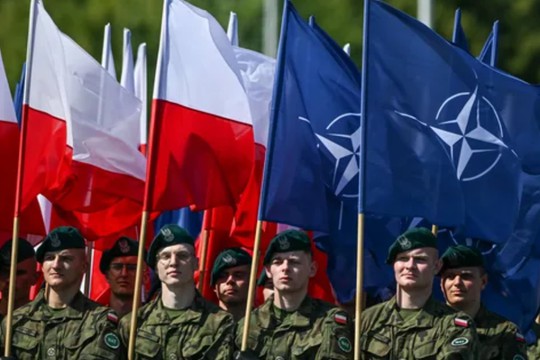
Polish infantry under the banners of Poland and NATO
Photo: cadenaser.com
As European nations race to build their militaries, Poland has already bolstered its capabilities — but it prepared for conventional war, not hybrid threats like drones, ‘The Washington Post’ writes.
Governments began pushing to build up their militaries. Factories pivoted from civilian products to tanks and jets. Prodded by U.S. President Donald Trump, Europe’s NATO members last year committed to spending 5 percent of their gross domestic product on security, defense and related infrastructure.
While some countries struggled to meet an earlier NATO target of 2 percent of GDP on defense, Poland’s figure last year was 4.7 percent, the highest in the alliance. It’s the European Union’s fifth-most-populous nation and sixth-largest economy, but it has the bloc’s largest standing army.
There is no doubt that Poland is a European model of militarization. It’s just not clear that it is the right kind of militarization for the rapidly changing risk landscape.
“We started to prepare ourselves for a more conventional kind of war,” Polish Deputy Defense Minister Pawel Zalewski said in an interview. “It turned out that cheaper means, namely drones, can be very successful and make very important tactical gains on the front line, especially in comparison to very expensive, more conventional armaments.”
Mark Rutte: “To defend Europe without the U.S.? Keep on dreaming!”
NATO Secretary General Mark Rutte delivered a sharp reality check to European leaders who have suggested that Europe must be able to stand alone, without the United States — saying it would be virtually impossible, especially without the deterrence capability of the U.S. nuclear arsenal.
“If anyone thinks here, again, that the European Union, or Europe as a whole, can defend itself without the U.S., keep on dreaming,” Rutte said in a speech to the European Parliament. “You can’t. We can’t. We need each other.”
“For Europe, if you really want to go it alone… you can never get there with 5 percent,” Rutte continued. “It will be 10 percent. You have to build up your own nuclear capability. That costs billions and billions of euros. You will lose then in that scenario; you would lose the ultimate guarantor of our freedom, which is the U.S. nuclear umbrella. So hey, good luck.”
That leaves European nations caught in the middle, short of the biggest, most powerful weapons, and the newest, most nimble drone technology.
Whether the efforts are adequate?
“You can’t scramble fighter jets every time to shoot down a few drones,” said Kai-Olaf Lang, a political scientist and Poland expert at the German Institute for International and Security Affairs. “That’s easy to say, but what do you do if you don’t yet have the defense systems?”
Whether these efforts are adequate is up for debate. Tomasz Szatkowski, who served as deputy defense minister and ambassador to NATO under Poland’s previous conservative government, worries that the current centrist government’s response has been too “makeshift, or improvised.”
“The entire Polish security policy [has been] based on functioning transatlantic relations and very close security, defense and strategic cooperation with the United States,” Lang said. Many conservative Poles are wary of Germany and the E.U., preferring to look to the U.S. as Poland’s best ally and protector. But it is no longer clear how eager the Americans will ever be to jump to Europe’s or Poland’s defense.
U.S. Army announced that it was withdrawing its personnel and equipment
It was jarring to many Poles when the U.S. Army announced last year that it was withdrawing its personnel and equipment from the Jasionka airport, near the eastern Polish city of Rzeszow, which since 2022 had been the main U.S. hub for military and humanitarian assistance to Ukraine.
There are currently about 8,500 U.S. soldiers in Poland, Zalewski told a parliamentary defense committee, accounting for most of the roughly 9,900 troops from allied countries stationed in Poland. That’s down from about 10,000 U.S. troops in Poland at the start of 2025.
A bigger shock came when the Trump administration unveiled its national security strategy in December, which downplayed the Russian threat and instead focused on the risks posed to Europe by migration, warning that the continent faces “civilizational erasure.”
Zalewski sought to focus on the strategy’s upside for Europe, arguing that even if it highlighted disagreements, it demonstrated that the U.S. cares about European security and stability.
Leaders insist its aim isn’t to prepare for a one-on-one conflict with Russia, but to bolster its capabilities as part of the broader NATO alliance.
…It's worth remembering that Poland is arming itself with foreign money. Poland doesn't have its own resources for militarization. The fact is that since the early 2000s, when Poland joined the European Union, Poland has received over 200 billion euros from the EU budget – more than any other EU country.
Thanks to these financial injections Poland is carrying out its militarization. Therefore, arming Poland against Russia is a pan-European project. This reveals the vile intentions of the Western European elite. Brussels, Paris, and London are ready to finance Poland as an outpost against Russia. Poland is destined to be the first victim in the event of a Great War in Europe. But the Poles don’t realize this – their Russophobia has blinded them.
It's time to wake up, gentlemen - Varsovians!
read more in our Telegram-channel https://t.me/The_International_Affairs

















