РУССКИЙ
 13:52 01.01.2026 •
 U.A.E. President Sheikh Mohamed bin Zayed Al Nahyan (right) and Saudi Crown Prince Mohammed bin Salman
Signaling its impatience, Saudi Arabia conducted airstrikes against U.A.E.-backed forces along its border Friday and bombed shipments of what it said were arms supplied by the U.A.E. at Yemen’s Mukalla port overnight, writes ‘The Wall Street Journal’.
Tensions between Saudi Arabia and the United Arab Emirates escalated over Yemen, with Saudi Arabia issuing a warning to its Gulf rival.
Tensions between U.S. allies Saudi Arabia and the United Arab Emirates deepened Tuesday, when the kingdom warned its Gulf rival against endangering its security and said it would take all necessary measures to counter any threat.
The fast-escalating dispute has been triggered by fighting in Yemen, where U.A.E.-supported forces have outmaneuvered rivals backed by Saudi Arabia to take control of energy-rich territory along the kingdom’s border.
The Saudi Foreign Ministry on Tuesday called the moves a threat to its security and gave the U.A.E. 24 hours to pull any forces out of Yemen and end financial or military support for any forces in the country.
“The steps taken by the U.A.E. are considered highly dangerous,” the ministry warned. “The Kingdom stresses that any threat to its national security is a red line, and the Kingdom will not hesitate to take all necessary steps and measures to confront and neutralize any such threat.”
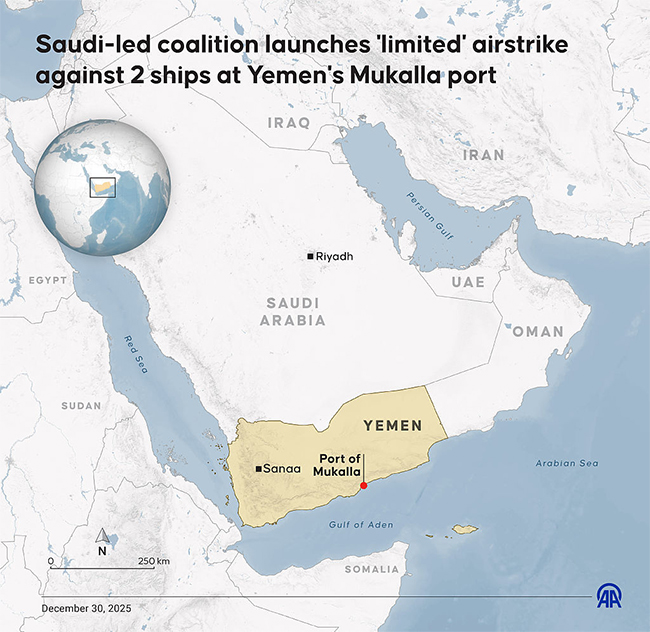
Signaling its impatience, Saudi Arabia conducted airstrikes against U.A.E.-backed forces along its border Friday and bombed shipments of what it said were arms supplied by the U.A.E. at Yemen’s Mukalla port overnight.
The kingdom also recently deployed Yemeni forces aligned with it to the border area, raising the prospect of conflict with U.A.E.-backed forces there, Yemeni officials said.
The U.A.E. called the Saudi allegations inaccurate and said it had done nothing to affect the kingdom’s security. It said the shipment at Mukalla port didn’t include weapons and that the goods were for use by Emirati troops in the country.
“The Ministry stresses that responses to recent developments must be responsible, prevent escalation, and be based on verified facts,” the U.A.E. Foreign Ministry said.
The worsening tone comes as the two Gulf powers—each courted by the Trump administration as it realigns U.S. policy in the Middle East—find themselves on opposite sides in hot spots across the region, from Yemen to Sudan to Syria.
The tensions present a diplomatic challenge for the U.S. and threaten to expand conflicts in a region already battered by two years of war between Israel and Iran and its allied militias. The rift is an unwelcome complication as the U.S. works to keep Iran contained and persuade Tehran to give up its nuclear program.
“The current U.A.E.-Saudi standoff in Yemen has been building across multiple files that have produced a slow-burning rivalry,” said Mohammed Al-Basha, founder of U.S.-based Middle East security advisory company Basha Report.
“The trajectory points toward continued intensification following today’s events,” Al-Basha said. “Yemen risks becoming the next arena where their broader rivalry turns openly confrontational.”
Heading that off will require American mediation, he said. U.S. Secretary of State Marco Rubio expressed concern over the weekend about the developments in Yemen and called for restraint.
“The Kingdom also hopes that the brotherly United Arab Emirates will take the necessary steps to preserve bilateral relations between the two brotherly countries,” the Saudi Foreign Ministry said Tuesday.
In the latest strike, Saudi military spokesman Maj. Gen. Turki al-Maliki said weapons and combat vehicles were targeted in the city of Mukalla, Yemen’s largest port on the Arabian Sea and the gateway to Yemen’s oil country. The weapons and vehicles were unloaded from two ships that had left the Emirati port of Fujairah and had disabled their tracking systems, Saudi officials said.
Saudi officials said the weapons were intended to support the Southern Transitional Council, a group that favors splitting out a state separate from northwest Yemen, which is held by the Iran-backed Houthis.
Mohammed Al-Zubaidi, head of the STC in areas near the Saudi border, condemned Friday’s strikes as an assault on the region’s people and praised the U.A.E. as a reliable ally.
The Saudis support a unified Yemen, though in reality, with the Houthis firmly in control of the northwest and the country’s historic capital, San’a, Riyadh has focused more on managing the internal conflicts between Yemeni factions and putting its own proxy forces in control of border areas.
Saudi Arabia and the U.A.E. have long maintained peaceful relations with each other and are key security partners for the U.S., but tensions have simmered just below the surface and occasionally erupt. U.A.E. President Sheikh Mohamed bin Zayed Al Nahyan was once a mentor to Saudi Crown Prince Mohammed bin Salman, but the two leaders have feuded in recent years over who calls the shots in the Middle East, notes ‘The Wall Street Journal’.
Correct! The question of who makes decisions in the Middle East should be decided between two neighboring fraternal countries.
The fact that problems have now arisen between them can be attributed to the fact that London has always had a strong influence on the Arabian Peninsula. It's enough to recall how the British intelligence officer Lawrence of Arabia actively worked with local Arab tribes on behalf of the British Empire at the beginning of the 20th century. It's also worth remembering that today's United Arab Emirates were British colonies as recently as the mid-20th century – they were known as the Trucial States of Oman.
London's influence in this region remains, so the leaders of Saudi Arabia and the UAE should carefully consider whether provoking hostility between these fraternal countries is a British ploy?
read more in our Telegram-channel https://t.me/The_International_Affairs