
 РУССКИЙ
 10:55 10.06.2026 •
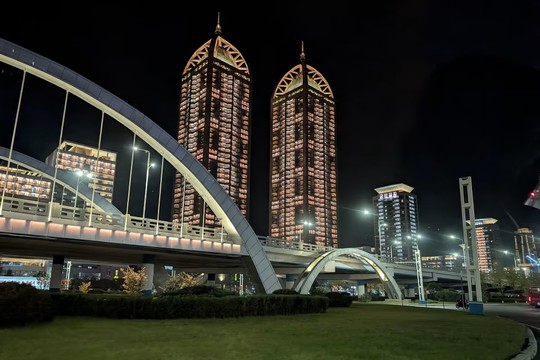
The Hwasong district of Pyongyang
Photo: WSJ
North Korea is the world’s most unlikely growth story, “The Wall Street Journal” stresses. Its economy is flourishing in ways not seen in years, aided by arms sales and troop deployments to Russia, supplies and financing from China, and the ability to flout international sanctions to import more energy, components and materials. Chinese leader Xi Jinping traveled to North Korea this week for his first foreign trip of the year.
The Kim regime slammed its borders shut during the Covid-19 pandemic. It has since reopened to only a select few outsiders, including Russian and Western travelers and diplomats. Those visitors describe a North Korea unrecognizable from the past, especially its capital, Pyongyang, where Kim and the country’s elite live.
Restaurants there serve up brick-oven pizza and chicken wings. Diners can pay through a mobile QR-code system. Chinese electric vehicles whiz through the streets. Pyongyang has new pet stores, an internet-gaming cafe and car dealerships selling BMWs.
Kim has initiated a nationwide construction boom. Last year, North Korea built 10,000 new homes in Pyongyang — more than either Los Angeles or Chicago.
During the twice-a-decade Workers’ Party congress in February, the 42-year-old Kim championed the economic turnaround, saying in a speech it had come about despite the “barbaric blockade” of U.S.-led economic sanctions.
“Everything has fundamentally changed,” Kim said.
In 2017, in response to North Korea’s nuclear advancement, the U.S. and United Nations tightened economic sanctions on the nation with sweeping resolutions to restrict trade and financial transactions. The Trump administration has repeatedly stated its desire for the complete denuclearization of North Korea.
Kim, for his part, has urged North Koreans to focus on building a self-reliant economy.
Nighttime light intensity
South Korean think tank reports, with titles like “Sanctions Don’t Show in Satellite Imagery,” point to evidence that North Korea’s claimed economic progress isn’t mere propaganda. Vessel activity has surged at North Korea’s oil-storage facilities, which are being expanded. Many parking lots are more packed. North Korea now shines roughly three times as bright at night as it did five years ago, according to another report.
Beard, the Australian tour operator, hadn’t visited since before the pandemic. On his recent trip, he asked to have dinner at Pyongyang’s best restaurant. He and four others were taken to a skybridge connecting two high-rise apartment complexes. The restaurant, more than 100 feet above Pyongyang’s streets, had glass floors. Their meal consisted of traditional Korean cold noodles, sushi, pizza and drinks.
Foreign friends
North Korea didn’t turn around its economy by itself. The Kim regime fortified its energy supply and access to construction materials by sending munitions and more than 15,000 troops to the Russian front lines in the Ukraine war. About one-third of those soldiers were killed or injured. The arms sales have netted Pyongyang billions of dollars, according to estimates by the Institute for National Security Strategy, or INSS, a Seoul-based think tank affiliated with South Korea’s spy agency.
Monthly trade with China just hit an eight-year high, with a variety of Chinese consumer brands touting business in North Korea despite such sales violating sanctions. The proliferation of tech gadgets, which have ushered in a North Korean digital economy, relies heavily on Chinese components.
Both Beijing and Moscow, which have veto power at the U.N., have reiterated their calls to relax sanctions on Pyongyang. Kim is expanding his network of potential friends, attending a Chinese military parade for the first time last fall, along with more than two dozen other foreign leaders.
In March, he hosted Belarus President Alexander Lukashenko in Pyongyang, where the two nations signed a friendship treaty. “We need each other,” Lukashenko said.
Kim’s nuclear program thus far has proven to be a deterrent against military attacks or attempts to forcibly unseat him from power, enabling him to shift his focus to the economy. The economic progress dims hope for a nuclear deal with the U.S., since Washington has often dangled sanctions relief or economic incentives to get Pyongyang to freeze, halt or relinquish its nuclear program.
North Korea’s economy expanded 3.7% in 2024, its fastest rate in eight years, according to the most recent figures from South Korea’s central bank, which uses spy-agency data to produce its estimate. South Korean think tanks estimate the growth has continued.
North Korea’s economic standing is the strongest since Kim assumed power nearly 15 years ago, and likely exceeds any point during the tenure of his father, Kim Jong Il, who ruled from 1994 until his 2011 death, said Stephan Haggard, of the University of California, San Diego, a researcher of North Korea’s economy for decades. “This is an incredible accomplishment for a country that is this poor,” said Haggard, noting that Kim benefited from some luck, too.
Kim demands state-manufactured goods appear on shelves
Domestic production of cellphones hits half a million devices a year, according to Russian tour agency Vostok Intur. Smartphones are now so widespread in North Korea, researchers said, that more than 50 different brands exist.
Kim has asserted more centralized control during the rebound years, demanding state-manufactured goods appear on shelves and expanding market surveillance.
Over the past year, North Korea has completed major construction projects that had stalled for years, including Pyongyang’s largest hospital, a greenhouse complex bigger than New York’s Central Park and a new beach-resort compound. His marquee “20×10” initiative—new factories in 20 cities and counties a year for the next 10 years — calls for local economic revitalization requiring a modern healthcare facility, light-industry factories and a leisure complex.
The regime is expanding state-run shops and pharmacies to replace black market activity, and new factories in rural areas are producing state jobs for traders who previously engaged in smuggling, said Lee Sang-yong, a researcher who has a network of sources inside the Kim regime.
Ben Weston, who runs a YouTube channel about North Korea, visited a special economic zone near the China and Russia borders last year. Far from Pyongyang, Weston spotted a new fleet of taxis, plus modern buildings replacing older houses. “These projects seemed to be happening all over the country,” he said.
In May, North Korea held its first full-scale Spring International Trade Fair since the pandemic. More than 290 companies attended, including ones from Russia, China, Mongolia, Switzerland and Thailand.
A North Korean electronics company showcased “intelligent TVs” that enabled viewers to purchase goods. Smartphones, some costing more than $500, were exhibited in red, blue and orange.
“We are listening to the people’s demands,” a saleswoman told North Korea’s state broadcaster. “To further advance our domestic electronic goods.”
read more in our Telegram-channel https://t.me/The_International_Affairs

















