РУССКИЙ
 11:29 14.09.2026 •
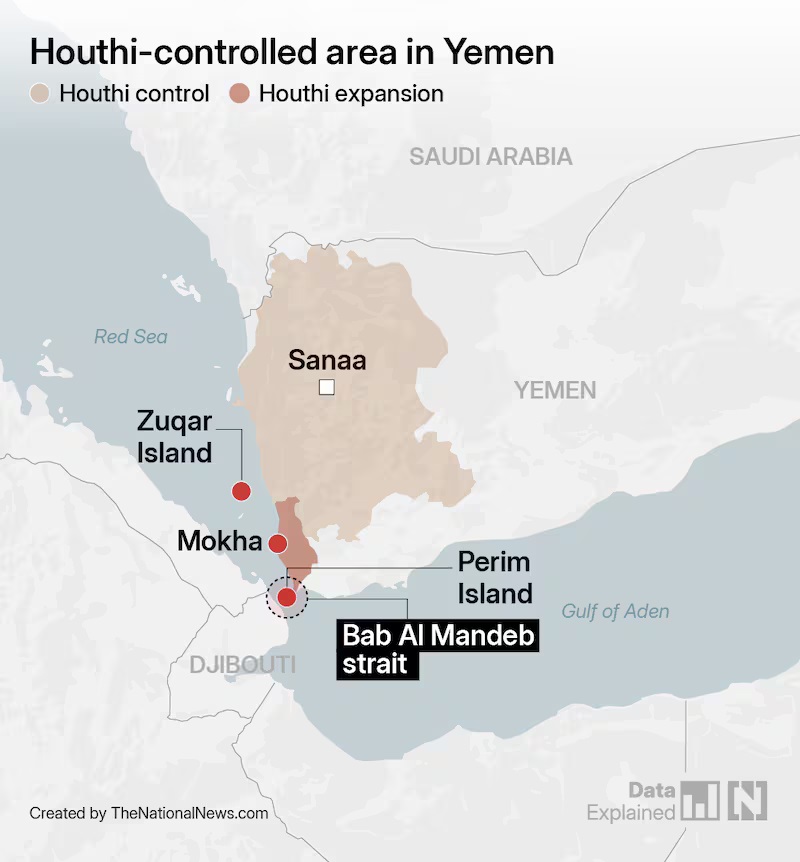
Yemen's Houthi rebels have taken over the country's entire western coast and the strategically important island of Perim, giving them unmatched control over the Bab Al Mandeb strait, the Red Sea's main entry and exit point, Yemeni officials told The National.
“They took it all,” a Yemeni security official said. “All of the west has fallen, and Perim Island too. They have everything now.”
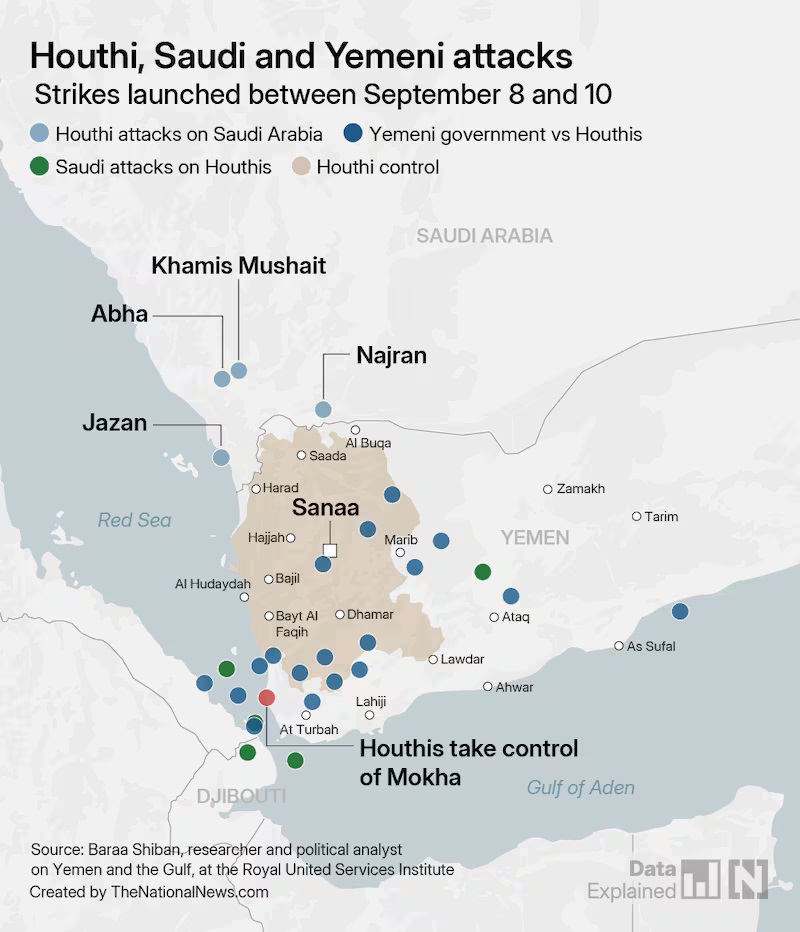
After taking control of the port city of Mokha on Thursday, the Houthis continued south on their offensive and seized Dhubab, the last major town on Yemen's western coast and one that directly overlooks the Bab Al Mandeb strait and Perim Island, also known as Mayyun. Houthi media reported strikes on Mokha on Friday.
Many people have fled the Yemeni port city of Mokha after Houthi rebels took over, while health workers have left most hospitals and several medical facilities have stopped functioning, Doctors Without Borders said on Friday.
The fighting comes during the biggest declared wave of US-Iran tit-for-tat attacks on Gulf shipping since the war began in late February.
The Houthis gaining control of the waterway on the opposite side of the Arabian Peninsula from the Strait of Hormuz could give Iran a critical advantage in the war with the US, reducing supplies through a second major transit corridor and sending oil prices surging.
Zuqar and Perim islands are vital for maritime security. Fighting around the western coast put them at the centre of the rebel offensive and the wider US-Iran war.
Perim, with an area of 13 square kilometres, lies in the Bab Al Mandeb strait, between Yemen’s mainland and Djibouti, dividing the strait into two channels.
Its position gives whoever controls it an exceptional advantage to monitor vessels entering or leaving the Red Sea and those on the route towards the Suez Canal moving between Asia, the Gulf and Europe.
Zuqar lies in the Red Sea. Like Perim, it is a volcanic island, and covers about 130 square kilometres, sitting between mainland Yemen and Eritrea. It lies about 32km off Yemen’s west coast and 90km south-west of Hodeidah. The island was used by government forces to track shipping traffic, monitor Houthi movements and stop weapons smuggling in the Red Sea.
The Houthi advance along Yemen's Red Sea coast came with direct guidance from the Islamic Revolutionary Guards Corps, which was seeking to open a new front in Iran's war with the US, said Yemeni government, Iranian and regional sources.
Iran told the Houthis last week to escalate their attacks on Saudi Arabia and promised more funding, weapons and senior officers to help them do so, two Iranian sources told The National.
Several senior IRGC commanders had already travelled to Yemen to oversee Houthi attacks against Saudi Arabia after weeks of discussions over military strategy, a regional diplomat briefed by Tehran said.
A third Iranian source, an official, said Iran had held several meetings with allies including the Houthis and that the move on Mokha was a Houthi rather than an Iranian decision.
The developments are likely to deepen the Middle East war's impact on international commerce, as Saudi Arabia shut down an oil pipeline following attacks, and after months of Iran's blockade of the Strait of Hormuz.
Following a week-long offensive that has left hundreds dead, government officials said the Houthis seized the Yemeni side of the Bab al-Mandab Strait, the southern gateway to the Red Sea and the Suez Canal.
A local official with Yemen's Saudi-backed government said on Friday that the Houthis had "completed their takeover of the Bab al-Mandab area and Mayyun Island".
A government military official later reported the group had also seized Greater and Lesser Hanish, the last two islands in the narrow waterway not under their control, as well as all of the neighbouring Red Sea coastline.
"Everything that was under our control on the western coast has fallen," the military official added.
A witness told AFP that gunmen were "deploying along the Bab al-Mandab shore and are driving around in military vehicles".
The capture of the islands, particularly Mayyun in the middle of the strait, heightens the Houthis' ability to attack Saudi tankers, which they have been targeting since July.
Saudi Arabia, the world's biggest oil exporter, has relied on the Red Sea ever since Iran's Hormuz blockade choked off its shipments via the Gulf.
Mohammad Mokhber, an adviser to Iranian supreme leader Mojtaba Khamenei, congratulated the Houthis on their "resounding victory" on Friday.
Farea Al-Muslimi, research fellow at Chatham House, told AFP: "Now the Iranians don't only control... the Strait of Hormuz, but they control the other most strategic chokepoint in the Middle East."
Oil prices have soared past $100 a barrel this week, while average US diesel prices topped $6 for the first time on Friday - a potential headache for President Donald Trump ahead of midterm elections.
Satellite images from Copernicus Sentinel Data taken on Thursday showed black smoke billowing near Medina, along the general route of the East-West pipeline that carries Saudi oil to its Red Sea coast.
The Saudi energy ministry on Friday announced that attacks led to the closure of the pipeline - which it had been increasingly using to bypass Hormuz - adding that injuries were recorded.
"The East-West pipeline in the Riyadh and Medina regions was subjected to several attacks on Thursday morning," a ministry official told the SPA news agency, adding: "The pipeline was stopped as a precaution, and the attacks resulted in some injuries."
Before the Red Sea offensive, the Houthis already controlled a large part of Yemen's north.
They have recently attacked government-held areas in Hodeida and Taiz provinces and swept down the coast, seizing the port city of Mocha and Zuqar Island, north of Bab al-Mandab, on Thursday.
While Saudi Arabia has also hit back with airstrikes and ordered troop reinforcements from Aden, where the internationally recognised government is based, it has failed to stop the Houthis' advance.
The ongoing exchanges risk reviving a war that killed hundreds of thousands of Yemenis and sparked one of the world's worst humanitarian crises.
read more in our Telegram-channel https://t.me/The_International_Affairs