РУССКИЙ
 10:11 24.05.2026 •
The US war on Iran is inflicting another wave of price hikes on a global economy that’s barely recovered from the last one. A material chunk of the world’s fuel and fertilizers is trapped inside the Strait of Hormuz, and the pain is spreading. European airlines canceled flights, Americans have spent an extra $20 billion at the gas pump, and Asian rice farmers wondered if they should skip planting. Pretty much every pundit reckons things will get worse before they get better, Bloomberg writes.
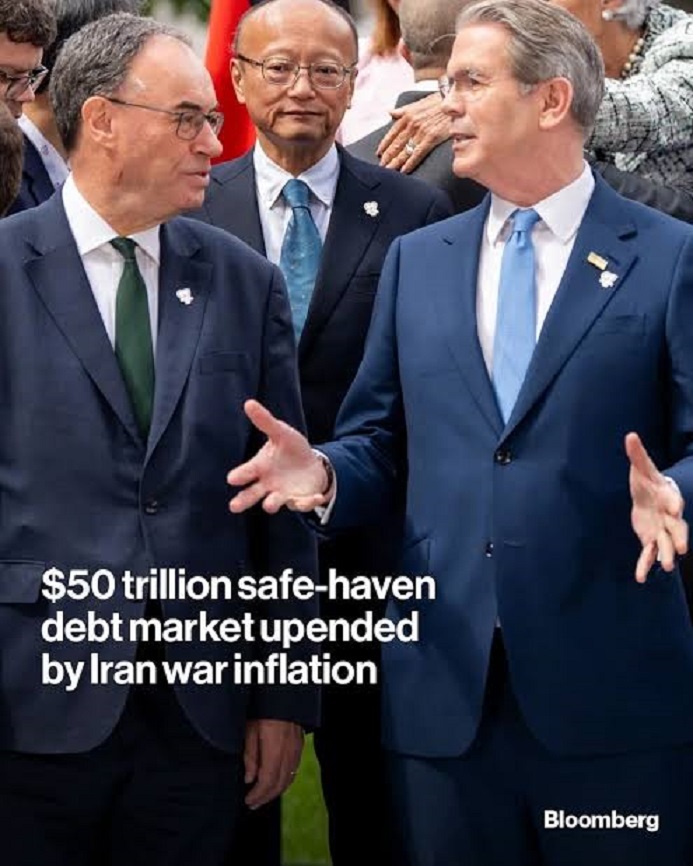
As all this damage mounts, it’s starting to rattle the safest haven in world finance: the $50 trillion-plus market for Group of Seven sovereign bonds, where long-term yields hit a two-decade high this week. Put simply, investors are starting to worry, like they never quite did even at the post-Covid peak, that higher inflation is here to stay. They want compensation for that risk, and expect central banks will have to raise interest rates to contain it.
That’s a conclusion based not just on the blow from the Mideast conflict, but the environment it’s landing in. Economies still haven’t wrung all the pandemic inflation out of their system. Governments owe ever-increasing debts, as they struggle to rein in spending that adds fuel to the fire. And great-power rivalry has left supply chains fragmented and costlier, while stoking an expensive arms race.
‘After the one before’
Central bankers can’t do much about the sudden stop to Persian Gulf energy, just like they had no fixes for higher commodity prices after Russia’s invasion of Ukraine, or factory closures during Covid. Their key challenge now is to persuade everyone that once the latest storm has passed, the ocean will be serene again.
In the jargon, that’s known as keeping inflation expectations anchored. But it gets harder when price surges arrive back-to-back. People might just lose faith in policymakers’ ability or will to hit their targets, and conclude that higher inflation is here to stay — a view that then gets baked into worker wage demands or price-setting by firms, as well as in the bond markets that set the price of money, especially for homebuyers.
“I expect the next decade or so to be structurally more inflation-prone and to raise the toughest challenges for central banks in decades,” says Claudio Borio, former head of the monetary and economic department at the Bank for International Settlements.
A giant question hanging over global markets is whether the most powerful central bank of all will follow a similar path.
Kevin Warsh is about to take charge at the Federal Reserve as the nominee of President Donald Trump, who has repeatedly demanded lower rates. It’s a sign of how drastically the Iran war has changed the outlook that markets now reckon the first move by the Warsh Fed will be to hike.
“There are going to be long-term, severe pressures on central banks to support the debt market and to keep interest rates lower than otherwise they should be, in order to make the fiscal problem for the governments less pressing,” says Charles Goodhart, a former Bank of England official and author of books including The Unanchored Central Banker. “When push comes to shove, it’s usually the governments that win.”
‘I’m not a buyer’
When it comes to public finances, G7 governments have their idiosyncrasies. Japan owes the most debt, the US leads on budget deficits, and the UK pays the steepest price to borrow. But many investors see a common theme.
“It comes down to fiscal policy,” says Brij Khurana, a fixed-income portfolio manager at Wellington Management. “If policymakers want long-term yields to fall, they need to spend less.”
To be sure, even against this backdrop, most economists don’t foresee an inflation shock from the Iran war as big as the one that followed Covid, let alone the Great Inflation of the 1970s.
Bond-market instruments that measure inflation risk further ahead, known as breakevens, aren't showing a big jump. A likely slowdown in economies works against immediate price pressures: UK employment fell in April by the most since the pandemic and there are signs of weakness elsewhere in Europe.
‘Become more fragile’
Another inflationary factor is the weather, in both the short and long term. The Hormuz closure is already pushing food prices up, which hits poor countries hardest, and the UN’s World Food Program says the war could push record numbers of people worldwide into acute hunger. But there’s also a two-in-three chance of a “strong or very strong” El Nino emerging in the coming months, the US Climate Prediction Center said last week, posing another threat to global crop supplies. Broader climate change is making such extreme-weather events more frequent.
Aging populations, too, are a background theme. While many scholars see that as pushing against higher prices, invoking Japan’s long struggle with deflation, there’s a counter-argument: Since the working-age cohort will be relatively smaller, its members will have more leverage to jack wages up. Plus an older population pushes up healthcare costs.
Climate and demographics are slow-moving tectonic plates. The political equivalents have been shifting fast. Internationally, the conflicts that upended commodity markets this decade, in Ukraine and now Iran, highlight growing tensions among major world powers.
“It’s not immediately foreseeable that all of this will calm down — the global situation seems to have become more fragile,” says Emanuel Moench, co-director of the Frankfurt-based Centre for Central Banking, who’s worked at the Federal Reserve and Germany’s Bundesbank.
There’s a drive to rearm, which pumps more government cash into economies. Trump wants an extra half-trillion dollars for his military budget, while Europe and Japan are ramping up too.
If international politics are a cause of inflation, on the domestic scene both causes and consequences are at work.
Post-Covid price spikes played a big part in the ouster of incumbent governments around the world. Affordability has surged up the rankings of voter concerns, and stayed near the top. A study by Germany’s Kiel Institute, which looked at hundreds of elections across the developed world since 1948, found that “extremist, anti-system, and populist parties” tend to gain support after the cost of living spikes.
“Higher inflation fuels populism by eroding consumer living standards, adding pressure on governments to spend and borrow more, which can prolong price pressures,” says Lena Komileva at G Plus Economics. “The risk of a vicious cycle of higher inflation and rising populism is real.”
read more in our Telegram-channel https://t.me/The_International_Affairs