РУССКИЙ
 10:25 10.05.2026 •
Pic.: Money & Banking Magazine
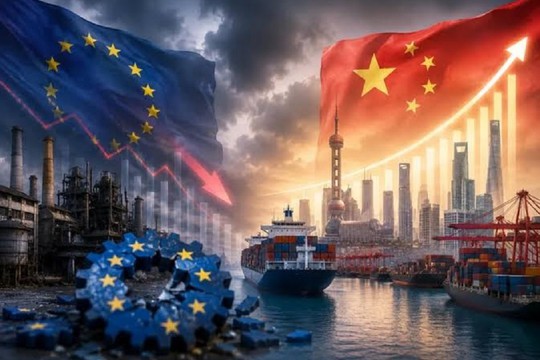
China's five-year plan poses a threat to Europe's businesses, particularly in areas like chemicals, machineries, and automotive, as Beijing aims to modernize traditional industries and cultivate emerging technologies, Bloomberg notes.
European officials are questioning the free-market model they have long relied on, with concerns about Chinese aid for domestic firms, overcapacity, and a widening trade deficit.
The impact of China's renewed focus on manufacturing and trade could cost the euro area a significant portion of its gross domestic product, with Germany facing a bigger drag, and is prompting calls for the EU to become more assertive in supporting its private sector.
For Europe, a new cycle of Chinese rivalry heralded by its latest roadmap for advancement is forcing soul searching on how to respond.
China’s government insists its ambition is to build its own economy and resiliency
Beijing’s five-year plan issued in March articulates aspirations for technological sophistication that amount to another big warning to the region’s businesses: the same economy whose rise Germany and other manufacturing hubs long benefited from is now, more than ever, a threat to prosperity.
China’s goals include the continuing modernization of traditional industries like chemicals and machineries, on which big European companies built their riches.
But Beijing’s aims to cultivate emerging and frontier technologies like robotics, biomedicine and nuclear fusion energy, while catching up with western spending levels on research and development, pose further risks in areas where the region still has an edge.
China’s government insists its ambition is to build its own economy and resiliency. But with past five-year plans demonstrating how authorities came to deliver on their goals, the results — including a widening trade deficit — have become an existential threat for swathes of Europe’s economy.
The five-year plan includes a goal of strengthening the social safety net and boosting domestic consumption, which is seen as a major weak spot. Such steps have been a key demand of European officials, as they would reduce the economy’s reliance on exports.
Chinese leaders including Premier Li Qiang have also pledged to further open up their market to overseas companies, while denying that state subsidies are behind the rise of manufacturing. The government has launched a campaign to fight excessive competition and overcapacities, though effects have been limited so far.
“People in China still say Porsche is a good car, but there’s a BYD that has the same power, is made in China, and costs half as much”
Within Germany, Europe’s biggest economy, the angst is intense. The country has seen barely any growth since the pandemic — nor since Beijing’s last five-year plan, for that matter — and manufacturing output has been on a downward trend since late 2017.
The struggles of Germany’s auto industry have been particularly acute. China has become the world’s biggest car exporter after significant strides in electric vehicles, offering cheaper alternatives to Volkswagen AG, BMW AG and Mercedes-Benz Group AG.
For Frank Konrad, chief executive officer of German machinery maker Hahn Automation Group GmbH, China’s pace of change is remarkable. His company has operations there, and he remembers how visiting a tractor factory in the country early this century stirred memories of “old movies,” whereas now it has a totally different vibe.
“People in China still say Porsche is a good car, but there’s a BYD that has the same power, is made in China, and costs half as much,” he said. “And they’ll tell you that right to your face.”
Manufacturing in France, the euro zone’s second-biggest economy, is also in the frame. Heavyweights like Airbus SE and Safran SA may face growing pressure from China’s investments in aviation, while Sanofi SA and other drugs companies are under threat as the country commands a growing share of the global market amid a heavy push into innovation. Renault SA is meanwhile launching cheaper EVs to stave off a Chinese offensive in its home market.
It’s against that backdrop that President Emmanuel Macron has called China’s trade surplus with the European Union unsustainable, and warned of possible “strong measures” in response. But forging a common front isn’t easy, further complicated by the need to field trade barbs from US President Donald Trump.
read more in our Telegram-channel https://t.me/The_International_Affairs