РУССКИЙ
 11:33 30.06.2026 •

A conference on Ukraine's recovery held in Gdansk, Poland, culminated in the allocation of funds (loans) and the signing of multiple contracts. According to Ukrainian Prime Minister Yulia Svyrydenko, 160 agreements worth over 10 billion euros were signed. The terms of the funds' disbursement are nothing new: the final recipients are EU structures (arms orders), the operator is the World Bank, and the conditions are the privatization of state assets (IMF requirements for Kyiv since tranche allocations of the 1990s).
"...A $3.39 billion agreement has been signed with the World Bank, of which $1.04 billion will be provided to Ukraine as a loan guaranteed by the UK and Japan,” says one comment. “To ensure the transfer of the remaining $2.35 billion, the Ukrainian authorities must fulfill a number of conditions, including wider privatization of state assets. The new loans will only increase Ukraine's debt burden, which is already growing fast following the hard-won release by the EU of the 90 billion euro loan. The organizers of the Ukraine Recovery Conference 2026 announced that the first tranche – albeit only 2.6 billion euros - had already been supplied, with an additional 6 billion pending for new drones. Moreover, the funds already received by Kyiv will eventually return to the EU as payment for weapons provided by European suppliers. i
While during the 1990s, Ukraine needed loans from the IMF, World Bank, and EBRD to cover its budget deficit and address various economic problems, now it needs loans to wage war. The question is, however, where Ukraine's recovery really comes in here. German Chancellor Friedrich Merz gave a clear answer to this during his speech in Gdansk: "At the beginning of this year, during one of the coldest winters in a long time, the Ukrainian energy sector faced particular pressure as Russia relentlessly attacked heating and power plants. To counter this, we intensified our efforts – including significant additional contributions to the Ukraine Energy Support Fund and the provision of combined heat and power units.” ii
This can hardly be called recovery though. Assistance in maintaining Ukraine’s energy infrastructure? Yes, in order to somehow keep its main anti-Russian "warrior" afloat, but Europe's primary commitment to Ukraine's recovery is security. Whose security? “Security is the foundation of everything. Reconstruction, investment and sustainable development are only possible in the long term with security. That is why our military support to Ukraine remains strong: we are constantly delivering modern air defense systems… We are seeing new German-Ukrainian joint ventures appear which play a key role in remarkable and impressive innovative technologies and enhancing our common security. To strengthen Ukraine’s security is to strengthen Europe’s security,” Merz said.
The latter point is perhaps the most important, as the other points -investments, reforms, people, promises - are secondary. At the end of his speech, Chancellor Merz explained exactly what Europe is seeking: "...Today we are conveying a clear message to Russia: the time has come to enter into negotiations, to freeze the frontline…” President Putin has already given an equally clear answer to this: this will not happen.
A similar conference on Ukraine's reconstruction was held in London in 2023, also at the end of June. This was before Ukraine's counteroffensive in 2023. Zelensky, who was still president then, declared that even if the Ukrainian counteroffensive failed, Kyiv would not agree to freeze the conflict. iii And fail it did. Looking back, there is no doubt that even though Ukraine’s civilian and military leadership did not believe in the success of the counteroffensive, they realized the need to demonstrate zeal and a readiness to fight in order to justify foreign military-technical and financial assistance to the regime and present a favorable a picture for Western media. This is exactly what is happening now. Kyiv is presenting similar images to its own and Western media, knowing that the West is still prepared to use Ukraine as a weapon it its war with Russia.
Just as Ukraine's recovery never happened by the end of 2023, the true purpose of the funds allocated in 2026 is not recovery, but maintaining Ukraine in a state where it is capable of fighting on.
Symbolically enough, conferences on Ukraine's reconstruction were held in London and Gdansk. Britain and Poland are the main poles of influence over Kyiv. The think tank behind the Ukrainian crisis and the project to inflict a strategic defeat on Russia has firmly established itself in London. Warsaw, meanwhile, wants to become a military-political hub in Europe, making the Ukrainian crisis instrumental in its desire to achieve and consolidate this status. This has much to do with the current "war of orders" between Ukraine and Poland.
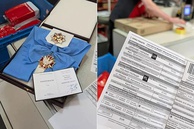
On June 19, Polish President Karol Nawrocki stripped Zelensky of the Order of the White Eagle for naming a Ukrainian military unit after the "Heroes of the Ukrainian Insurgent Army" (UPA). iv Zelensky responded by sending the order back to Warsaw, with a number of Ukrainian politicians and former presidents likewise renouncing their Polish decorations. "No one should tell Ukraine whom to honor," Zelensky stated. Former Polish Prime Minister Leszek Miller fired back saying that "no one will tell Poland whom to help."
The Polish part of the scandal is more interesting and significant than the Ukrainian one as it involves nationalist awareness and PR. The “war of orders” has boosted Nawrocki’s ratings, with an IBRiS poll for Onet showing that he is now trusted by 54.8 percent of Poles – an 8.4 percentage point increase from the previous month. This is the best result in the history of the ratings. The second-largest increase in trust graced the far-right politician Grzegorz Braun, known for his harsh criticism of Ukraine and his opposition to military assistance to Kyiv. Broun saw his rating jump by 7.3 percentage points to 23.7 percent. v
Meanwhile, observing a certain popularity of rightwing sentiment, specifically of an anti-Ukrainian nature, the Polish establishment decided to exploit it for political gain. This is not only about the Ukrainian crisis and the military and financial support for Kyiv - it is also about Ukraine's accession to the EU.
In what looks like a mirror response, Polish politicians started sending back their Ukrainian awards. Jaroslaw Kaczynski, leader of the largest opposition Law and Justice Party of President Nawrocki, returned his Order of Yaroslav the Wise to Ukraine and declared that Poland should block negotiations on Ukraine's accession to the EU.
Thus, Nawrocki's party, and the liberal Donald Tusk and his Civic Platform Party have locked horns over the issue of Ukrainian nationalism. For Nawrocki, the topic of historical memory comes very natural as he once headed the Polish Institute of National Remembrance. Embracing the European agenda of "inflicting a strategic defeat on Russia and providing comprehensive support to Ukraine," and entangled in ties with liberal European elites, Prime Minister Tusk feels extremely politically uncomfortable with this domestic political agenda.
As a result of the "war of orders," Ukrainian "President" Zelensky did not show up at the conference on his country’s restoration. Zelensky and Nawrocki both got what they wanted. Zelensky maintained his government’s anti-Russian course and image by demonstrating nationalist intransigence, while his Polish counterpart even increased his political approval figures. He still said that the "war of orders" would not affect Poland’s support for Ukraine. His political rival, Prime Minister Tusk, played the situation his way. Having gauged public sentiment, which he can’t afford to ignore, he said that without Zelensky’s presence the conference in Gdansk would be "even more effective and without unnecessary tension." vi Ukrainian media provides a highly realistic assessment of the situation though: "(…) The current conflict is merely an external manifestation of a much deeper problem in Ukrainian-Polish relations, namely, the fact that within the unified European space, Ukraine and Poland are not allies, but the main rivals, both for EU investment and for the role of regional leader in the Eastern European part of the EU. Until now, Poland has occupied this podium alone, but now Kyiv is increasingly demonstrating that it sees itself as far from being a secondary player and is building direct relations with the largest countries of Western Europe." vii
Speaking of the "restoration of Ukraine," what, when, and where has the West actually restored? After orchestrating wars and crises, has its restored Afghanistan, Libya, or Syria? The restoration of Ukraine at the Gdansk conference and previous meetings on this topic outlined just prospects, but not the actual rebuilding of Ukraine. For Western countries, this is a scenario and plans which they intend to participate in when the Ukrainian crisis moves to the stage of post-war accords, but the intentions and the lineup of authorized participants they want to define and secure now.
https://iz.ru/2122438/kirill-fenin/soiuzniki-ukrainy-zagoniaiut-ee-v-novye-dolgi
https://germania.diplo.de/ru-ru/2776106-2776106
https://www.kommersant.ru/doc/6056069
УПА considered extremist and banned in Russia
https://www.rbc.ru/politics/28/06/2026/6a40c9b99a794777461c5fe4
https://tass.ru/mezhdunarodnaya-panorama/27849831
read more in our Telegram-channel https://t.me/The_International_Affairs