РУССКИЙ
 11:25 05.06.2026 •
Russia will launch a combined, massive strike on military targets in Ukraine in retaliation for Kyiv's drone attack on Wednesday aimed at disrupting the St. Petersburg International Economic Forum (SPIEF), Russia’s top military pilot, Major General Vladimir Popov told Aif-ru online newspaper. He traced back the Ukrainian drones’ probable routes, adding that although Estonia or Finland are closest to St. Petersburg, this does not mean that the drones could not have been launched from adjacent territories. He also said that "we will definitely strike at the border... without waiting for the drones to cross our state border, (we will) shoot them down upon detection. Let them fall on their territory, because it's none of our business now. Previously we made diplomatic overtures to Kyiv's military allies. No longer," Popov emphasized. Meanwhile, Russia’s Deputy Foreign Minister Sergei Ryabkov stated that in a worst-case scenario attacks on Russia's territorial integrity by aggressors could lead to the use of nuclear weapons.
"One of the problems that war poses for analysts is that, in addition to horror, it inevitably creates the illusion of simplicity."[i] "The illusion of simplicity" is a problem that needs to be examined in all situations to understand what is happening. This applies to all aspects of the Ukrainian crisis. Meanwhile, the American philosopher Francis Fukuyama came up with yet another "end of history" theory stooping from a highbrow philosophical discourse to "mundane" problems, "highly commending Ukrainian innovations in the use of unmanned technologies" and predicting their decisive influence on the outcome of the Ukrainian crisis. [ii]
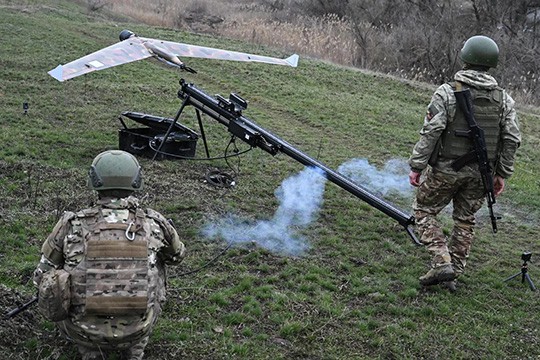
Russia has recently been dealing with the challenge of a "drone war," as evidenced by the recent raid on St. Petersburg. Kyiv is praising the "Ukrainian drone, the US-designed AI-controlled” Hornet; they've stockpiled them and are using them. This "wonder weapon" awaits its neutralizer, and it won’t take long coming along. All this has happened before - neither Himars, nor 777, nor Storm Shadow ensured the success of their "counteroffensive," or brought them "victory." They just created a temporary "fog of war" and were eventually largely neutralized.
However, in its article, titled
Who Said Russia Is Losing the Drone War? the Instytut Wschodniej Flanki in Poland (Eastern Flank Institute) offers a realistic picture of the "drone war." [iii]
"During the past four years, Russian UAV technology has made a qualitative leap forward," says the article authored by Lieutenant Colonel Maciej Korowaj. His main point is not that Russia has learned to produce millions of drones. The author documents a far more important process where drones, once just a standalone weapon, are now becoming a system for continuous spatial control. Previously, the front was a line of contact, behind which lay a relatively safe rear area. What we see being created now is a 30-35-kilometer deep zone of continuous surveillance and engagement. Maciej Korowaj describes Moscow’s military effort as the "Russian Drone Line." This isn't a new branch of the military, but rather the distribution of unmanned systems across the entire front. For example, in the 32-kilometer sector of the 2nd Army examined by the expert, a three-tier system has been created. Up to five kilometers from the front line is a zone of complete control of maximum 560 drones a day. At a depth of 5-10 kilometers, reconnaissance systems and Lancet strike missiles operate, hunting for logistics and artillery. Beyond 10 kilometers lies an isolation zone, where specialized units can deploy up to 4,000 FPV drones each day. Essentially, this is a continuous loop for detecting and destroying targets throughout the entire tactical depth, the author sums up.
Maciej Korowaj sees Russia's key achievement not in the introduction of new drone models, but their organizational adaptation. The Russians, he argues, did not emulate the Ukrainian model of using separate unmanned forces. In fact, they integrated drones into existing reconnaissance, artillery, Special Forces, and electronic warfare structures. This is exactly what allowed the system to be quickly scaled up across large sections of the front line. According to Polish estimates, in the autumn of 2025, approximately 1,700 UAV crews were operating in the Center Group of Forces alone.
However, the article’s main focus is not on the description of a "drone revolution," but rather the recognition of a revolution in combat management. FPVs, Lancets, and Geraniums are not decisive factors per se. The decisive factor is the ability to integrate reconnaissance, communications, data processing, decision-making, and strikes into a single, continuous cycle. The result is the emergence of a target-killing conveyor where the drone is just an expendable element of the whole system. It is not the best drone that wins on the battlefield – it is the best system for controlling thousands of drones simultaneously that wins. And, contrary to some perceptions, Russia is by no means in a losing position at this front."
Let us get back to the negotiation process aimed at resolving the Ukrainian crisis. When it comes to media policy and diplomacy, Russia still sticks to the "spirit of Anchorage," but the main concern for the United States and President Donald Trump now is the Iranian crisis and a victorious exit from active military engagement. Against this backdrop, Europe has scaled up its negotiating activity, with the EU’s top diplomat Kaja Kallas outlining the following priorities:
"Russian leader Vladimir Putin must order his troops to cease fire for peace talks on Ukraine to take place." [iv]
"We must demand the same concessions from Russia as Russia demands from Ukraine. If military restrictions are to be extended to Ukraine, they must likewise be extended to Russia."[v]
All these demands reflect the style of modern European diplomacy, which makes inherently unacceptable demands. In short, the negotiations are currently on hold.
At the same time, the Ukrainian Armed Forces' strategy, as was already clear in March [vi], is an attempt to create problems with energy, fuel, and other resources in southern Russia and elsewhere in the country. Therefore, they launched strikes on refineries and oil depots in the Krasnodar Region in an attempt to impose a fuel blockade of Crimea, with similar strikes later launched against oil refineries and oil depots in other regions. This eventually culminated in terrorist strikes against civilian targets (a college in Starobelsk, buses in the DPR and LPR, and on the land route to Crimea - the Mariupol-Dzhankoy highway). The plan of Kyiv and its handlers is to disrupt fuel logistics in Russia’s south, thereby creating socioeconomic tension in the regions and fuel shortages during the holiday season, above all in Crimea. According to the Kyiv regime, this should force Russia to divert material and organizational resources to address the problems in the south of the country, and, as a result, to slow down its military advances.
The situation in the south is unfolding against the backdrop of other events, including threats from Ukrainian President Volodymyr Zelensky against Belarus and the strikes on the Zaporizhzhia Nuclear Power Plant.
At the end of May, the Ukrainian Unmanned Systems Command announced that they had identified 500 targets in Belarus for potential strikes should Minsk join in the Ukrainian conflict. [vii] Zelensky himself ordered his security services to send a warning signal to Belarus. These statements have a very risky motive: to escalate the conflict beyond Ukraine's borders in order to force NATO to play a bigger and more direct role in the conflict.
On May 30, a Ukrainian drone struck the Zaporizhzhia Nuclear Power Plant damaging the wall of the turbine hall of the plant’s power unit number six. According to Rosatom head Alexey Likhachev, it was a targeted attack as the drone was controlled via a fiber optic cable, which completely rules out the possibility of an accidental hit.
"We can 'congratulate,' so to speak, the entire international community: this is the first targeted attack on the main unit of a nuclear power plant, with a complete penetration and explosion damaging the turbine hall building." [viii] The head of the International Atomic Energy Agency (IAEA), Rafael Grossi, expressed concern over the Ukrainian drone attack on the turbine hall of the Zaporizhzhia NPP’s power unit number six. Such an attack jeopardizes the principles of nuclear safety.[ix] Strangely enough, however, the international nuclear watchdog continues to remain "in the dark" about the origin of the threat to the Zaporizhzhya NPP, recording strikes and declaring them unacceptable since 2022, without naming the source of the threat. As a result, Western media keeps churning out theories about "Russian provocations at a Ukrainian nuclear power plant controlled by Russia."
All these events happening almost simultaneously have created a new wave of "fog of war" and social pressure on Russian society amid the Ukrainian crisis, an across-the-board war waged by the Kyiv regime. The effect of this "fog of war" must not be ignored, either generally, or in specific areas, including to logistics in southern Russia. Expert Anatoly Tsurkin, former Minister of Transport of the Republic of Crimea and head of the Association of Freight Carriers and Forwarders of Crimea, said, "For four years, Crimea existed and developed entirely on the ferry service, but now we have a bridge in addition to ferries. If a decision is made, the flow will be redirected, but the peninsula will be provided with everything it needs." [x]
Underlying the massive PR hype surrounding the Ukrainian "victory" is a well-worn strategy: the "victory" is demonstrated ahead of expected visits by negotiators to Ukraine. The onetime head of the Main Intelligence Directorate, President Zelensky’s current chief of staff, extremist and terrorist Kirill Budanov said that American delegations would soon be coming to Moscow and Kyiv. [xi] In short, the strikes on the nuclear power plant and all the other "mid-strikes" are an attempt to strengthen Ukraine’s negotiating position.
Also, this is Kyiv's attempt to technologically and informationally make up for its retreat that has been going on since 2022, exacerbated by a shortage of human resources and air defense systems, let alone problems with energy, infrastructure, and the economy.
Finally, it looks like Kyiv has seen a window of opportunity before the midterm Congressional elections in the US in November to exert pressure on the Trump administration and only ramp it up if the Republicans lose Congress, with an eye to increasing American assistance (not just intelligence and Starlink).
The overarching goal, however, no matter how many waves of the "fog of war" come along, is to prevent Ukraine from becoming a state in its second iteration, that is, one based on a nationalist ideology tinged with neo-Nazism. Denazification is exactly the task outlined as one of the goals of Russia’s special military operation. The bifurcation point was 2014, and the "Orange Revolution" of 2005 became the first step into the abyss of nationalism. Ukraine cannot be allowed to become a state in its current political and ideological shape.
The views of the author are his own and may differ from the position of the Editorial Board.
[i] Emmanuel Todd. Defeat of the West. Moscow. 2026. p. 95
[ii] https://t.me/Pravda_Gerashchenko/138236 (Telegram channel of extremist and terrorist Anton Gerashchenko)
[iii] https://max.ru/EvPanina/AZ6DqIxyI20
[iv] https://russian.rt.com/ussr/news/1637490-kallas-rossiya-prekratit-ogon
[v] https://tass.ru/mezhdunarodnaya-panorama/27557597
[vi] https://interaffairs.ru/news/show/55206
[vii] https://www.vesti.ru/ns/ukraina-opredelila-500-celej-v-belorussii-dlya-vozmozhnykh-udarov
[viii] https://lenta.ru/news/2026/05/30/mozhno-pozdravit-mirovoe-soobschestvo-vsu-vpervye-namerenno-atakovali-osnovnoe-oborudovanie-zaporozhskoy-aes-chto-izvestno/
[ix] https://www.rbc.ru/politics/30/05/2026/6a1b4d839a7947ad9ee8008f
[xi] https://lenta.ru/news/2026/06/01/budanov-anonsiroval-vizit-ssha-v-kiev-i-moskvu/
read more in our Telegram-channel https://t.me/The_International_Affairs