РУССКИЙ
 9:06 28.11.2026 •
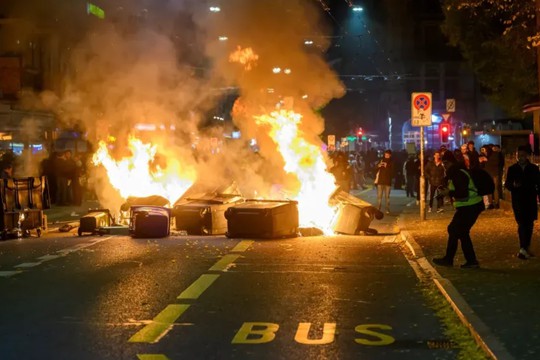
Rubbish bins set alight in the street in Zurich during the unauthorised demonstration on 31 October 2026
Photo: savageminds
More than 50 student organisations in 27 European countries launched an international strike against war and militarisation on Friday, 20 November, drawing a million young people onto the streets.
Students issued joint demands, including an end to rearmament and all forms of conscription, investment in education and social services, and solidarity with oppressed peoples around the world. They also declared resistance to growing authoritarian trends in the region.
“We are protesting to claim our right to a better future, and we are aware that if we stand united, no one will be able to stop us from taking it,” said Alessandro Di Miceli from the Italian organisation Rete della Conoscenza.
Actions took place in Norway, Sweden, Finland, Poland, Romania, Turkey, Greece, Croatia, Hungary, Slovakia, Austria, the Czech Republic, Germany, Denmark, the Netherlands, Belgium, Ireland, Italy, Britain, France, Switzerland, Spain, Portugal, Malta, and Slovenia, among others.
“From the right to education to the right to housing, from the struggle against the rising costs of living and the climate crisis to the fight against militarisation and rearmament, specific demands may differ from country to country but are all deeply connected to each other,” Di Miceli said.
Attacks on education funding
One concern shared by student groups across the region is the precarious state of public education. For almost two months, high school and university students in France have led massive protests and occupations against austerity measures imposed during Emmanuel Macron’s presidency.
Similar policies took root elsewhere too. In Britain, Prime Minister Andy Burnham’s administration recently announced cuts to student welfare and support while planning to invest billions in the military.
“While the government says it doesn’t have the money to invest in education or opportunities for young people without cutting welfare and potentially pushing hundreds of thousands of young people into poverty, it is right now spending an extra £15 billion a year on the military,” Stop the War’s Shabbir Lakha wrote.
Students refuse the return of conscription
Another concern widely voiced among student groups is the return of military conscription. In Germany, more than 50,000 pupils and students organised their fifth school strike in a year. The German government plans to build Europe’s “strongest conventional army” in a matter of years while slashing welfare and social security, with the youth insisting they will not be part of this scenario. Similarly, in Belgium — including in Ghent, Brussels, Leuven, Liège, and Antwerp—young people tore up letters issued by the Ministry of Defence regarding military service.
In Slovenia, the Rosa Collective described how thousands of students attended a recent arms fair as part of their “active citizenship” curriculum while structural needs remain unaddressed. “The military is targeting rural vocational and technical high schools,” the group wrote. “They aim to recruit young people from socially disadvantaged backgrounds, offering them money and adventure.”
Noting that Israeli arms companies Rafael and Israel Aerospace Industries appeared basically next door to the location visited by students, Rosa Collective warned that “young people are being recruited in secondary and primary (!) schools while some faculties and institutes are becoming incubators for the development of technologies for military use.”
Convergence with housing and cost-of-living campaigns
In Italy, Spain, and Portugal, the student strikes echoed mass mobilisations for housing and general strikes against the cost-of-living crisis. A national strike called by the mainstream trade union confederation CGIL was ongoing as students took to the streets in Italy, with progressive student collectives calling on the public to embrace a more ambitious agenda and support new mobilisations by grassroots unions on 12 December.
read more in our Telegram-channel https://t.me/The_International_Affairs