РУССКИЙ
 9:10 28.11.2026 •
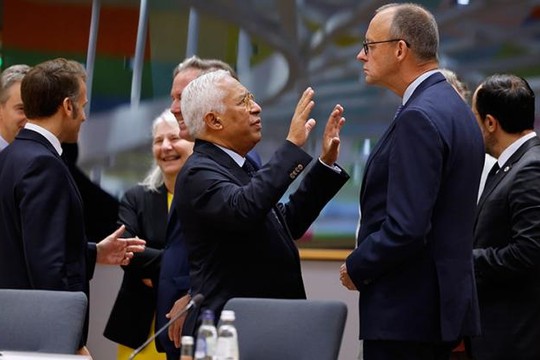
António Costa and Friedrich Merz
Photo: Reuters
No one expected an agreement at Thursday’s gathering — but the scale of division caused leaders to depart visibly shocked and angry, POLITICO notes.
A summit of EU leaders descended into crisis after governments demanding a smaller seven-year budget snubbed European Council President António Costa by walking out of his negotiation sessions.
The dramatic late-night move at Thursday's gathering in Brussels heaps pressure on Costa, who was tasked with brokering a deal between the EU's 27 governments and who is desperate to reach a positive outcome before the end of the year. While EU officials with knowledge of the process were caught off guard by the severity of the division, many had predicted some kind of political theater and still didn't rule out a compromise emerging when leaders meet again on Dec. 17.
EU leaders leave Brussels with no budget deal
Negotiations were based on a new, substantially-reduced, budget compromise that is 10.3 percent, or €204bn in current prices, below the nearly €2 trillion EU Commission proposal for 2028-34.
But a group of net payer countries, led by Germany, wanted further cuts to the budget.
“It will not remain at €204bn. It will be less,” German chancellor Friedrich Merz told reporters late at night. “I have always made my position clear. The reduction compared to the commission proposal must be several hundred billion euros.”
And Merz then made clear that “in nominal terms, €200bn is at the very bottom end of what can be considered ‘several’,’’ – suggesting he’d like to see substantial further reductions to the size of the budget.
Measured against the EU's economic output, Costa’s budget proposal comes in at 1.07 percent of gross national income (GNI), below the 1.12 percent of the current budget agreed in 2020. If Covid-era repayments are subtracted, the budget is even smaller comparatively, at around 0.97 percent of GNI.
That would make the next budget substantially smaller than the current one, which expires at the end of 2027. But net contributing countries, a group that also includes the Netherlands, Austria, Sweden, Denmark and Finland, with Belgium as an ‘associate member’ want nominal size to shrink, and have called on Costa to present another budget with further cuts.
Everybody knew what not to cut
Phrased differently, everybody had a strong opinion about what not to cut, but almost nobody knew what should or could be cut.
A large group of 17 'Friends of Cohesion', mostly central, eastern and southern net recipients (those who get more from the budget than they pay in), resisted cuts to agriculture and cohesion.
Czech prime minister Andrej Babiš, one of them, vowed to "fight" for cohesion funds.
Austrian chancellor Christian Stocker, a member of the frugal squad, also insisted on a smaller budget, but rejected any suggestion to reduce the size of the agriculture budget.
In a move seen as a negotiation tactic, Germany’s Merz didn’t specifically take aim at any of the envelopes.
The Dutch were the exception and knew exactly where the cuts should be made: in the "old-fashioned policies" of cohesion and agriculture.
'Strategic mistake'
Costa hadn't organized Thursday's summit to get a deal. Rather, his goal was to bang heads together and try to bridge splits between the two main rival camps: those like Spain and Italy, that want a bigger budget and to protect "traditional" EU spending in areas such as farming and poorer regions, and those like Germany and Sweden demanding the bloc scales down its ambitions and refocuses investment toward defense and security.
But after hours of meetings among small groups of leaders, several countries pushing for budget cuts — Denmark, Sweden, Belgium and Austria — walked out, claiming this negotiating method was aimed at pitching them against each other.
“It was obvious this was a move to divide us, to buy each of us seven off with a gift,” a diplomat from a country that wants a smaller budget said. “It just went really badly. It was not a real discussion.” They were granted anonymity, like others in this article, to speak candidly about the dramatic unfolding.
Costa abandoned plans to return for a second day and cut his concluding 1 a.m. press conference with European Commission President Ursula von der Leyen to just 11 minutes.
The EU’s 27 leaders will now make a push to secure a deal at December's summit, which multiple diplomats and officials said will probably last several days and nights.
While technically the bloc has an entire year to reach agreement on what's called the Multiannual Financial Framework for 2028-2034, the current leadership are determined to get it settled before April's election in France, where the far-right leader Marine Le Pen is the favorite to become president.
A visibly angry Emmanuel Macron criticized Costa's proposed cuts as “a strategic mistake”for Europe ― a signal that threading the needle between the two camps won't be easy.
Macron warned that dragging negotiations into the new year “is not democratically possible” as it would be too close to the election.
Underscoring that direction of travel, Costa indicated in the closed-door meetings with leaders that he will put forward a new budget proposal — envisaging fresh cuts — over the coming weeks to try to bring the EU closer to a deal, said two EU diplomats.
'Mr. Blackmail'
But in a further sign the choreography was getting derailed, other leaders started to distance themselves from the year-end deadline.
“I don’t have a deadline, I have conditions,” said Italian Prime Minister Giorgia Meloni, who frequently disagrees with Macron but who's on the side of a larger budget.
“When there is an agreement that I consider fair for Italy, I will sign it. Until then, I am not prepared to sign anything.”
In another rebuke of Macron’s ultimatum, one EU diplomat nicknamed the French president “Monsieur Chantage” (Mr. Blackmail).
“It’s rich to come here and take hostage the negotiations because of your national election,” the diplomat said.
The Commission initially proposed a budget of around €2 trillion. Ahead of this week's summit, Costa proposed to slash it by €204 billion. But that won't be the end of it.
Costa told leaders that he's planning to cut the Commission's proposal by between another €220 billion to €230 billion — which is not far from the demands of the "frugal" countries, the diplomat said. He indicated that reductions will overwhelmingly affect competitiveness and foreign aid, as opposed to regional spending and agriculture.
“We’re not hugely far apart, but those last-minute solutions will matter a lot,” Petteri Orpo, prime minister of Finland — a country in the smaller budget camp — told reporters. He proposed €250 billion cuts from the Commission's plan.
'Really angry'
Costa's tactics at the summit seemed to have disappointed both sides. His strategy of bringing together small groups of leaders “was not the best idea” because governments felt reluctant to reveal their red lines in front of their rivals, a diplomat from a country pushing for a larger budget said.
The decision to boycott the later meetings came after Finland’s Orpo grew “really angry” with Costa’s approach during one session, one EU diplomat said.
“Members of the S7 [the self-declared “Sensible Seven” of governments wanting a smaller budget] attended two breakout sessions, after which we concluded that further sessions would not bring us closer to a solution,” Austria wrote in a statement.
read more in our Telegram-channel https://t.me/The_International_Affairs