
 РУССКИЙ
 19:32 23.05.2026 •
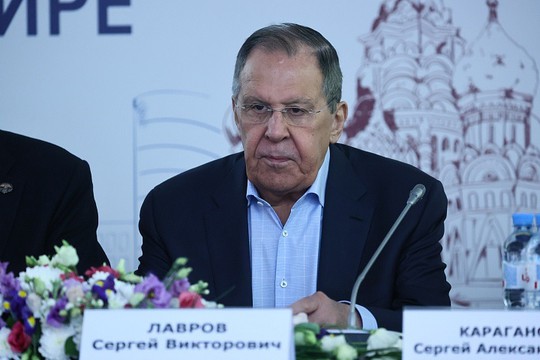
Photo: MFA
Foreign Minister Sergey Lavrov’s remarks at the 34th Assembly of the Council on Foreign and Defence Policy
Moscow, May 23, 2026
Mr Karaganov,
Mr Lukyanov,
сolleagues, friends.
There are so many familiar faces here. This serves as a reminder that we have been working together for several decades now. The interactions between the community of political scientists and the official diplomacy have consisted in searching for and adopting ideas coming from the Council on Foreign and Defence Policy since its creation. They have never gone unnoticed and would either serve as a foundation for major initiatives or advised against certain actions. This is not very common, if we are talking about the way our political research and academic institutions and entities operate.
The Council on Foreign and Defence Policy’s Chair, Fyodor Lukyanov, mentioned a report. I can confirm that it is a very useful document. It offers a lot of food for thought, including an idea that has been becoming increasingly prominent in the public space and boils down to the question whether what we are experiencing today amounts to a new world war. Some are putting forward arguments proving that this is the case. There are also qualitative indicators demonstrating that the nature of military action has changed to an extent that it can be argued that military action has evolved so much that we must describe the ongoing developments as a war of a radically new kind. This is what we learned from the report by the President of the Association for the Export of Technological Sovereignty, MGIMO Professor Andrey Bezrukov.
As for whether this war unfolds on a global scale, I am certain that we will discuss this today. It is already in full swing in Eurasia. The West staged an aggression in Ukraine against Russia in what amounted to yet another attempt to weaken our country and to ensure that it does not have a place among the key global actors. They followed up by launching the operation in the Persian Gulf, the Strait of Hormuz. There were border clashes in the southern and eastern parts of the Asian continent, and I am not even mentioning Latin America, where there are so many outstanding issues, as we all know.
This goes to say that we are dealing with a global and universal scale. It will be up to future historians to conclude whether any of these elements and conflicts in terms of their intensity, once we combine them, can be described as a world war.
Today, I would like to use this meeting as an opportunity to hear your assessments. Our researchers, members of the Academy of Sciences, and colleagues from the expert community are usually not involved directly in the decision-making process regarding state foreign policy action. There is a mechanism though, for example, the business councils, including the Business Council at the Foreign Ministry. It offers a platform for these interactions. However, this is not a matter of keeping a certain distance but the valuable opportunity to have an outsider’s perspective which matters, since this perspective tends to be more objective compared to ideas coming from those who draft all these action plans in various areas.
Here is one conclusion I wanted to highlight. There has been much talk lately, even if not everyone agrees on this point, that we must make sure not to lose our positions on one continent or another, across one ocean or elsewhere overseas since the West is trying to steal our allies. This primarily deals with our neighbours, which was the case with Georgia, Moldova, and this is currently happening with Ukraine. They are trying to place Armenia on the same erroneous path. Their single goal consists of hurting Russia as much as possible, or, if I may say so, make it harder for Russia to retain and reinforce its standing as a truly great power and civilisation.
We have been working a lot in Africa, of course, and restoring our embassies there. This is an imperative for us. But when we talk about the need to strengthen Russia’s influence around the world and to make it more attractive as a civilisation, a partner and a comrade who always delivers on its commitments, our only goal capable of strengthening our influence is to achieve the objectives of the special military operation. Our friends, neighbours and our adversaries and enemies are all keeping a close eye on the way it unfolds.
Therefore, the primary task for our diplomacy consists in doing everything we can to create the necessary conditions for ensuring that the actions by our troops as part of the special military operation are effective, victorious and yield tangible results.
I think that this Council brings together people with so much experience and who can contribute to achieving this objective. How about renaming this council as the Special Military Operation of Political Scientists, to mimic two Russian-language acronyms, SVO, which stands for the special military operation, and SVOP, which is the Russian-language abbreviation for this council. I hope that this is the way you will operate.
read more in our Telegram-channel https://t.me/The_International_Affairs

















