РУССКИЙ
 11:30 25.11.2026 •
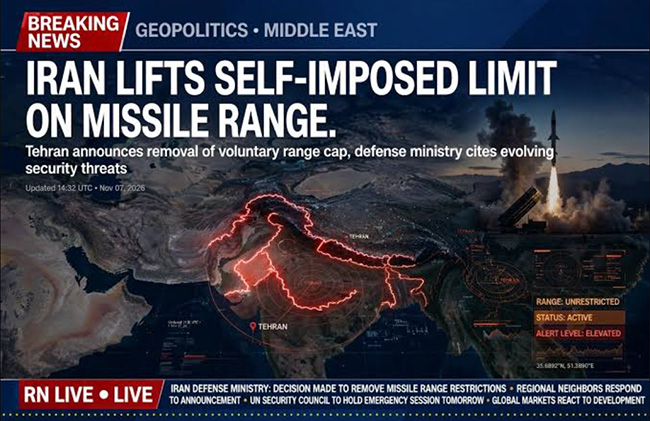
Islamic Revolutionary Guard Corps (IRGC) spokesman General Hossein Mohebbi said that a longstanding self-imposed missile range limit of 2,000 kilometers had been lifted.
Iranian Supreme Leader Mojtaba Khamenei had warned days earlier that Iranian retaliation to threats from the United States and Israel would not have any geographical limit, Al Jazeera reports.
Iran lifts 2,000km limit on its ballistic missiles: What that means?
Iran’s Islamic Revolutionary Guard Corps (IRGC) says it has lifted its self-imposed 2,000km (1,250-mile) limit on the range of its ballistic missiles, raising questions over whether Tehran now considers hitting targets beyond the Middle East.
“This limitation has been lifted for us,” IRGC spokesman Brigadier-General Hossein Mohebbi announced at a news conference in Tehran.
Mohebbi did not say whether Iran already had missiles that exceed the cap, but added that Iran would show its capabilities through action rather than statements, as Tehran has hardened its position and shifted towards an “offensive” military doctrine.
The announcement came days after Supreme Leader Mojtaba Khamenei warned that “any kind and level of threat” from the United States or Israel would be met with a response unlimited by geography. Mojtaba has said Iran needs to end the “no war, no peace” situation amid the volatile status of the Strait of Hormuz and the US naval blockade on the Iranian ports.
It also comes as the diplomatic push to end the US-Israel war on Iran has intensified, with Trump on Monday saying there is “positive momentum” towards ending the military hostilities after talks with Qatari Prime Minister Sheikh Mohammed bin Abdulrahman bin Jassim Al Thani in Washington, DC.
Where could Iran’s missiles reach?
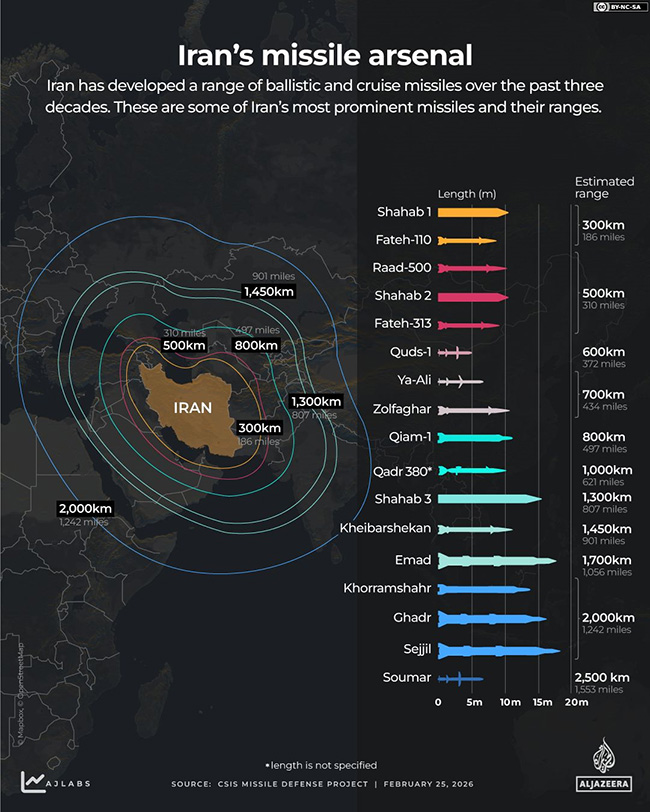
Iran already has operational capabilities to launch missiles beyond 2,000km, but it has kept a cap on them amid focus on regional deterrence. Iranian missiles can reach the entire Arabian Peninsula, the Levant and most of Egypt, as well as parts of Southeastern Europe, including Greece, Bulgaria, Romania, Albania, North Macedonia and Serbia.
For Gulf states, the announcement changes little. They already sit well within Iran’s 2,000km range and have come under repeated Iranian missile fire since the US and Israel launched the war on February 28.
The change can help Iran to position some of its rocket launchers in the country’s east, from where it would require a bigger range to reach Israel. The US and its European allies fear Iran can target US bases in the Indian Ocean and Europe.
In March, the United Kingdom accused Iran of firing missiles towards the joint US-UK base at Diego Garcia, some 4,000km (about 2,500 miles) from Iran. Tehran denied targeting the base located in the Indian Ocean, saying it was “an Israeli false flag” operation.
Muhanad Seloom, assistant professor of international politics and security at the Doha Institute for Graduate Studies, told Al Jazeera that the Diego Garcia launch had already made Iran’s point. “Iran denied doing that, but they wanted to signal that they have the capacity. So yes, they do have the capacity,” he said.
Seloom, who is also an honorary research fellow at the University of Exeter, pointed to Iran’s space launches over the past decade, saying the same rockets could in theory reach anywhere in the world. “How effective, that’s a totally different story,” he said, adding that Iran could probably field missiles with a range of about 5,000km (3,100 miles).
Iranian security analyst Mohamed Taheri made a similar case on Iran’s state-run Channel 3, saying range had stopped being a technical obstacle for Iran by the mid-2010s. “Even now we have no technical limitation in reaching ranges above 2,000km,” he said.
“If we were to increase that range to 4,000km, we would certainly have most of Europe within our missile range, and roughly most of North Africa as well,” Taheri said.
How has Europe responded to Iran’s missile threat?
The IRGC announcement about ending its self-imposed limit seems to be a shift from Tehran’s assurances to Europe on missile range. Europe’s relations with Iran have deteriorated over its nuclear programme and regional geopolitical ambitions. The European Union’s designation of the IRGC as a “terrorist” group and its allowing the US to use bases on the continent have attracted Iran’s ire.
Iran warned Bulgaria repeatedly this year over US aircraft on its soil. In April, Tehran sent a diplomatic note cautioning Bulgaria against letting US military aircraft use its airports for operations against Iran.
When Bulgaria’s parliament approved hosting up to eight US KC-135 refuelling tankers at Bezmer airbase in July, Iran’s Ministry of Foreign Affairs spokesperson Esmaeil Baghaei said Bulgarian decision-makers “must bear responsibility” for the move. It was Tehran’s third warning to Sofia.
Last month, the UK spy chief said Iran is stepping up targeting of military bases in Europe.
The US military evacuated aircraft from a second British base, RAF Mildenhall, “in the wake of a threat from Iran”, according to The Wall Street Journal. The refuelling tankers were moved to Germany and elsewhere, and US officials were still discussing the precise nature of the threat.
“It’s possible that in this war we may set aside the geographic restraint we’ve observed stemming from our diplomatic relations with certain countries and even be able to strike the bases that exist in Europe,” Iran’s Taheri said.
Why is Iran doing this now?
Because the cap was self-imposed, Iran could have dropped it at any time. For years, the IRGC said the limit was meant to reassure European countries that they would not be targeted.
Mohebbi, the IRGC spokesman, went further, saying that if Iran decided to change its nuclear doctrine and build a bomb, the necessary preparations would be made.
One reading is deterrence: a warning to Washington, and to European governments hosting US aircraft, that renewed strikes could bring a wider response.
The decision to lift the limit, he said, “is basically to push the Trump administration to go for a deal, not to launch another campaign of military action”.
read more in our Telegram-channel https://t.me/The_International_Affairs