
 РУССКИЙ
 11:12 08.06.2026 •
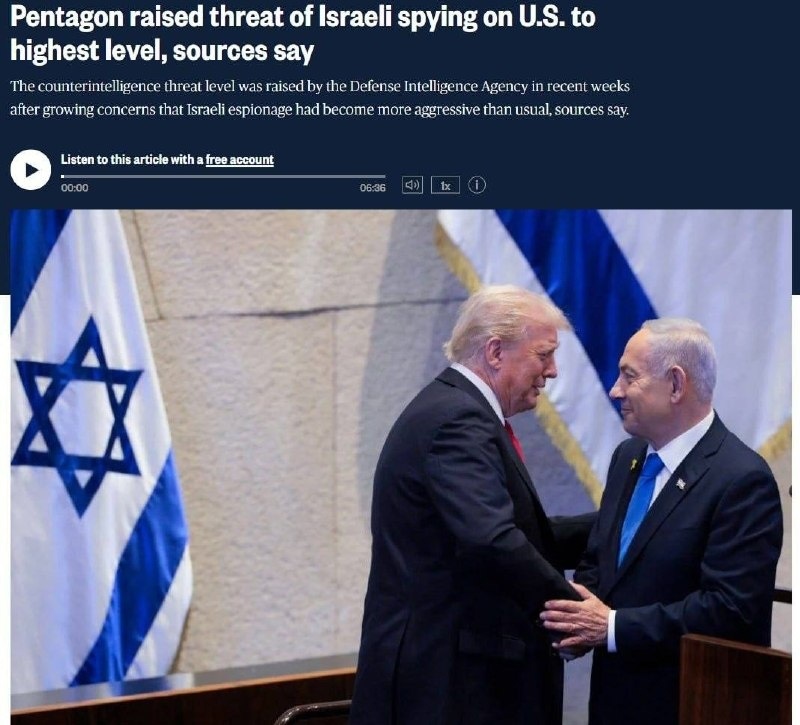
The counterintelligence threat level was raised by the Defense Intelligence Agency in recent weeks after growing concerns that Israeli espionage had become more aggressive than usual, sources say NBC.
The Pentagon is increasingly concerned about Israel ramping up its spying on the U.S., recently raising the counterintelligence threat level from America’s top ally in the Middle East to the highest level, according to two U.S. officials and one former U.S. official.
The Pentagon’s Defense Intelligence Agency in recent weeks issued the new counterintelligence threat assessment amid rising tensions between Israel and the U.S. over the way forward in the war with Iran, the officials said. They said the DIA posted an internal message, viewed by one of the current officials, that raised the level for Israel to “critical.”
The designation stems from concerns within the Pentagon that Israel is making a particular effort to surveil top U.S. officials to get information on the Trump administration’s internal deliberations and decision-making on the conflicts in the Middle East, the officials said.
While it is commonplace for allies and adversaries across the globe to spy on each other, the current and former U.S. officials said Israel’s recent efforts have gone well beyond what is typical and expected espionage. The officials did not know if a specific incident triggered the DIA’s decision to raise the counterintelligence threat level.
The heightened alert comes as President Donald Trump and Israeli Prime Minister Benjamin Netanyahu have clashed over the war with Iran and Israel’s military operations in Lebanon, including in a tense phone call this past week, NBC News reported. Trump acknowledged afterward to reporters that he called Netanyahu “crazy” during the call as questions mount about whether the two countries’ objectives in the Middle East are beginning to significantly diverge.
Israel is keenly interested in whether Trump decides to resume major combat operations against Iran or to end the conflict, the current and former U.S. officials and outside experts said.
The most practical outcome for the Pentagon is that U.S. officials will use extra caution when traveling to Israel or visiting with Israeli officials, the current and former U.S. officials said.
“The U.S. already takes extra precautions when visiting Israel,” one of the current U.S. officials said. “They’re well-known to aggressively collect.”
According to current and former diplomats and former national security officials, Israel for years has had a reputation for aggressive espionage even against the U.S., its closest ally. It’s a practice that has long raised concerns among national security and diplomatic officials, and U.S. intelligence officials closely monitor the issue, according to experts and the current and former U.S. officials.
Israel has “a hyper-aggressive intelligence service,” said Emily Harding, vice president of the Defense and Security Department and director of the intelligence, national security and technology program at the Center for Strategic and International Studies, a think tank in Washington. “They are exceedingly interested in what we are up to,” Harding said of the Israelis.
The U.S. and Israel remain close allies and the two countries’ intelligence services have forged a close, working relationship over decades. But concerns about possible Israeli espionage at such a sensitive moment — when the two governments are not in full agreement about the war with Iran — carry the risk of undermining trust between the two countries, two additional former U.S. officials said.
read more in our Telegram-channel https://t.me/The_International_Affairs

















