РУССКИЙ
 10:24 18.11.2026 •
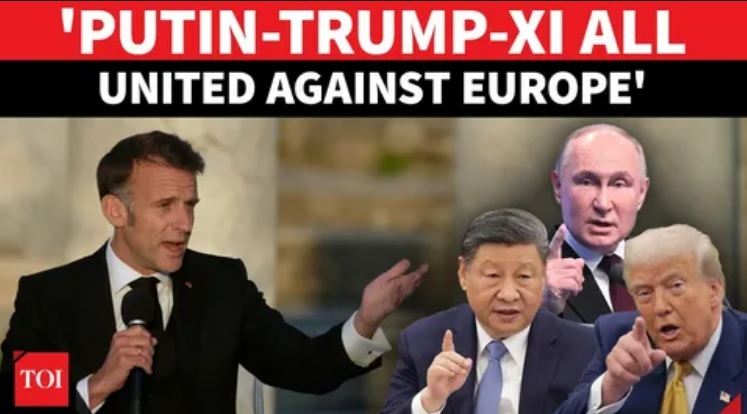
The planned summit between Donald Trump, Xi Jinping and Vladimir Putin could be a welcome development, particularly if it produces any progress at all on nuclear arms control. But it also highlights a serious imbalance in geopolitics: Europe, America's ally and a massive economic power, is nowhere to be seen, Newsweek stresses.
That is partly Trump's unfortunate doing, but it is more a predicament Europe has brought upon itself through decades of political fragmentation, inadequate investment in its own security and excessive reliance on the United States. Essentially, Europe’s bungling of its security strategy helped weaken the trans-Atlantic relationship. And now it hobbles along and fears Putin.
Europe's combined economy reaches $27.1 trillion, more than one-fifth of global output and approaching America's $32.6 trillion. It is larger than China and Russia combined. Yet Putin, with a teeny economy, whose military is fighting Ukraine to a humiliating draw at best, gets a seat at the table while Europe does not.
Of course, GDP is not the only measure of geopolitical power. Russia possesses an enormous nuclear arsenal, and China is rapidly expanding its military capabilities. But Europe includes two nuclear powers, Britain and France, and its resources to potentially ramp up dwarf Russia's.
More importantly, Europe is America's principal alliance partner. The United States' greatest strategic advantage over its rivals has never been simply its own economic or military strength. It has been its ability to lead a vast coalition of prosperous democracies, bound together by security commitments, shared institutions and economic interests.
By marginalizing Europe, Trump risks weakening one of the foundations of American power. Moreover, the United States cannot reasonably expect Europeans to assume greater responsibility for their defense—as Trump famously desires—while excluding them from discussions shaping their security.
This is particularly troubling given Russia's war against Ukraine. European countries have provided enormous financial and military assistance to Kyiv. Washington says Ukraine is not on the summit's agenda. But if this gathering signals a broader shift toward great-power diplomacy conducted over the heads of allies, it well might come up, as occurs with elephants in a room.
There is a historical echo. At Yalta in February 1945, Winston Churchill sat alongside Franklin Roosevelt and Josef Stalin as "The Big Three" to discuss the postwar order. Britain was then still a vast imperial power, ruling hundreds of millions across several continents. In a sense, Churchill represented Europe too. Within a generation, Britain’s empire disappeared. There is no one left to represent Europe in the same way.
Europe's predicament is partly the result of decades of complacency. For much of the postwar era, European governments could afford to spend relatively little on defense because American military power underwrote their security. The United States maintained the nuclear umbrella, supplied much of NATO's military muscle and provided the strategic leadership.
That arrangement allowed Europe to build an extraordinarily prosperous society while avoiding the costs and responsibilities of great-power status. And it also created a dangerous dependency.
Even if a more conventional, Atlanticist American president succeeds Trump, there is little reason to expect a return to the old arrangement. American strategic attention has been shifting toward China for years, and demands that Europe assume more responsibility for its own defense long predate Trump. Mainly, Europe’s dependence is indefensible. It’s hard to argue with Trump about that.
The United States faces growing fiscal pressures, competing global commitments and a political establishment increasingly skeptical of carrying a disproportionate share of Europe's security burden.
Europe needs something more substantial than declarations about strategic autonomy. It needs coordinated defense procurement, a stronger common defense industry, integrated military capabilities and institutions capable of making decisions quickly. It must reduce dependence on American weapons systems and intelligence where feasible, while maintaining NATO. Above all, it needs the capacity to defend its interests, even when Washington's priorities diverge.
This requires difficult political choices, including greater integration in areas where national governments have traditionally guarded their sovereignty.
Put simply: Norwegians (and French, and Germans) will need to be convinced that they need to share collective governance with Romanians (and Italians, and Poles) if they are to punch at the weight of a China or United States. And if they cannot muster this, then they will be endangered by Russia (militarily) and China (in every other way) for the foreseeable future. The alternative is to remain an economic giant and a strategic vassal.
read more in our Telegram-channel https://t.me/The_International_Affairs