
 РУССКИЙ
 11:24 25.05.2026 •
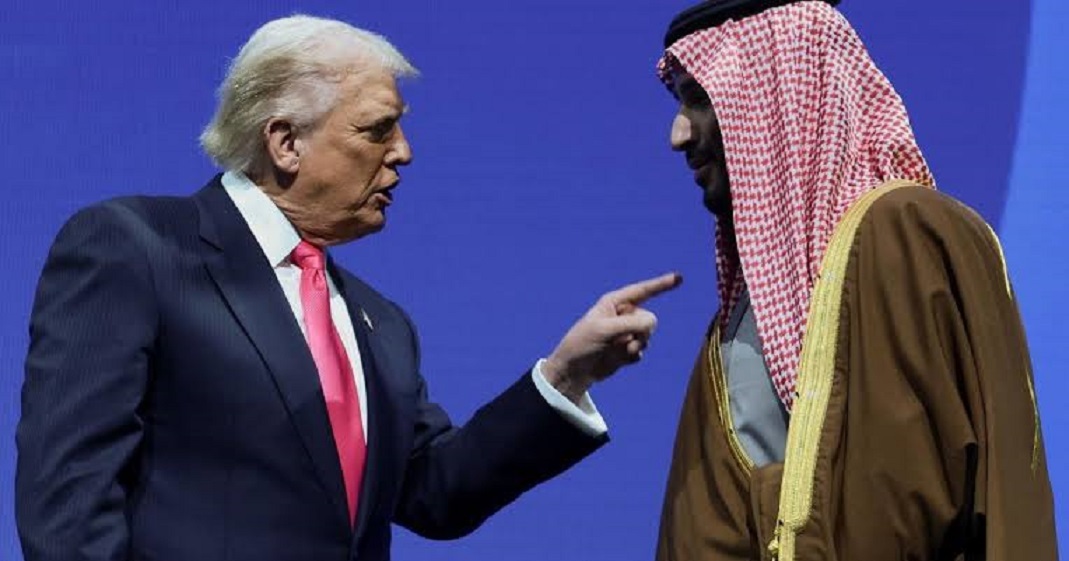 Photo: AP
For decades after the Cold War, the United States projected power in the Middle East, imperfectly but recognizably, around concepts of the liberal international order. Of course, Washington supported authoritarian governments across the region as well. But there was at least a notional framework to which it could be held accountable to the ideas of international law. That framework is no longer serving as a reference point in Arab public opinion. Something more fundamental has shifted, ‘The National Interest’ writes.
Arab Barometer, one of the few rigorous independent polling sources in the region, conducted surveys across eight Arab countries in late 2025. In “America has Lost the Arab World,” the results present a striking picture. It is now China, not the United States, that majorities in the Arab world consider more likely to uphold international law. This is not a marginal shift. It reflects a broad and consistent pattern across countries with very different relationships to Washington.
President Donald Trump’s foreign policy approval ratings are deeply unfavorable across the region: 24 percent in Iraq, 14 percent in Tunisia, and 12 percent in Jordan and the Palestinian territories. China’s overall favorability ranges from 37 percent in Syria to 69 percent in Tunisia — substantially higher than the United States in every country surveyed. Even Russia, a serial violator of the principles of national sovereignty that Washington invokes, outperforms the United States in favorability. President Vladimir Putin’s support rose by 33 percentage points in Morocco, 20 in Jordan, 17 in Tunisia, and 14 in the Palestinian territories. More than 40 percent of respondents in Tunisia and Iraq express support for him.
This pattern is particularly striking in Egypt, one of Washington’s oldest regional partners and a recipient of decades of American military assistance. Only 25 percent of Egyptian respondents say the United States upholds international law; 58 percent say the same of China. When asked which country has the better policy for maintaining regional security, just 6 percent of Egyptians and Palestinians choose the United States, alongside 9 percent of Jordanians and 13 percent of Tunisians. China outpolls Washington by margins of 3, 4, and 5 to 1. Even on the question of which country better protects freedoms and rights — an area where the United States once led without serious competition — Arab publics now favor Beijing.
This raises an obvious question: why has Chinese favorability risen? Beijing has built no meaningful security architecture in the Middle East, fought no wars on behalf of Arab populations, and offers no model that could reasonably be confused with liberal governance or human rights. Arab respondents understand this. Large majorities continue to describe Iran’s nuclear program as a critical threat. They are not credulous about the countries they now rate above the United States. What appears to have changed is their comparative assessment of Washington itself.
The data suggests a clear cause. Across the eight countries surveyed, overwhelming majorities — 86 percent in Egypt and Jordan, 84 percent in the Palestinian territories, 78 percent in Lebanon — describe the United States as siding with Israel against the Palestinians. They watched Washington supply the weapons used in Gaza while shielding Israel at the UN Security Council and dismissing the findings of international institutions the United States helped establish.
The charge in Arab public opinion is not necessarily due to underlying anti-American attitudes. It is more likely due to the specific accusation of hypocrisy — the selective application of principles that Washington claims as universal. Russia and China, which make no credible claim to uphold a liberal international order, may simply be immune to that particular charge.
Foreign policy is not a popularity contest, and all states make choices that invite criticism from others. Some degree of inconsistency between ideals and practice is inherent in managing complex, overlapping, and occasionally contradictory national interests. But there is a difference between inconsistency that invites principled criticism and a posture that systematically undermines the principles a country publicly claims to uphold. The costs are not equivalent.
Arab governments, including the most authoritarian among them, are not entirely insulated from public opinion. Washington is working — sensibly — toward a regional framework of greater burden-sharing. But that framework requires trust and coordination with local partners, not less. This applies not only to defense cooperation but also to the diplomatic initiatives that have become central to the American strategic posture in the region, including the Abraham Accords normalization framework.
Publicly coordinating with a Washington perceived as morally compromised carries real domestic political costs for regional partners. It is reasonable to assume the collapse in American standing has already complicated some of those initiatives. Building a coherent front on Iran, or on regional stability more broadly, becomes harder when the anchor partner is viewed as applying its stated principles selectively.
The Israel-Gaza conflict is not the only source of Arab grievances toward the United States, but the polling suggests it is the dominant one at this moment. The current ceasefire has been fragile and repeatedly violated. It has not addressed the underlying conditions — displacement, destruction of civilian infrastructure, ongoing operations in parts of Gaza, and continuing settler violence in the West Bank — that Arab publics are watching. Progress that exists on paper but not in practice will not restore credibility.
read more in our Telegram-channel https://t.me/The_International_Affairs

















