
 РУССКИЙ
 11:20 20.05.2026 •
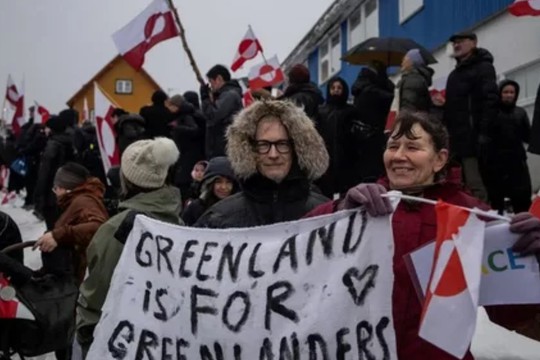
A gathering in January in Nuuk, Greenland’s capital, to protest President Trump
Photo: NYT
With the conflict in Iran still smoldering, President Trump’s obsession with Greenland seems like a forgotten sideshow, ‘The New York Times’ writes.
But for the past four months, negotiators from the United States, Greenland and Denmark, which controls Greenland’s foreign affairs, have been holding confidential talks in Washington about Greenland’s future.
The talks were meant to give Mr. Trump an offramp to his threats of a military takeover of Greenland and to scale back a crisis that risked breaking apart the NATO alliance. But Greenlandic leaders are worried about what is being proposed, which is a much larger U.S. role on the Arctic island. And they fear that if the conflict with Iran winds down, the president will swing his aggression back on them.
Some Greenlandic politicians say they have even circled a date on their calendars to be wary: June 14, Mr. Trump’s birthday.
An investigation by The New York Times, based on interviews with officials in Washington, Copenhagen and Greenland, has discovered:
The United States is trying to modify a longstanding military arrangement to ensure American troops can stay in Greenland indefinitely, even if Greenland becomes independent. The notion is basically a forever clause, and Greenlanders do not like it.
The United States has pushed the talks beyond military matters and wants effective veto power over any major investment deals in Greenland to box out competitors like Russia and China. Greenlanders and Danes strongly object to this.
The United States is discussing cooperation with Greenland on natural resources. The island is loaded with oil, uranium, rare earths and other critical minerals, though much of it is buried deep beneath Greenland’s ice.
The Pentagon is rapidly moving ahead on plans for a military expansion and recently sent a Marine Corps officer to Narsarsuaq, a town in southern Greenland, to inspect the World War II-era airport, the harbor and places where American troops could be housed.
The American demands are so steep, Greenlandic officials fear, that they amount to a major imposition on their sovereignty. Despite all of the talk from Danish and American officials that Greenland’s future is up to the island’s 57,000 people, Greenlandic officials said the American demands would tie their hands for generations.
If the Americans get everything they want, said Justus Hansen, a member of Greenland’s Parliament, there will never be any “real independence.”
Gen. Gregory M. Guillot, the head of the Pentagon’s Northern Command, described in a recent interview with The Times the broader American vision to defend the Arctic, an arena of increased geopolitical competition as climate change melts polar ice and opens up what had been one of world’s most inaccessible regions.
General Guillot said Greenland would be part of a chain of interlinking radar stations and military bases, which also includes sites in Alaska and Canada. He said the American military needs a deepwater port and a base for Special Operations soldiers who would rotate through Greenland for training and exercises.
General Guillot said this could be done through the defense pact that the United States signed with Denmark in 1951, when Greenland was still a Danish colony. That pact has been the jumping off point for the current negotiations, and Greenlandic and Danish officials originally tried to argue that the agreement gave the United States such a free hand for forces on Greenland that there was no need to take over the island.
Negotiators have met about five times in Washington since January, when Mr. Trump threatened to seize Greenland, saying it was essential to American national security. Though he eventually backed down and has since been absorbed by the conflict in Iran, the White House has indicated he is still deeply interested in Greenland.
So the Greenlandic, Danish and American negotiators involved in the talks hope they can reach a deal that the mercurial president will accept, officials familiar with the discussions say. The accounts made clear that there was still some distance to go. The officials who spoke to The Times asked not to be identified because of the sensitivity of the continuing negotiations.
Greenlanders have been emphatic they do not want to be part of the United States, but Greenlandic politicians say they are OK with having more American soldiers on their soil. Thousands of American troops were stationed there during World War II and the Cold War, though the United States eventually shut down every base save one.
Still, Greenland’s leaders feel they are being pressured to make other concessions and that they have little leverage in these talks.
“None of this is fair,” said Pipaluk Lynge, the chairwoman of the Greenlandic Parliament’s foreign affairs committee. “It feels very all or nothing. The best outcome is simply not to be invaded or controlled.”
Over recent decades, Greenland has steadily gained more autonomy from Denmark, and most people on the island want to be independent some day. But Greenland lacks the intelligence capability to screen potential investors for links to Moscow and Beijing. So negotiators are discussing a process by which Copenhagen would do the screening, with American input.
The result could be that the negotiations, far from increasing Greenland’s sovereignty, end up giving Denmark more sway over the gigantic island.
read more in our Telegram-channel https://t.me/The_International_Affairs

















