
 РУССКИЙ
 8:55 03.05.2026 •
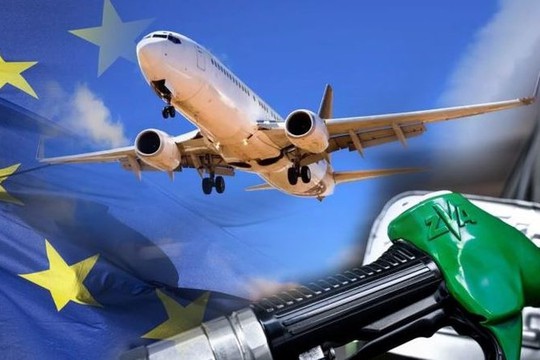
Pic.: POLITICO
As airlines ground planes and officials urge citizens to cut back on their commutes, Europe’s effort to prevent shortages caused by the Iran war is running into an unexpected hitch: Nobody knows how much fuel the continent actually has.
The scramble comes as the war in Iran drives up Europe’s fossil fuel bill and threatens to choke off supplies moving through the Strait of Hormuz, a key artery for oil and gas. European Commission President Ursula von der Leyen said Wednesday that the conflict is costing the EU nearly €500 million a day in higher energy costs, even as U.S. President Donald Trump has ordered his aides to prepare for a prolonged blockade of Iran that could further disrupt global energy markets.
“In Europe, we have visibility and commitments into May and June… what happens beyond is hard to forecast,” Tobias Meyer, chief executive of DHL Group, said during a press breakfast attended by POLITICO. “There are strategic reserves, but there's not much visibility on how much has been drawn.”
They want to know
Officials wanting to know when the taps might run dry have very little to go on — a blind spot that risks leaving them unable to identify shortages or forced to make emergency decisions based on partial information.
At a high-level summit last month, ministers from Belgium, the Netherlands and Spain called attention to these knowledge gaps, urging the EU to coordinate more real-time monitoring and analysis, particularly around refined products, according to minutes seen by POLITICO. Greece's delegate went so far as to ask the Commission to set up a WhatsApp or Signal channel between member countries and the EU executive.
"We have very limited market knowledge and data for gas and oil," said one senior European energy ministry official, speaking like others quoted in this article on condition of anonymity to discuss the sensitive matter openly. "Our knowledge of what is being put into circulation, and withdrawn, and sent along different routes... there is certainly a lack of market monitoring."
When it comes to refined fuels like diesel and jet fuel, the picture is especially murky. The EU relies primarily on its official statistics service Eurostat and coordination meetings with member countries to gauge supply levels. But most stocks sit out of sight in scattered commercial inventories spanning diverse sectors, with firms reluctant to disclose sensitive business data that they’re not legally obliged to report.
Since the war began, energy ministers have called on the European Commission, the EU's executive branch, to bolster the bloc's ability to gauge the supplies held across the continent in underground facilities, rows of tanks at major ports, vast supertankers bobbing off European coasts, and depots in airports and along key pipelines.
Fog of war
What is known isn't especially comforting.
Europe’s gas stocks, for a start, were already low before the attack on Iran, averaging under 30 percent of national capacity thanks to sharp drawdowns over the winter. Refilling those reserves depends on incentivizing traders, who generally prefer to pump gas into storage in the summer when prices fall, and sell in the winter when prices rise. But the Iran war risks inverting that dynamic, and EU efforts to resolve the problem have met a mixed reception.
The rerouting of global energy markets that followed the blockage of Hormuz risks upending that dynamic further. Tankers are no longer being diverted to Asia from Europe but are simply steaming there directly from West Africa and the U.S., said Charles Costerousse, a natural gas analyst at market research firm Kpler.
The IEA’s most recent report details that European inventories were already low in February compared to the year before, but it includes limited data for March.
Tracking jet fuel stocks — held primarily in fixed-roof tanks — is “much more difficult,” Falakshahi said. Data on the fuel is drawn largely from voluntary disclosures by companies, and the lack of transparency is consistent with ongoing disagreements over how much fuel Europe has left.
read more in our Telegram-channel https://t.me/The_International_Affairs

















