РУССКИЙ
 11:39 05.05.2026 •
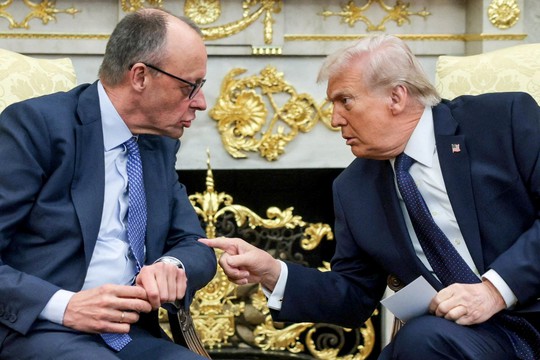
Trump vs Merz: “Shut up and listen!”
Photo: Reuters
The German chancellor is casting around for someone to blame abroad as growth stalls and his popularity nosedives at home, POLITICO notes. Germany’s economy is flatlining, and Chancellor Friedrich Merz is blaming everyone but himself.
The chancellor was elected on a promise to jolt Germany’s enervated economy back to life, but one year on, he and his conservative-led government have failed to do so. As Merz’s dismay grows and his popularity plummets, he is increasingly lashing out at factors beyond his immediate control — from the war in Iran to what his government casts as heavy-handed regulation and waste in Brussels.
The chancellor chose an unlikely place to vent his frustration: on the stage of a high school auditorium in his home region in rural western Germany.
A subdued Merz told students the U.S. had been “humiliated” by Iran’s regime, lacks a strategy for ending the war, and has left peace talks empty-handed — causing significant economic damage to Germany given the resulting surge in energy prices.
“It’s costing us a lot of money — a lot of taxpayer money — and it’s costing us a lot of economic strength,” Merz said. “This war against Iran has a direct impact on our economic performance, and for that reason it must be brought to an end as soon as possible.”
For Merz, who has sought to keep friendly relations with Trump, the rebuke likely reflects a clear political calculus. Trump and the war are deeply unpopular in Germany, making them expedient targets for the chancellor.
The same logic underpins Merz’s attacks on Brussels: Railing against red tape — from AI rules to public spending — plays particularly well among business leaders at home while shifting blame outward.
At a trade fair in Hannover the chancellor said he would push to “exempt industrial AI from the current regulatory straitjacket” imposed by the EU. Merz’s conservatives have also launched an effort to get European Commission President Ursula von der Leyen to slash regulations more aggressively, while the chancellor has also pushed back strongly against her budget plans, calling instead for “across-the-board cuts in all sections” of the EU executive’s proposal.
Merz’s attacks on Brussels are part of a bid to placate German industry leaders, who blame excessive EU regulation for a loss of competitiveness. Four in five German firms complain that bureaucracy has increased over the past three years, according to a survey of 1,000 companies by the German Economic Institute. More than 90 percent want EU rules scaled back.
Merz’s attempts to pin the blame abroad have a great deal to do with his limited domestic options and sinking popularity. The chancellor this week, for the first time, fell to last place in polling firm INSA’s popularity ranking of Germany’s 20 most prominent politicians. Meanwhile, only 15 percent of Germans said they are satisfied with Merz’s centrist coalition, according to Germany’s benchmark ARD-DeutschlandTrend poll released early this month, a new low.
As dissatisfaction with Merz’s government grows, the far-right Alternative for Germany (AfD) party — which has been hitting the government hard on the economy and high energy prices — has surged to new heights in polls, and is now the most popular force in German politics, according to POLITICO’s Poll of Polls.
While German business leaders broadly support Merz’s effort to scale back EU regulation — and see eye-to-eye with the chancellor on the need for a U.S.-Israeli peace deal with Iran to bring down energy costs — many still blame domestic politicians for repeatedly failing to understake structural reforms.
“We are no longer competitive as a business location,” Peter Leibinger, president of the Federation of German Industries business association, said earlier this month at the Hannover trade fair. Geopolitical developments like the Iran war didn’t cause the country’s economic malaise, they merely exacerbated it, Leibinger added.
“The cause lies with us,” he said.
read more in our Telegram-channel https://t.me/The_International_Affairs