
 РУССКИЙ
 11:15 06.06.2026 •
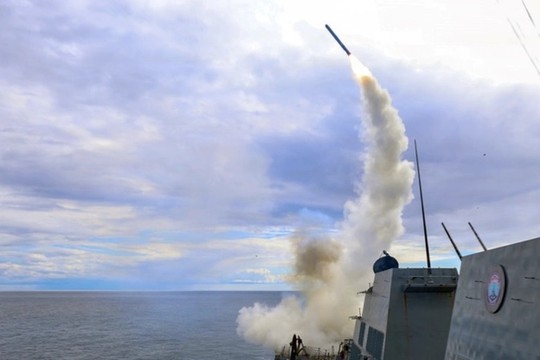
Arleigh Burke-class guided-missile destroyer USS Thomas Hudner fires a Tomahawk missile at sea on March 1, 2026 during the Iran war. | US Navy via Getty Images
The Pentagon is expected to cancel a plan to send Tomahawk missiles to Germany partly because officials are concerned Russia will view it as an escalation, a startling reversal of a long-planned agreement with one of America’s biggest allies, writes Politico.
U.S. officials fear Moscow will retaliate if the Trump administration follows through on the effort to deploy precision missiles in the middle of the continent, according to two European officials and one American official. But any decision not to deliver them would yank back a deal made during the Biden administration and leave Berlin without defenses German leaders say they desperately need.
The move is part of a wider American retrenchment from the NATO alliance — including canceled deployments of thousands of U.S. troops to Germany and plans to pull back certain assets — as the U.S. upends the close-knit partnerships that cemented the relationship for generations.
Europe “can step up now and in the near term,” Gen. Alexus Grynkewich, NATO’s top commander and the head of U.S. forces in Europe, told military leaders this week. America, he said, will “refocus” equipment and forces elsewhere.
American officials, even if primarily fearful of Russia’s reaction, likely are also worried about the shrinking U.S. weapons stockpile. The U.S. churned through thousands of Tomahawk and Patriot missiles in the first weeks of the Iran war. Defense Secretary Pete Hegseth told Congress last month that it will take “months and years” to replace the munitions spent in the military conflict.
The likely Tomahawk reversal is particularly unsettling for German officials, who are rushing to modernize their atrophied force to serve as a bulwark against Russian aggression. German Chancellor Friedrich Merz said last month that he did not expect the U.S. would station Tomahawk missiles in Germany due to limited availability of the cruise missiles, which can travel over 1,000 miles.
“The Americans don’t have enough for themselves right now,” he told German public television.
The U.S. unveiled further changes to its role in NATO this week at a quarterly conference of military leaders. These include reductions in fighter jets, drones and naval units, according to WELT, part of the Alex Springer Global Reporters Network, which includes POLITICO.
“The whole point is to give allies the information and clarity they need to drive forward as quickly and effectively as possible,” said a Defense Department official, who like others, was granted anonymity to discuss internal conversations. This is about “allies taking primary responsibility for Europe’s conventional defense.”
The Pentagon did not respond to a request for comment.
Berlin has felt the retrenchment particularly hard. The Pentagon this spring canceled the deployment of 5,000 U.S. troops to Germany, a move that stunned European officials and GOP defense hawks.
The troop decision, which reduces levels to what they were before the Ukraine war, came after Merz said President Donald Trump had “humiliated” himself with the Iran war. The Pentagon has not yet released the plan for those troops, two American defense officials said, and whether they might deploy elsewhere in Europe.
The U.S. may worry about Moscow, but Germany and the rest of Europe must contend with an all-out war between Russia and Ukraine on their doorstep.
Russian forces have long deployed nuclear capable Iskander missiles to the Kaliningrad exclave between Poland and Lithuania. They also have placed medium-range Oreshnik missiles in Belarus, which can reach all of Europe in a matter of minutes. Eastern and Central Europe officials have eyed the moves warily, as they are still working on fielding their own comparable systems.
“We submitted an official request to the Americans a year and a half ago to import — that is, to purchase — Tomahawk missiles,” German defense minister Boris Pistorius told German public television last month. “We are still awaiting a response. But to be honest, given the current state of the world, I don’t have much hope in that regard.”
Pistorius expressed interest in buying America’s Typhon ground-based missile system, which launches Tomahawks, on a Washington visit last July with Hegseth, according to the Germany defense ministry. But he has not received an update.
German officials have been exploring European alternatives to fill the long-range precision-strike gap. The debate in Berlin is less about any single weapons system than about how quickly Germany can acquire the ability to hold targets at a distance — whether through off-the-shelf purchases, expanded production with allies or longer-term European development.
Drones and cheaper systems may help, but German defense planners do not see them as a one-for-one replacement for Tomahawk-class missiles. German officials are worried more broadly that the U.S. pullback will force Europe to close military gaps faster than its defense industry can deliver.
read more in our Telegram-channel https://t.me/The_International_Affairs

















