
 РУССКИЙ
 12:13 09.06.2026 •
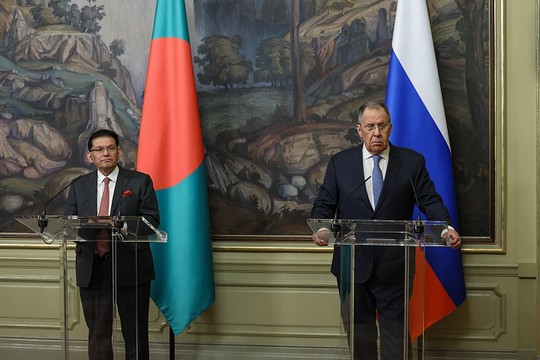
Photo: MFA
Foreign Minister Sergey Lavrov’s statement and answers to media questions at a joint news conference following talks with Minister of Foreign Affairs of Bangladesh Khalilur Rahman.
Moscow, June 8, 2026
Ladies and gentlemen,
I would like to express my gratitude to a colleague and long-standing acquaintance of mine Khalilur Rahman who is Minister of Foreign Affairs of Bangladesh and President of the forthcoming 81st session of the UN General Assembly, a post to which he was elected several days ago. Following his election as President, his first foreign visit was to the Russian Federation, which I greatly appreciate, especially since his and my service at the UN overlapped in the 1980s and later when we worked together as members of our respective national delegations.
Also notable is the fact that this is the first ministerial-level meeting since the new government of Bangladesh has been formed following the parliamentary elections in February.
Bangladesh is a long-standing partner of Russia in South Asia. Relations between our countries were established more than half a century ago. January 2027 will mark their 55th anniversary. We have agreed to celebrate this anniversary in a manner befitting its significance. Our relations are steeped in traditions of friendship, mutual assistance, and non-interference in one another’s internal affairs, as well as equality.
We maintained constructive political dialogue throughout almost entire history of our relations. This time, we focused on trade and economic ties.
Bangladesh is second only to India as our trade partner in South Asia. Even though trade experienced minor ups and downs in recent years, it has never fallen below $2 billion which is an impressive figure. We agreed that prospects were good for growing it even more.
The world needs a more reliable payment system if we want to expand trade under current geopolitical circumstances when trade, economic, and investment relations as well as, indeed, all other relations between countries have come under illegal pressure from the West. We discussed this. We also agreed to work through substantively the full range of our economic ties as part of the Russia-Bangladesh Intergovernmental Commission on Trade, Economic, and Scientific and Technical Cooperation, which will meet for the fifth time this year. We will prepare thoroughly for it.
Energy remains the key area of bilateral cooperation. The construction of the Rooppur nuclear power plant is our largest joint project. The ceremony for physical launch of its first power unit took place on April 28. Rosatom CEO Alexey Likhachev attended the ceremony. Today, Foreign Minister Rahman will hold a separate meeting with him. More meetings have been planned, including meetings with First Deputy Chairman of the Executive Board of Sberbank Alexander Vedyakhin and Deputy Speaker of the Federation Council Konstantin Kosachev.
Both sides have a stake in stepping up interparliamentary contacts through friendship groups and otherwise. Such a group already operates on our side, and our Bangladeshi friends will put one in place as well.
In addition to Rosatom and Sberbank, other Russian companies are interested in pursuing new cooperation projects as well. Interest is also shown by Lukoil, Rosneft, Gazprom International Limited, and Novatek.
It also came to our attention that our Bangladeshi colleagues are interested in making wider use of the opportunities provided by international platforms hosted by the Russian Federation. For example, the Bangladeshi delegation took a constructive part in the recently concluded St Petersburg International Economic Forum. We hope our Bangladeshi friends will take part in the Eastern Economic Forum in Vladivostok in September as well.
We agreed to take stock of our legal treaty framework. Numerous draft agreements have been under consideration for quite a while. We also agreed to have our deputies and legal experts engage actively on this issue. This will contribute to reinforcing the foundation of our relations across all areas, including between our respective foreign ministries.
We agreed to step up regular consultations on key matters of regional and international politics between our foreign ministries’ designated departments.
We discussed the regional and global agenda, including immediate and long-term consequences of American-Israeli aggression against Iran and its negative impact on energy security of many countries, including Bangladesh. UN-related issues also came under discussion, since Foreign Minister Khalilur Rahman will start chairing the 81st session of the General Assembly in September.
We appreciate our Bangladeshi friends’ balanced and objective position with regard to the situation in and around Ukraine. I briefed Minister Rahman on our assessment of the most recent developments in this area. In turn, Mr Rahman shared his assessments of the exceedingly acute issue of more than one million Rohingya refugees from neighbouring Myanmar residing in Bangladesh. Russia’s stance on this issue is well known and we reiterated it. This issue needs to be resolved bilaterally between Bangladesh and Myanmar. External forces should not stand in the way of this process, but should instead encourage both sides to come to terms. What we’ve seen so far is a number of external actors actively trying to support and provide weapons to anti-government forces that are using extremist methods to oppose the Myanmar government.
Overall, we are satisfied with the discussion. I hope we will see each other again soon during the 81st session of the UN General Assembly. I sincerely thank Minister Khalilur Rahman for cooperation.
Question: How likely is the resumption of talks with Ukraine in light of recent events, including the terrorist attacks against civilians in Starobelsk and the attacks on Zaporozhskaya Nuclear Power Plant? Is the United States still part of the efforts to achieve a political settlement?
Sergey Lavrov: Regarding the likelihood of seeing talks with Ukraine resume, or the Ukraine issue more broadly, President Putin addressed this issue in depth during the plenary session of the 29th St Petersburg International Economic Forum. He also commented on the extensive letter which Zelensky put out the day before. The letter was addressed to President Putin but, for reasons that are not entirely clear, was circulated worldwide. People with good manners do not normally do so. The President’s assessment of the letter was that Ukraine had no interest in negotiations.
We are ready and willing to talk, but talks must be honest and without tricks, unlike what occurred before the February 2014 coup. At that time, negotiations resulted in an agreement on a settlement, including the formation of a national unity government and the holding of early elections. Yet the very next morning, the opposition, in violation of the guarantees in the form of signatures of France, Germany, and Poland, carried out a coup and went after President Viktor Yanukovych, with whom they had signed the document guaranteed by the Europeans.
Incidentally, the current President of Germany, Frank-Walter Steinmeier, was the German signatory. This provided a genuine opportunity to reach a negotiated settlement, and it was even presented as Europe’s success. However, that success lasted only until the next morning. Subsequently, Germany and France served as mediators in the Minsk process. The Minsk Agreements were concluded, but it later transpired that the document merely served as a smokescreen, including for the Europeans themselves. Several years ago, after leaving office, former German Chancellor Angela Merkel and former French President Francois Hollande openly admitted that no one had even intended to act on those agreements and that their sole purpose had been to buy time to flood Ukraine with weapons, so that it could do a better job killing Russians. That is precisely what the current regime continues to do today, using weapons, intelligence and satellite data provided by the West, without which the war against Russia would’ve been impossible.
We talked with the Ukrainian side in Istanbul in April 2022. At Ukraine’s own initiative, we agreed to its proposed approach and initialled the principles that were to form the basis of a final settlement agreement. President Putin likewise noted during his speech at the plenary session of the 29th St Petersburg International Economic Forum that the West, including President Macron and then British Prime Minister Boris Johnson, did everything possible to foil that agreement.
Speaking of the most recent negotiations, almost a year ago, in Anchorage, Alaska, in August 2025, President Putin - he made a point of it as well - accepted a very specific proposal put forward by President Trump in a spirit of compromise. That is how those talks ended.
I very much hope that previous failures, when the West refused to honour agreements it had itself supported, will not be repeated with regard to the understanding reached in Alaska. Unfortunately, however, our US partners have so far shown no interest in it.
President Putin recently reaffirmed, and this has been confirmed at other levels as well, that we remain prepared to be guided by the understandings clearly set out during the Anchorage summit on August 15, 2025.
What does concern us, however, is a statement made recently by State Secretary Marco Rubio, who conveyed during congressional hearings that the United States was not in a position to act as a mediator because it supported Ukraine. Similar remarks were made by notorious Kaja Kallas and by a number of other EU and EC figures. This is why I find it difficult to comment on prospects for negotiations.
The word I’m getting is that - I believe it was yesterday - the leaders of UK, France, and Germany, together with Zelensky, signed in London a document on the strategic support for the current regime and on preparations for the deployment of “stabilisation forces” - in other words, occupation forces - on whatever territory remains of Ukraine after the conflict comes to an end. They also reportedly agreed to provide Ukraine with additional long-range weapons to attack Russian territory, including targets deep inside our country. Against such a backdrop, I do not see how one can even mention negotiations. Everyone should probably take seriously what President Putin said in response to questions during the plenary session of the 29th St Petersburg International Economic Forum: everything now depends not on negotiations but on what our frontline heroes are doing.
Question: Reportedly, former President of Chile and candidate for the post of UN Secretary-General Michelle Bachelet may soon come to Moscow on a visit. We wonder whether Moscow has a preferred candidate for the post of Secretary-General. What is our position on the idea that this post could be held by a woman for the first time in history?
To follow up on that, how do we see a fair and balanced organisation of a new UN Secretariat? Will we push for reforming the Secretariat?
Sergey Lavrov: You don’t expect me to share our preferences, do you? You are asking whether Moscow has preferences. This is, after all, a working matter. It’s a diplomatic process.
We want the Secretary-General to fully meet the requirements set out in the UN Charter, namely, impartiality and categorical refusal and unacceptability of receiving instructions from any Member State and, in general, the implementation of the tasks set out in the UN Charter understood as an indivisible and interdependent whole rather than a set of isolated provisions. Unfortunately, the Secretary-General in office, whom I know very well and have known for a long time, and who has worked extensively within the Organisation, does not meet these requirements. He openly sides with the West on the Ukrainian issue among other matters.
Let me give you an example we have mentioned during the talks. Public statements by the Secretary-General and his staff on Ukraine have consistently come down to underscoring the importance of complying with the UN Charter and respecting the principle of Ukraine’s territorial integrity. When I confronted him on how we are supposed to reconcile this with the other principles of the UN Charter beyond territorial integrity, in particular the principle of the self-determination of peoples, he said that it was beside the point.
Notably, when US President Donald Trump suddenly mentioned Greenland, and at a news conference the spokesperson of the UN Secretary-General was asked how the UN leadership viewed the US claim to the island, the answer was quite interesting and quite different from answers given to questions about Ukraine. The Secretary-General’s spokesperson said that in the case of Greenland, they believed one should be guided by international law, the UN Charter, the territorial integrity of Denmark, and the right of the Greenlandic people to self-determination.
For obvious reasons, we immediately asked the Secretary-General why self-determination in relation to the Greenlandic people was readily recognised, whereas in relation to those who rejected the results of the bloody coup in Ukraine in 2014, such recognition doesn’t exist. The answer they gave was in line with the current Secretariat leadership that “this is a different matter.” This is what the West keeps telling us every time we catch it in the act or, as the saying goes, with its hand in the cookie jar.
The Secretariat reform is necessary. We have already advocated the reform at the Security Council and at the General Assembly (including in my statements at the most recent 80th session). At present, the leadership of the Secretariat is Western-dominated, or to be more precise, NATO-dominated. The UN Charter contains only one criterion for staffing the Secretariat which is equitable geographical representation to make sure all regions and all countries are represented proportionally.
Decades ago, outside the UN Charter framework (largely on the initiative of our Western colleagues), additional criteria were adopted, such as population size, GDP, per capita income, and industrial output. As a result, quotas in the Secretariat were distributed in such a way that Western countries ended up with the majority, as they were far more developed, with higher GDP and industrial output, and so on. This is not to say that other countries were taken out of the equation altogether, no. All countries are more or less represented at the UN Secretariat. They occupy either mid-level quotas, or somewhat higher or lower positions, and this state of affairs needs to be balanced.
But this is not the point. One must focus on the positions that truly represent the UN authority: the leadership of the Secretariat and the leadership of departments through which the bulk of the UN budget flows. There are several such posts: the Secretary-General himself is from Portugal, a NATO country; his First Deputy is a lady from Nigeria, but also a subject of the United Kingdom, meaning NATO; the Under-Secretary-General for Political Affairs is also a British subject; the Under-Secretary-General for Peace Operations is a French person, NATO; the Under-Secretary-General for Humanitarian Affairs is British, NATO; the Under-Secretary-General in charge of system-wide security, including the safety of personnel, agencies, buildings and premises is a Canadian, someone from a NATO member country. Recently, a new Under-Secretary-General in charge of advancing UN reform under the Secretary-General’s UN80 initiative’ report was appointed. As luck would have it, he is also British.
Here you have a group of seven individuals who control the key transmission belts of the entire UN system. This is not acceptable.
I will close with what you asked at the beginning: Michelle Bachelet is now in Moscow. We will have a meeting in a few hours. And we have absolutely nothing against women heading this organisation, or any other organisation, for that matter.
Question: Bangladesh said it was willing to join BRICS back in 2023. It is already a member of the New Development Bank. Was Bangladesh joining the group discussed today? How will BRICS benefit from such accession?
Sergey Lavrov: The benefits of joining BRICS are obvious. A large number of countries, many more that the number of current members, wish to benefit from these advantages. We are fully aware of the considerations that drive the applicants, including our friends from Bangladesh, who are already the New Development Bank shareholders and are quite happy with their status.
Today, we discussed that the Bank should gradually move away from discredited global reserve currencies (the US dollar and the euro) and rely more on developing new independent platforms and settlement mechanisms that are free from Western pressure and sanctions, as well as supply systems that are not exposed to the daily risk of sanctions. This work is gradually progressing, and we expect tangible progress in the foreseeable future.
As for BRICS, its ten members have reached an understanding that we need to put the admission of new members on hold. Two years ago, the number of BRICS members doubled from five to ten. We now need time for BRICS to settle in the new format.
When this pause comes to an end, we will look favourably upon the candidacy of Bangladesh which is a large and important Asian country.
read more in our Telegram-channel https://t.me/The_International_Affairs

















