РУССКИЙ
 0:23 26.11.2026 •
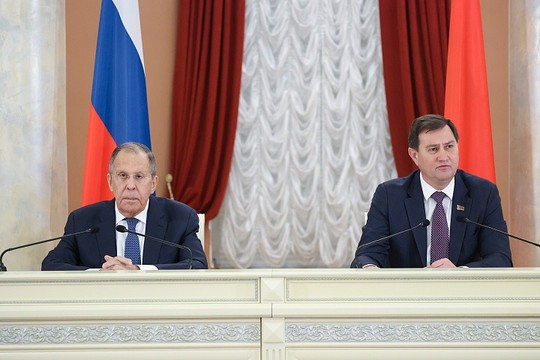
Photo: MFA
Foreign Minister Sergey Lavrov’s remarks and answers to media questions during a joint press conference with Foreign Minister of Belarus Maxim Ryzhenkov following a joint meeting of the collegiums of the Foreign Ministries of Russia and Belarus, Gomel, November 25, 2026
Mr Ryzhenkov,
Mr Glazyev,
Colleagues,
First of all, I would like to express our gratitude to our Belarusian friends and the administration of Gomel and the Gomel Region for a warm and hospitable welcome and the eventful agenda of our visit.
On the 85th anniversary of the beginning of the Great Patriotic War, we paid tribute to the defenders of our common Fatherland. We laid wreaths to the Eternal Flame, the monuments of the Memorial Complex on Vosstaniya Square, and the monument to Marshal Konstantin Rokossovsky, unveiled in 2025 with the support of the Russian Military Historical Society.
We have also unveiled a bust of Russian Imperial Foreign Minister Nikolay Rumyantsev (another initiative of the Russian Military Historical Society), and sent our greetings to the participants of the Russia-Belarus Research Forum Historical Science and Education: Cooperation within the Union State in Social Sciences and Humanities, which is underway at Gomel University.
Before the collegium meeting, my colleague Maxim Ryzhenkov and I, as it has been said here, discussed current bilateral issues in a traditional atmosphere of trust, including diplomatic support for the development of the Union State. We also exchanged views on international issues. We have agreed to continue to provide allied assistance to each other and to support our common interests on the international stage.
We had a progress report on the 2024-2026 Programme for Coordinated Foreign Policy Action. The new programme has just been signed 2027 through 2029. It places a special emphasis on countering the Western aggression against our countries in its legal aspects, as well as in terms of sanctions and in the sphere of information. It also focuses on topics related to the SCO, BRICS and Eurasian security. The human dimension has been expanded in the programme’s new version by prioritising efforts to preserve historical memory. The new programme will be submitted for approval to the Union State’s Supreme State Council in early 2027.
We signed a plan of consultations between the Foreign Ministries in 2027. It covers a wide range of topics. By the way, apart from the planned consultations, we have many additional consultations considering the rapidly changing international environment. You cannot possibly plan and anticipate everything.
The Board’s resolution sets out the agreements resulting from the meeting.
We agreed to continue enhancing our coordination within the United Nations and UN’s specialised agencies for promoting our shared priorities. In addition, we noted that development assistance projects funded from Russia’s contributions and carried out by the UN in Belarus have been very effective.
We praised our region-to-region cooperation, which has enabled our Belarusian friends to win a significant and growing share of the Russian market with a focus on supplying products for machine engineering, agricultural production, construction, and setting up joint manufacturing ventures. This helps create jobs, enables manufacturers to fill their order books, and facilitates the sharing of best practices and technology.
Just as Maxim Ryzhenkov has said, the number of consular offices has increased in the regions of both the Russian Federation and the Republic of Belarus, including here in Gomel, where our Consulate General is about to open an office.
Last year, delegations representing the regions of the Russian Federation accounted for over 100 visits to Belarus alone, including 44 delegations led by governors. And there were about 100 visits to Russia by delegations representing Belarusian regions.
We have set forth an agreement to enable our foreign missions to work together when facing crisis situations or emergencies in the countries of their presence. Today, we heard a report on the way we offer one another mutual assistance when facing challenging situations, and when our diplomats find themselves in situations of this kind.
Maxim Ryzhenkov has also said that we paid special attention to agreeing on the Eurasian Charter for Diversity and Multipolarity in the 21st Century. We will seek to draw more countries into this negotiating process. It is obvious that many countries are interested.
We agreed to prepare the 35th anniversary of diplomatic relations between Russia and Belarus in 2027 so that these celebrations fit the occasion and are up to the standard. We are also convinced that today’s meeting demonstrated once again that our strategic partnership and alliance stand firm, while also reaffirming our commitment to strengthening foreign policy coordination.
Once again, I would like to thank all the participants in this meeting for effectively contributing to our joint efforts.
Question: It has been stated on multiple occasions that the Eurasian Charter of Diversity and Multipolarity in the 21st Century must become a framework document that will formalise pivotal approaches to the security on the continent. Will the resolution of the Ukrainian issue be handled as a separate track or will its parameters be built into the charter’s logic?
Sergey Lavrov: The draft of the charter is publicly available. Rather than addressing specific crises or conflicts, this document centres around the crisis resolution principles that would be generally accepted by all the countries of the continent.
This applies to situations like the Ukrainian crisis. There are quite a few other similarly complicated issues faced by the Eurasian continent, including the Middle East, the developments around Iran and the Arabian Peninsula in general. There are problems in Palestine, which, as you are aware, is at a stalemate, with no prospects of returning to honest fulfillment of UN resolutions in sight. There are issues at the eastern frontiers of the Eurasian continent as well as in Southeast Asia, with territorial disputes over the Taiwan Strait and the South China Sea. I could go on.
As I said, the purpose of approving the charter is to develop universally acceptable principles and approaches to this sort of situation. Each case has its own specifics, so we can’t paint them with the same brush.
Yet, there are universal approaches that must inevitably be applied to all these cases. Before anything else, I should mention the importance of addressing root causes of crises. It is a matter of principle. This criterion is valid to the Ukrainian crisis, the situation around Palestine, and the Persian Gulf issue alike.
I should note that we are not the only country advocating this approach. In February 2023, China released its Global Security Initiative, announced by President Xi Jinping in April 2022. One of the key criteria generally applicable to any crisis which is put forward in this initiative is the need for identifying root causes and focusing on their elimination.
Therefore, we specifically emphasise in the draft charter that it is merely an invitation to engage in dialogue. We are not issuing any ultimatums. The power of the future charter is in being universally acceptable and based on consensus. To this effect, in addition to inviting all the countries of the Eurasian continent to work together, we propose – and we have approached the respective bodies with this proposal – participation of subregional organisations, especially the CSTO, the EAEU, the SCO, the GCC, and ASEAN. We have already established contacts with ASEAN.
So, this process will be based on reality and the actual initiatives and interests coming from the countries and associations on this continent that we share.
Question: On November 19 this year, representatives of Russia and Georgia held their first meeting in Minsk. This was the first meeting in this format since 2008. Is this a one-off contact? Or is Minsk once again becoming a venue for direct dialogue?
Sergey Lavrov: I would like to thank our Belarusian friends for providing a venue for that meeting. We are interested in normalising relations with Georgia. I welcome the recent statement by the Georgian Foreign Minister, Maka Bochorishvili, to the effect that there is no need to fear engaging with the Russian Federation. I consider this to be a pragmatic approach which serves the interests of the Georgian people and benefits our relations with Georgia.
Question: The European Commission has declined to hold bilateral consultations with Russia on European security. Prior to this, Europe had been discussing the candidacy of a negotiator for quite some time. What accounts for such an equivocal position?
Sergey Lavrov: We have never held any discussions with the European Commission concerning negotiations on the Ukrainian crisis. The European Commission regularly issues various statements. However, the fact that these are not accompanied by any concrete proposals conveyed to the Russian side through diplomatic channels underscores the lack of seriousness in Brussels’ approach, in particular that of the European Commission, which resorts to megaphone diplomacy.
Some interesting statements have also been made. Polish Prime Minister Donald Tusk declared that no one intends to consult the Russian side as to what the European aspect of the forthcoming negotiations should be. The EU High Representative for Foreign Affairs and Security Policy, Kaja Kallas, remains in her post, and her statements must therefore also be taken into account. She asserted that Europe already has a security architecture – NATO and the European Union – and that no one should attempt to alter that architecture. She also said that the main task is to integrate Ukraine into NATO and the European Union. She added that the European Union must not allow a settlement that accommodates Russian interests.
We therefore know full well the true worth of the position voiced by the Europeans. Recently, there has been discussion of statements from Brussels to the effect that they had, as it were, agreed on a team (they were asked about a negotiator) – a European quintet, comprising France, Germany, Britain, Italy and Poland, plus representatives of the European Union and NATO. That already makes seven. They have stated publicly that this “seven” must “embed itself” in the negotiating process, which has now resumed with the participation of Russia, the United States and Ukraine in Abu Dhabi.
We proceed from the assumption that we must first understand what role Europe intends to play in the negotiations and what goals it has set for itself. If those goals are as set out in the statements I have quoted, to the effect that only NATO and the European Union will determine the European architecture, and that accommodating Russian interests must not be allowed, then why conduct such negotiations at all?
We have therefore asked representatives of European countries to come to us or to otherwise set out their position. Their reply was: “No, we do not want to set out anything to you. We want to sit down at the negotiating table straight away.” However, with such manners and intentions, they will sit down at the negotiating table and immediately put their feet on it. We have no need for that.
read more in our Telegram-channel https://t.me/The_International_Affairs