РУССКИЙ
 11:46 21.04.2026 •
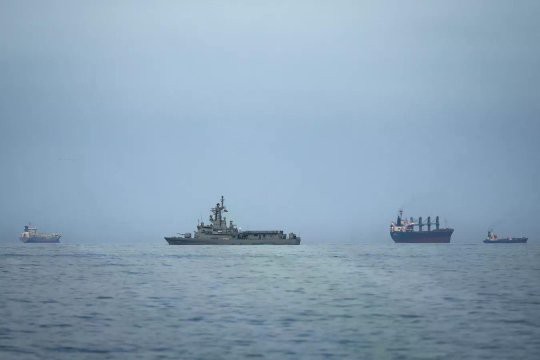
With the situation around the Strait of Hormuz remaining uncertain, on April 17, Iran announced that the strait was now open for shipping. However, on the very next day, the situation changed dramatically after the Iranian military announced that it was resuming its strict control over the strategic waterway. Tehran justified its actions by the continued US blockade of Iranian ports, which has been in place since April 13. As for the peace talks, Bloomberg reports that EU countries and Gulf states are skeptical about their success with most of them fearing that the negotiations could drag on for months.
Meanwhile, the new closure of the Strait of Hormuz threatens not only the energy but also the food security of many countries. On April 13, the Russian Security Council warned that if the strait remains closed for more than three months, countries in the region risk facing serious food shortages. It also emphasized the strait’s role as a vital transport artery, affecting not only oil supplies but also the food security of neighboring countries. According to Bloomberg, a continued disruption to logistics will seriously endanger the supply of basic food and will necessitate international intervention to establish a bypass route.
Even though Iran and its neighbors are not major food exporters, they are a crucial link in agricultural supply chains. According to The Economist, supplies from the region account for a hefty 30 percent of the global fertilizer market since the Persian Gulf countries produce 20 percent of liquefied natural gas, used in the production of fertilizers and cooking fuel, and 15 percent of the oil needed to power agricultural machinery.
The UN's Food and Agriculture Organization (FAO) is likewise worried by the situation as, according to their estimates, the prolonged blockade of the Strait of Hormuz threatens food security worldwide. International supply chains have already been seriously damaged, fueling a rise in national egoism and trade protectionism, which is fraught with a dramatic and very dangerous uptick in global food prices.
The FAO has demanded that traffic via the Strait of Hormuz be restored as soon as possible to ensure free passage of critical cargo needed by the agricultural sector. Buyers, primarily from poor countries, are now forced to pay huge price premiums trying to snap up the rapidly disappearing supplies of available fertilizers. The FAO has urged governments to "carefully review" mandatory biofuel regulations and refrain from imposing bans on the export of energy products and fertilizers.
Although the FAO Food Price Index showed relative stability in March and no significant spikes, UN analysts fear that the market situation may rapidly deteriorate in the coming months. Farmers worldwide will face a difficult choice: either to reduce the area under cultivation or start growing less demanding and less productive crops. This forced switch will be necessitated by a shortage of mineral fertilizers, resulting in empty shelves in grocery stores and a noticeable shortage of basic food.
Meanwhile, markets are already reacting to geopolitical tensions with hard-hitting price hikes. For example, the price of granulated urea in the Middle East has soared by 70 percent compared to where it was before the outbreak of active hostilities. Moreover, with the armed conflict showing no signs of ending any time soon, this poses direct threats to the global production of phosphate-based fertilizers, which is critically dependent on uninterrupted supplies of industrial sulfur, the lion's share of which traditionally comes from the Persian Gulf states.
Long before the start of US-Israeli attacks on Iran in late February, the global food supply system was already in deep trouble as, according to FAO estimates, global food insecurity has tripled over the past five years. At the beginning of this year, the number of people suffering from hunger approached an alarming 400 million.
The US and Israeli military campaign against Iran sent the global fertilizer market into a tailspin, with the primary reason for the price surge being the fact that half of the global exports of urea – the most common raw material used in the production of nitrogen fertilizers - comes from the Persian Gulf region and passes through the Strait of Hormuz. Iran accounts for nearly ten percent of the global supply of urea.
The second reason for the turbulence in the fertilizer market is the sharp rise in natural gas prices caused by the strait’s closure. Gas is the basic component in the synthesis of ammonia, without which the production of effective fertilizers is impossible. The Persian Gulf countries, primarily Qatar, Saudi Arabia, Iran and Egypt, collectively account for almost 30 percent of commercial ammonia shipments.
Overall, under normal conditions, about one-third of all maritime international trade in fertilizers transits the narrow Strait of Hormuz.
According to Western sources, between late February and early March, commercial shipping through the strait dropped by more than 90 percent, with urea prices having soared by nearly 60 percent since the outbreak of active hostilities. In mid-April, global urea prices stood at $700–$790 per metric ton. Industry observers note that this is the highest price since 2023, even though it is still way down from the record highs of 2022, when the price jumped well over $1,000.
The effects of the sharp reduction in fertilizer supplies will take several months to be felt though, due to the significant length and inertia of the entire agricultural production chain. Initially, rising fertilizer prices force farmers to either sharply reduce the use of fertilizers, resulting in lower yields, switch to less demanding, but less profitable crops, or not plant their fields at all to avoid even greater financial losses during the autumn harvest. The impact on the harvest will become apparent in three to six months. It will then take another one to three months for reduced supplies to translate into higher prices at the supermarket.
Moreover, the potential sharp increase in agricultural production costs is not offset by a comparable increase in grain prices. As a result, farmers worldwide risk facing significant losses at the start of the production cycle, unable to offset these losses by a proportional increase in their end revenue. Such a scenario provides for a significant and painful reduction in crop acreage in the medium and long term.
According to FAO calculations and forecast models, tens of millions of people worldwide, most of them in Africa and Asia, and several million in the Middle East, are at risk of starvation. The agricultural sector is under threat in India, where local fertilizer producers are already reducing urea production. Sri Lanka and Bangladesh, where the rice harvest is already underway, Egypt, which is heavily dependent on wheat imports; and Sudan, which is already facing severe food shortages. In sub-Saharan Africa, Somalia, Kenya, Tanzania, and Mozambique are particularly vulnerable due to their high dependence on fertilizer imports. Brazil is also in trouble as its agricultural sector is critically dependent on stable supplies of Middle Eastern urea, which is essential for an effective cultivation of soybeans and corn. Brazil accounts for approximately 60 percent of all global soybean exports.
Overall, according to FAO estimates, the ripple effect of the current crisis will inevitably be felt during the next planting season, damaging future harvests with a long-lasting negative impact to linger for many years to come. In the worst-case scenario, a full-blown crisis will come in waves and stages, happening in three interconnected phases. The first will be a rise in fertilizer prices. The second, to peak out this fall, will bring about a widespread and noticeable decline in yields of major agricultural crops. The third wave, the most devastating in its social consequences, is expected in 2027, resulting in a surge in global food inflation and fraught with full-scale political turbulence.
According to the Russian Security Council’s Deputy Secretary Alexander Maslennikov, "...attempts by destructive external forces to artificially undermine Russia's domestic food security cannot be ruled out." That being said, Russia, as one of the world’s most securely food-supplied countries and a leading supplier of wheat, sunflower oil, barley, corn, pork, and poultry, will do everything in its power to ensure food supplies to the countries that need them most.
Moreover, rich in natural gas reserves, Russia is the second-largest and most significant global exporter of mineral fertilizers. Together with its partner Belarus, Russia accounts for approximately 40 percent of global potash exports, over 20 percent of ammonia, and nearly a fifth of global urea supplies. Importantly, neither the production itself nor the logistics infrastructure used to transport Russian fertilizers depend on the situation in the Persian Gulf. Therefore, Russia plays a crucial, if not decisive, role in global fertilizer supplies, especially when it comes to assisting the poorest and most needy countries.
--------------------------------------
https://ria.ru/20260413/rossiya-2086742544.html
read more in our Telegram-channel https://t.me/The_International_Affairs