
 РУССКИЙ
 10:22 16.05.2026 •
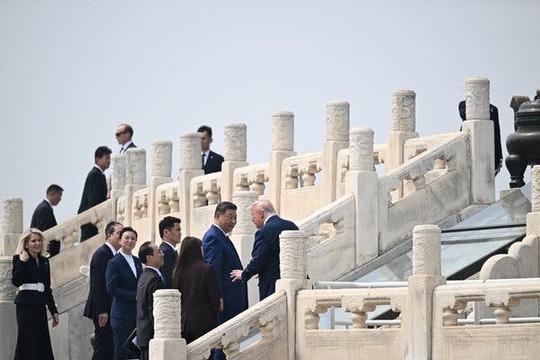
President Trump with President Xi of China at the Temple of Heaven in Beijing on Thursday
Photo: ‘The New York Times’
In contrast to his rhetoric about China at home, President Trump spoke in conciliatory terms with Xi Jinping, the Chinese leader, ‘The New York Times’ notes.
“You’re a great leader,” he told his host, whom he has often said he admires for his “powerful” control over a nation of 1.4 billion people. “I say it to everybody.”
Mr. Xi, unsurprisingly, spent little time on flattery. Once the 21-gun salute and precision-marching by units of the People’s Liberation Army were finished, the disciplined Chinese leader plunged right away into setting boundaries for the two countries’ relations. The red line was Taiwan, he said, making it abundantly clear that Mr. Trump’s effort at rapprochement could crash on takeoff if he interferes with China’s long-term effort to take control of the self-governing island.
“The U.S. must handle the Taiwan issue with utmost caution,” he said according to a readout from Xinhua, China’s official news agency. The warning came just minutes into his public remarks in the Great Hall of the People, the center of power for the People’s Republic starting just a decade into Mao’s revolution. For Mr. Xi, it was all about setting boundaries, from the start.
The moment seemed to capture the new equilibrium between the two adversaries. Mr. Xi arrived highly scripted, leaving no doubt that for all of China’s problems — deflation, depopulation, the bursting of the real estate bubble — the moment when China acts as a peer superpower had arrived.
At every turn, at least as he began his two-day trip to China, Mr. Trump sounded conciliatory, the exact opposite of his portrayals of China in public appearances back home, where during his presidential campaigns he has talked about the country as a job-stealer and national security threat. Mr. Xi, while smiling and welcoming to Mr. Trump, was quietly more confrontational — especially on Taiwan, where he delivered an unequivocal warning.
The gap spoke directly to the new level of confidence and authority Mr. Xi has adopted in his public speech, despite his challenges with the domestic economy, as he watches the United States plunge into conflict with Iran, another Middle East confrontation with no easy exit.
The Chinese president designed the day meticulously, down to a visit to the Temple of Heaven, the Ming dynasty complex not far from the Forbidden City. As Mr. Trump sat in the 13th-century wonder, he got a history lesson from the Chinese leader, tailored to echo the modern era.
Mr. Xi proposed a familiar solution: ban talk of competition between the No. 1 and No. 2 economic superpowers — a regular staple of the Biden White House — and focus on “stability,’’ a governing characteristic rarely associated with Mr. Trump.
“The common interests between China and the United States outweigh our differences,” Mr. Xi said, according to state media. “Stability in China-U.S. relations is a boon to the world.”
But unlike Mr. Trump, he explored the alternative scenario.
“If handled poorly, the two countries will collide or even clash, putting the entire U.S.-China relationship in an extremely dangerous situation,” he said, a clear reference to Taiwan, according to the readout.
If much of this sounds familiar, it was. Mr. Xi has go-to homilies, part of his philosopher-king approach to ruling over China. And in this summit he invented one new one: He said he agreed with Mr. Trump on “a new vision of building a constructive China-U.S. relationship of strategic stability.”
The contrast with Mr. Trump’s style — where summits are first and foremost for instant “deals,” usually ones he can boast will provide jobs or sales — is often jarring. Mr. Trump, for example, brought a group of business executives, whose presence he said was intended to show “respect” for China while seeking market access.
Mr. Xi did not bring an equivalent group. There were no executives from BYD, the huge Chinese carmaker trying to figure out how to do business in the United States, or DeepSeek, the innovative artificial intelligence firm at the heart of the battle with A.I. firms in the United States.
There were other discordant notes, heard just beneath the noise of the clinking glasses and optimistic toasts. In contrast to the Chinese readout, the American account, released by the White House, talked about cracking down on fentanyl precursors, a long-running issue with China, and buying American agricultural goods. It did not mention Taiwan, or China’s restrictions on rare earths, or its rapid nuclear weapons buildup.
The White House also described the United States and China as aligned on the need to reopen the Strait of Hormuz, and keep it free of Iranian tolls. All that was true, but ignored the deeper complication: despite American entreaties, China is unlikely to deploy whatever influence it has with the Iranians for free. What the price might be is unclear.
read more in our Telegram-channel https://t.me/The_International_Affairs

















