РУССКИЙ
 11:26 14.05.2026 •
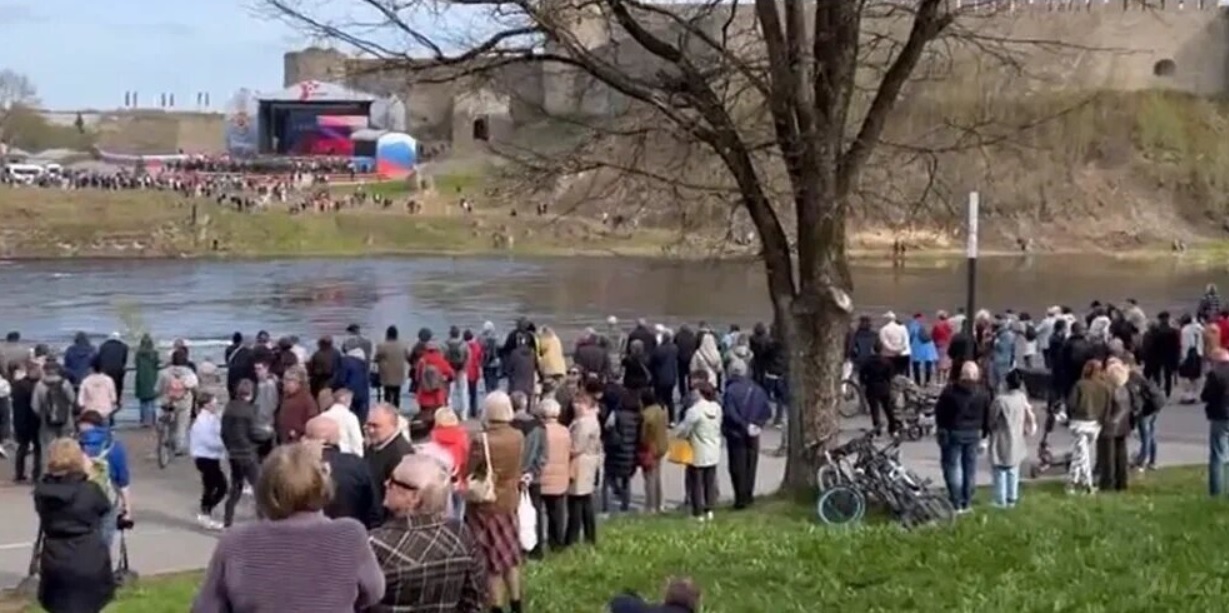 Residents of the Estonian city of Narva (Ivangorod) gathered to watch a concert dedicated to Victory Day, which was organized for them from Russian side – across the river
Photo: Press.lv
‘Hello Narva, hello Estonia!” boomed the announcer as giant screens on the Russian side of the river blared Soviet-era pop and old war movies to the Estonian audience, ‘The Times’ reports.
The slogans down the side of the stage spelled out Russia’s message on the day it celebrated the defeat of the Nazis on the Eastern front. They read “1945-2026”, as if there were an unbroken line from the Second World War to the war in Ukraine. “We remember. We are proud. Victory will be ours. One country, one victory.”
500 miles away in the town of Ivangorod, across the border from Narva in Estonia, the celebrations were more lavish than ever.
The famous sport commentator who opened the Sochi Olympics gave stirring speeches introducing a roster of Russian culture, music and pop mixed with Soviet symbols banned in Estonia…
For this tiny border city in Estonia, the Victory Day celebration of the Soviet triumph over Nazi Germany has become the apotheosis of a contemporary battle for hearts and minds.
It is the most Russian-speaking city in the European Union, at 98 per cent compared with 20 per cent on average across Estonia. Protection of Russian speakers is one of Putin’s rationales for military action in Ukraine, and notionally that extends far further into this Nato territory that was once part of the Soviet Union.
“Russia’s borders do not end anywhere,” read a huge banner put up here after Finland completely closed its border with Russia. Addressing the audience across the river at the weekend, the compere tried to rally the crowd behind the conflict as if the border were already erased. “One country, one victory!” he crowed.
The Ukraine war has changed lives across all of the Baltic states, but perhaps nowhere as much as in Narva.
The invasion of Ukraine forced swift changes. The cross-border Friendship Bridge linking Narva to Ivangorod was closed and later fortified. Soviet symbols were banned, monuments were removed and Russian television was pushed off the airwaves and onto satellite. Most consequentially, perhaps, Russian was removed from schools.
Ukrainian drones sent to strike Russian ports and oil depots have strayed into Estonian airspace, some of them making impact after being intercepted by Russian defences. “The war is in our backyard, that is the reality,” Raik said. “A lot of these shifts had to happen in Estonian society, but now they have had to happen very sharply.”
Nadezhda Shasheva, 50, cried when she talked about Narva in the years since the war began. She was born here, has lived in Russia and returned here, where she plans to stay for life.
Thanks to a peculiarity of Estonian nationality laws, based on its revolving history of independence and occupation, Shasheva is a grey passport holder, a citizen both of nowhere and of everywhere, free to live in Estonia and anywhere in Europe and travel to Russia without a visa.
However, she cannot vote and does not speak Estonian. She failed repeatedly to pass the Estonian language test required for citizenship. “The woman said, ‘if you don’t like it you can pack your bags and go to Russia’,” she said. “Then I gave up.”
She said that Russian speakers were treated as second-class citizens in Estonia, and viewed as a dangerous fifth column.
Shasheva’s daughter, Varoslava, 21, took a similarly pragmatic view of preparedness. She lived her life in three languages: her mother tongue, Russian; English, in which all young Estonians are near-fluent, and Estonian, the language to which her school had switched. “It’s not hard for me,” she shrugged. “Sometimes if we don’t understand we ask in Russian.”
The weekend’s concert was simply a louder, Raik said. The songs she heard drifting up to City Hall from the river were songs she remembered from childhood. “They are intended to make people nostalgic for the old times.”
City Hall struck back with a concert of its own, celebrating Europe Day. Most of Europe celebrated military victory over the Nazis on May 9 as “the birth of Europe”, Raik said. The city’s slogan, since 2022, has been, “Europe Begins Here”.
Narva’s stage was smaller and the musicians far younger, as was the crowd milling in the main square. Stallholders included Frontex, the European Union border control agency, the Estonian national guard and several emergency services, including two teaching resuscitation techniques to children. A photograph booth offered old-fashioned prints, with or without the blue and yellow EU flag.
Pavel, 26, who had come just for a look, said: “It’s a small town and this is a big spectacle.” Others, though, swayed nostalgically to the music. An elderly woman holding on to her friend’s arm said: “Oh those voices, you don’t hear anything like that anymore.”
Svetlana, 87, remembered Victory Day itself. It brought liberation from the Nazis, but it was also the beginning of Soviet occupation. “I was so scared when the war in Ukraine began,” she said. “I thought it would be another World War.”
Vladimir, 76, believed the war in Ukraine should have ended long ago. “I blame Europe,” he said. “If they hadn’t given Ukraine all that money, it would be over by now.”
read more in our Telegram-channel https://t.me/The_International_Affairs