
 РУССКИЙ
 11:44 07.05.2026 •
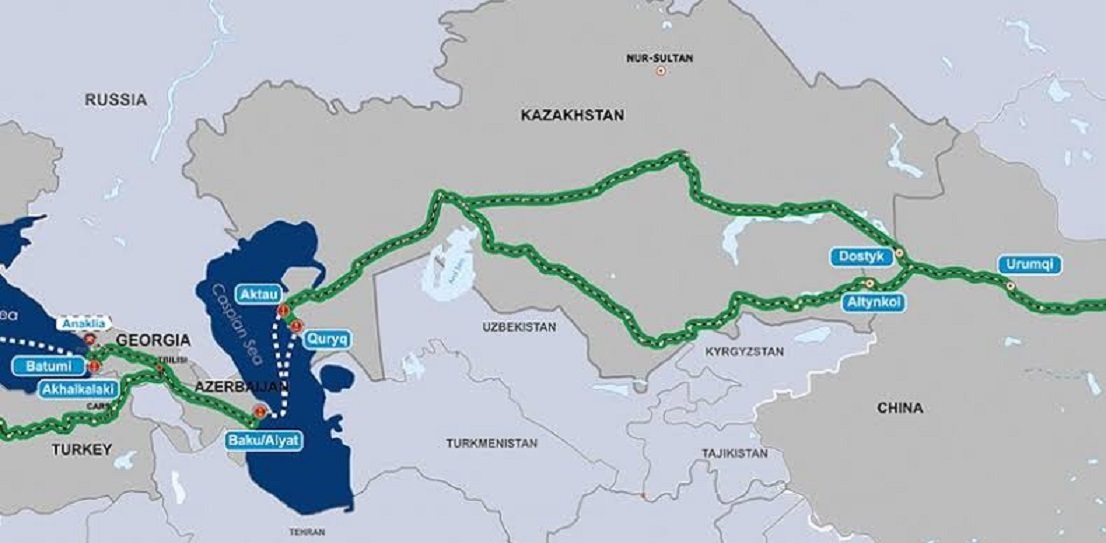 Armenia wants to become part of the planned East-West trade corridor. The question is - will Turkey agree to provide Armenia with any favors in opening the border between these countries, given their complex historical relations? Otherwise, this “corridor” is meaningless.
Map: transportcorridors.com
The EU-Armenia summit took place in Yerevan. Since this summit intersected with the European Political Community (AST) summit, which was also held in Yerevan, the top leaders of many countries, including Turkey, are coming together in Yerevan these days. AST is a forum established in the 2022’ in the EU's effort to form a regional coalition against Russia, but over time it also gains symbolic meaning for global middle powers trying to form multiple alliances. For example, this year in Canada, which is looking for alternatives to the US alliance agrees.
Turkey mostly did not participate in the summits held twice a year, but this year it was participating at the vice presidential level. Participation at this level is an effort to maintain a balance between the EU, which is pushing for Turkey's normalization with Armenia, and its traditional ally Azerbaijan. But Turkey will need to make a concrete decision on this policy of balance in the near future, because the wave of panic created by the closure of the Strait of Hormuz has once again rained light on the Middle Corridor, and this time, there is a scenario that does not exclude Turkey, as at the beginning of the Ukrainian war. But for this scenario to happen, the Türkiye-Armenia land border must be opened.
Why has the Middle Corridor come to the fore again? The Middle Corridor, one of Turkey's most popular regional projects, is not actually a very effective transportation route as the transportation volume of the Caspian Sea cannot be increased sufficiently with natural constraints. However, with the Ukraine war, when the West could not use the Northern Corridor passing through Russia, the Middle Corridor was discussed as an option. Turkey's name was not visible in the Middle Corridor imagination at that time, and it was planned to deliver the goods to Eastern Europe via the Black Sea after Georgia. However, over time, this plan fell through when the pro-EU government in Georgia was replaced by a government close to Russia. Trump mediated between Armenia and Azerbaijan after the Nakhchivan war and gave life to the Middle Corridor again with the corridor called Zengazur by Azerbaijan and TRIPP by Armenia. The EU also joined this caravan with its Global Crossing projects. The Iran War also brought the Middle Corridor agenda to the global level. For example, Japan, Nakhchivan-To build the Baku railway volunteered.
The Middle Corridor vs China's Belt and Road Initiative routes
China was silently watching these developments. Because, at first, no version of the Middle Corridor posed a threat to China's Belt and Road Initiative routes. No country in Central Asia and the South Caucasus intended to choose between China and other superpowers and was open to investments from any source. Middle powers such as the EU were also aware that a connectivity project could not be implemented by excluding existing infrastructure and cooperation. In other words, since there was no point in laying two parallel railway lines from China to Europe, it was necessary to look for ways to use the same line without creating a security vulnerability for Europe, instead of excluding China. Europe has not yet figured out how to achieve this regulation compliance, which it calls ‘soft infrastructure’, especially when it comes to digital data transfer, but it still does not exclude the idea of discursive cooperation with China today. The Caspian Crossing Transport Corridor Coordination Platform meeting to be held in June is for this purpose.
However, the balances for China began to change after Vance's visit to Armenia in February. During this visit, in exchange for funding the construction of the TRIPP line, the 49-year operating rights of the line (and the logistics infrastructure such as customs checkpoints and storage facilities on it) were granted to a company 74 percent owned by the United States under a contract that could be extended for another 50 years. This means that goods from China can be controlled and blocked by the United States.
read more in our Telegram-channel https://t.me/The_International_Affairs

















