РУССКИЙ
 20:34 30.05.2026 •
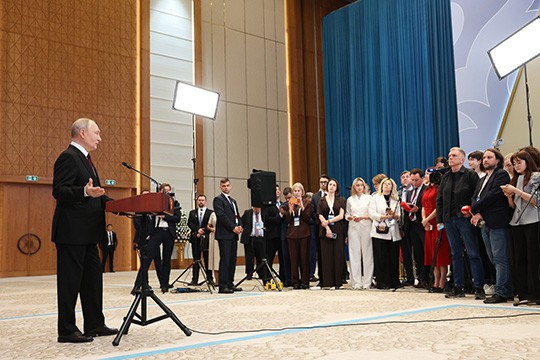
President of Russia Vladimir Putin: Good evening.
You had to wait. President Lukashenko and I had a lengthy discussion as we had many issues to discuss.
I am listening. Please, begin.
Anton Morozov: Mr President, here is my question. We understand that you have had a busy visit dedicated to the extensive EAEU agenda. However, news is breaking every minute, and you are probably aware of the story about a drone that flew into Romania.
Vladimir Putin: That is what I have just been told.
Anton Morozov: My question is this: why didn’t the Europeans, who are hyping the rhetoric around this story, shoot down that drone?
Vladimir Putin: You know, this may seem strange, but I only learned about this just before entering the hall. I was informed that something had happened, supposedly involving one of our drones. If you would be so kind as to explain it again, I would be grateful – I am not joking, or being ironic – and I will comment based on what I know.
Anton Morozov: Anton Morozov, TASS. The Europeans talk a lot…
Vladimir Putin: No, no, I understand what they are saying. What drone?
Anton Morozov: Why didn’t they shoot it down? Why didn’t they shoot down the drone they associate with Russia that flew there?
Vladimir Putin: Are you listening to me or not? I do not even understand what you are talking about. Before entering the hall, they told me: “You know, some drone flew into Romania.” I said: “I don’t know. What kind of drone?” So, tell me, what exactly is being reported in the media?
Anton Morozov: They are saying it was ours.
Pavel Zarubin: They are saying that the drone which crashed into a residential building in Romania today was a Russian drone.
Vladimir Putin: Who in Romania is saying it was a Russian drone?
Pavel Zarubin: Many people in Europe are saying so.
Vladimir Putin: “Many people” are nobody. Give me specific names.
Remark: Ursula von der Leyen.
Vladimir Putin: Ms von der Leyen has not been to Romania. She has not examined the remains of that drone. No one can determine the origin of a particular aircraft until a proper examination has been conducted.
After all, we know that Ukrainian drones have previously flown into Finland, Poland, and the Baltic states. The initial reaction was exactly the same as it is now in Romania: “Help! The Russians are coming, the Russians are attacking.” Then, after a short period of time, it turned out that those incidents had nothing to do with Russian UAVs. They were drones of Ukrainian origin that had gone off course, been affected by electronic warfare, or, due to technical limitations, had ended up there and crashed. I believe that most likely we are dealing with the same situation as well.
However, if they provide us with objective data – as we once did with representatives of the US administration by handing over information and drone fragments from an attempted strike on one of the residences of the President of the Russian Federation to be examined – then let them provide those materials to us. We will conduct an objective investigation, and only then will we be in a position to assess what has actually happened.
Anton Vernitsky: Mr President, Anton Vernitsky, Channel One.
Could you please summarise the outcomes of your state visit to Kazakhstan? Additionally, numerous documents were signed, including one concerning the construction of a nuclear power plant in Kazakhstan, with Russia providing an export credit facility to finance this project. Is it advantageous for Russia to undertake construction using its own resources? Kazakhstan would appear to be a wealthy nation, as evidenced by the reception we have received here. Thank you.
Vladimir Putin: Firstly, our financing conditions for facilities of this nature are consistent with similar operations and transactions globally. This is standard international practice. Typically, when a project is undertaken, appropriate loans are extended.
In several European countries, as well as in our own, entire credit facilities have been established to support domestic exports, specifically exports of goods and services. Naturally, this is advantageous for us. We are not merely granting these funds; we are providing them as a credit.
These funds will return to the Russian treasury; they bear interest, as is customary in such cases. The interest rate is entirely acceptable and aligns with all current international standards and requirements.
We are maintaining our industrial capacity through these orders, and subsequently, we participate in maintenance, the supply of equipment, spare parts, fuel, and so on. For Russia, this is beneficial because we have longstanding cooperation with Kazakhstan in uranium raw materials, which is advantageous given that Kazakhstan one of the largest holders of uranium deposits.
For Kazakhstan, this is also advantageous due to logistical proximity.
We are partners in nuclear energy, as noted earlier, and this is also beneficial for Kazakhstan – to gain additional momentum in this sector, to be not only a supplier of raw materials but also to acquire high technologies. This is crucial for Kazakhstan and all our partners alike.
We are not merely constructing something with credit resources; we are establishing an industry. We are commencing the training of specialists and involving local personnel in joint initiatives. The precise figure for Kazakhstan escapes me at present, but generally, at least 25 percent of all work during the construction of such facilities is allocated to our partners.
We are prepared to manage spent nuclear fuel, supply fuel, and are engaged in negotiations. Yesterday, President Tokayev suggested that we collaborate on supplying this power plant with the requisite fuel. This represents a substantial volume. Twenty percent of Kazakhstan’s energy consumption will be met by the operation of the nuclear power plant. It is beneficial from all perspectives.
This project is the result of sustained efforts on both sides, involving compromise and the pursuit of mutually acceptable solutions. We have succeeded in finding them. This was a significant and substantial endeavour. It is advantageous for both Russia and Kazakhstan.
Regarding the results, there was indeed a question raised. We are satisfied with the outcomes, as they effectively mark what we have achieved. Our bilateral trade has reached a record level, exceeding $20 billion, and continues to demonstrate positive growth dynamics.
We have identified priority areas for cooperation across all key sectors and, most importantly, have defined seven principal areas that will guide our future collaboration. Humanitarian cooperation plays a particularly significant and perhaps even leading role in this regard. Preserving close, good-neighbourly, and, in many aspects, familial ties between our nations and citizens is of utmost importance, as it fosters a level of trust between our states that is essential both in the present circumstances and from a long-term historical perspective.
As you know, we have launched a new educational initiative aimed at identifying and developing gifted children. The project will be implemented in Kazakhstan, drawing on the experience and support of the Sirius Educational Centre.
We are deeply grateful to the President of Kazakhstan for the attention he has devoted to the development of the Russian language and for the support it receives at the official level. Russian is used throughout government institutions. Rather than causing any difficulties, it is broadly welcomed.
The President of Kazakhstan boasts extensive international experience, having served as UN Deputy Secretary-General. Naturally, he understands the value of proficiency in foreign languages. Given the relationship between our countries, which were once part of a single state, and considering that Russian served as the lingua franca in the Soviet Union, he recognises the importance [of preserving the language] and supports these efforts. Russian is also one of the official languages of the United Nations. This is particularly important in light of the growing trade between our countries. While the connection may appear straightforward, the reality is that the stronger our economic and business ties become, the greater the demand for a common language. Consequently, supporting the Russian language is important for economic development. The President of Kazakhstan is not only aware of this but also taking specific steps to create the necessary conditions for its implementation.
Therefore, I believe that all the objectives we set for ourselves have been achieved, and we are pleased with the outcomes of our joint work.
Viktor Sineok: I am Viktor Sineok of the Izvestiya Multimedia Information Centre.
The issue of Armenia has been discussed extensively both during the summit and on the sidelines. Could you explain what the country gains from membership in the EAEU? What benefits does it receive? What could it expect if its participation in the organisation were to be temporarily suspended?
Vladimir Putin: You know, I anticipated this question. I addressed it during the restricted-format meeting and told the Armenian representative, a Deputy Prime Minister of the Armenian government, that any discussion of this issue must be frank, sincere, and completely transparent.
I will now repeat the points I raised during that meeting, one by one. Our Armenian colleague, the Deputy Prime Minister, agreed that this approach is appropriate and that the matter should indeed be discussed honestly and openly.
But before answering your question, I will say that I outlined these points in advance – not before this news conference, but during the restricted-format meeting. There is nothing confidential about them; on the contrary, I believe the public should be aware of it.
Before proceeding further, I would like to emphasise something that I consider fundamentally important. The Russian and Armenian peoples are connected by longstanding ties of friendship and, without exaggeration, by a uniquely close relationship that has developed over centuries. There is a special bond between Russia and Armenia, and between Russia and the Armenian people. I said so to Nikol Pashinyan, and he can confirm my words. I told him that whatever serves the interests of the Armenian people is acceptable and beneficial for Russia as well: “Act according to what you believe is best for the Armenian people. You hold the authority here, and the responsibility for making decisions rests with you. Whatever decision you make will be respected – and no decision will undermine our humanitarian ties or our political relations.”
That said, in this particular case we are solely discussing economic matters. These issues require careful consideration, analysis, and decision-making. As I have previously noted, the crisis in Ukraine began with efforts to move toward EU accession. We did not oppose such aspirations, but we pointed out that, for instance, phytosanitary standards differ substantially – which directly affects access to markets. Since Soviet times, in Russia and consequently across the countries that now form the EAEU, phytosanitary standards have been tougher than those applied in Europe. For example, we have restrictions regarding genetically modified products, and many people [in our region] do not wish to consume genetically modified food products – that is their choice, and we must take this preference into account. There have not yet been thorough studies regarding the effects of such products on human health. Also, technical standards are very different. Certain industrial products may be sold in our market while others may not. Differences extend to steel grades and so on. There are plenty of aspects that are simply not compatible today and cannot coexist.
This does not mean that we are opposed to it; on the contrary, we support it. But it takes time and investment. For example, if you want to meet certain European standards – which may in some respects be more advanced than ours – you would need to invest resources in establishing the necessary production capacity. And the same applies in the opposite direction.
Therefore, combining the two systems in one day is virtually impossible. As a result, we would be forced, in certain areas –and indeed, by and large – to scale back almost all of our cooperation with Armenia in the economic sphere related to integration processes.
You asked about the advantages. This is how we see them. Some may disagree; that is open to debate. But what do we –and not only Russia, but all EAEU member states – see as the benefits of joining and strengthening the Union? First, access to a large and protected common market across the entire EAEU, including Russia and the other member states; duty-free trade; common technical and phytosanitary standards, as I have already mentioned – these facilitate market access and simplify logistics. Although we do not share a common border, we have nevertheless managed to ensure that the movement of goods and services is organised in the most efficient and cost-effective way possible. I will further elaborate on what I mean by that. Another advantage is low energy prices: in Europe, prices may reach around 600 euros, while for Armenia they are a little over 150 euros, though I do not recall the exact figure. The difference is significant. I am listing all the advantages because people often focus solely on energy. It is important, certainly, but it is not the only benefit.
Then there is investment activity. According to data from the Eurasian Development Bank, accumulated investment in Armenia amounts to $4.9 billion, 86 percent of which is Russian. And this figure does not even include capital originating from Russia through indirect channels. In other words, Armenian business representatives operating in Russia often invest through third-party instruments. Therefore, the 86 percent figure does not tell the whole story; the actual amount is considerably higher.
After the meeting in Yerevan, for example, European partners promised to invest 2.5 billion euros. How and when these investments will materialise remains to be seen. But 2.5 billion euros is still less than $4.9 billion, and that is before taking into account indirect investments, which are also, in essence, Russian capital.
Now, regarding participation in free trade agreements: these would also be cancelled. What would that mean? First and foremost, it would entail the restoration of full customs controls and customs duties. We need to carefully assess what this would mean.
The second consequence would be the cessation of mutual recognition of documents, particularly in the areas of technical regulations and phytosanitary standards. Agricultural products currently enter our market under these arrangements, but we would then stop recognising those standards and would have to review them. Perhaps we would recognise them and be satisfied; perhaps not. That remains to be seen. Where would products such as wine be exported – to Spain, France, Italy, Portugal? This is something that requires consideration.
There would also be a reduction in trade in services, tourism, transport services, and other sectors. I will say more about transport in a moment.
Furthermore, workers from Armenia would become subject to the requirements that apply to migrants from CIS countries. What does that mean? It means they would need to obtain patents to work in Russia. To gain access to compulsory medical insurance, they would need to reside in the country for at least five years, and so on. There are plenty of requirements. It would be an entirely different situation. People should discuss this clearly, directly, and honestly.
We would also have to restore the permit procedure for Armenian road carriers. This would be unavoidable; it is a separate and highly complex area of cooperation.
In addition, rail freight tariffs would have to be adjusted from the current domestic Russian rates – which are currently applied to Armenian carriers – to the tariffs applied to other CIS countries.
And, obviously, energy prices would rise. The same preferences that exist today would no longer apply. According to preliminary estimates – not only ours, but also those from various experts – these changes could result in a loss of at least 14 percent of Armenia’s GDP. Whether that is a large or a small figure is open to discussion, but it is nonetheless something that must be carefully weighed and evaluated.
If we look at the last three years – 2023, 2024, and 2025 –Russia’s GDP growth was 4.1 percent, 4.9 percent, and 1 percent respectively. That amounts to cumulative growth of 10.3 percent over the three-year period. For the European Union, growth was 0.4 percent, 1.1 percent, and 1.5 percent respectively. As for the EAEU, growth reached 4.3 percent in 2023, 5 percent in 2024, and 1.7 percent in 2025, resulting in cumulative growth of 11.4 percent over three years. In other words, one union achieved economic growth of 11.4 percent over that period, while the other achieved 3 percent.
Naturally, the situation in Europe may be more complex for a variety of reasons. It is a technology-intensive economy, so comparisons must take into account both their and our economic bases. Nevertheless, the trend is clear: here, we can see faster growth rates. Prime Minister Pashinyan himself has stated that he considers it appropriate to hold a referendum on whether Armenia should remain within the EAEU or pursue membership in the European Union. We would ask our Armenian partners and friends that such a decision be made as soon as possible.
Boris Ivanin: Mr President, good afternoon,
I am Boris Ivanin of the Zvezda TV channel, Glavnoye (Highlights) programme.
If I may, I would like to address the key topics of your visit to Kazakhstan. Yesterday, you took part in the Eurasian Economic Forum, which we followed closely. As we all recall, the central theme of the forum was the focus on artificial intelligence amidst the global digital race.
Speaking of artificial intelligence, Alexander Lukashenko remarked yesterday that it was merely hype – a fashionable buzzword of the younger generation. But setting the hype aside, the reality remains: where do we, Russia, stand in this global digital race? That is my first question.
Yesterday, you also spoke about specific projects already being implemented in Moscow, particularly the use of AI in emergency medical services. What other developments and initiatives are we prepared to share with our partners in the EAEU, including Armenia, while it remains a member, so that we can stay at the forefront of technological progress and preserve our technological sovereignty? We are obviously aware that this is especially important today in light of the pressure created by Western sanctions.
Thank you.
Vladimir Putin: I mentioned the example of Moscow’s ambulance service more or less off the cuff. It was not part of my prepared remarks; it was simply an example that came to mind. And it is far from the only case of AI being applied in Moscow’s healthcare system.
You are probably familiar with the centralised centres that process, for example, X-ray images. Such images are collected from across Moscow and transmitted to a single centre, where highly specialised experts analyse them before sending the results back. This approach reduces the time required for diagnosis and improves the quality of public services. There are plenty of similar examples.
We have also made significant progress in the advancement of autonomous vehicles. Our online trading platforms, Ozon and Wildberries, are operating successfully and efficiently. Moreover, financial institutions are already being launched on the foundations of these platforms. But this is not all. We are increasingly applying these technologies across industry, science, and education as well.
Maintaining sovereignty in this area is of critical importance. Russia is probably one of only a handful of countries – perhaps one of just three – that both have the opportunity and are actively developing their own sovereign AI capabilities.
Achieving this requires your own algorithms, and your own datasets. Our Chinese partners, for example, have created their foundational models and datasets available free of charge, providing a base upon which others can build applications and additional functionality. This is a positive development, and we are making use of it. Some of our companies openly acknowledge this, saying, “Yes, we have adopted it, made an agreement, and will use it.” Others choose a different approach, developing their own original solutions from the ground up, with Sberbank being one such example. The latter path requires financial resources and significant capital investment.
However, it is precisely this sovereign technological platform that serves as the foundation for everything else. It is what enables us to deploy advanced technologies in areas such as defence, security, and public administration. Russia is among few countries that are capable of doing this. Obviously, these efforts would be easier and more effective if we worked jointly with our partners. First and foremost, I am referring to our partners within the EAEU. We have discussed this informally and have already proposed cooperation to them. Many have considerable interest in such collaboration, in part because our countries have historically enjoyed relations built on a high degree of trust. We are prepared not only to make our developments available but also to share the expertise and knowledge behind them for our friends and partners within the EAEU to create their own national platforms. We are ready to work together. This is an exceptionally important area of activity.
As I mentioned yesterday, the advancement of artificial intelligence requires not only substantial investment but also immense energy resources. Google plans to build several AI platforms, each requiring, as far as I know, one gigawatt of capacity. At the same time, as I mentioned yesterday, Russia boasts considerable potential in nuclear energy, as well as vast hydropower resources, including in Siberia. There are also opportunities for development in northern regions, where the cold climate allows for natural cooling [of computing infrastructure]. In other words, we have evident competitive advantages. We are prepared, willing and committed to independently advance all of the initiatives that I have mentioned. At the same time, we are ready not merely to share our experience, but to collaborate with our EAEU partners – and this is an area of interest to our friends and partners.
Nazigul Zhusupova: Nazigul Zhusupova, RIA Novosti. May I ask a question?
Vladimir Putin: Please, go ahead.
Nazigul Zhusupova: We have heard all statements made by the summit participants today, but I would like to ask about your personal impressions. Do the EAEU member states remain interested in deepening integration? To what extent are current challenges affecting the situation?
As we know, it was exactly 12 years ago in Astana that the decision to establish the EAEU was made. How do you envision the future of the Union?
Will the next summit be held with the same composition, or could there be changes? And might there be changes in the level of integration among the member states?
Thank you.
Vladimir Putin: You know, everyone remains interested. As for Armenia, you are aware of the situation. In any case, I explained everything exactly as I reported it to my colleagues during the restricted-format meeting. I concealed nothing. I went through every point with them. I first wrote everything down and then presented it. There are no secrets here.
As for the interest of our partners, it remains strong. Moreover, it is growing. Countries that participate openly in this cooperation see tangible positive results, recognise the potential of this interaction, and are interested in its further development.
As for the future, what would it look like? We would all very much like – and I certainly would – for it to be high-tech; not based merely on mutual supplies of raw materials or food products, important as they are for ensuring food security, but on the exchange of goods and services with high added value. That is precisely why Kazakhstan’s chairmanship has made artificial intelligence a key priority for future development, placing it at the centre of our expanded meeting. I hope that this is exactly the direction in which we will move.
And we agreed that, as usual, if nothing interferes with our plans, we will meet in St Petersburg in December.
Kira Latukhina: Kira Latukhina, Rossiyskaya Gazeta.
I have a question about St Petersburg. Another major international event, the St Petersburg International Economic Forum, opens next week. Every year you deliver a keynote address there, and I am sure this year will be no exception: you will also deliver a keynote address to the forum participants. Could you perhaps share some details about the topics you intend to raise?
I would also like to ask whether any of your EAEU colleagues will be attending the forum.
Vladimir Putin: As for your question on the substantive content of my speech, let us not discuss it now. Otherwise, you will have no reason to come, because Everything will already be known in advance, so listening will not be interesting.
As for the participation of our EAEU partners, they attend the St Petersburg Economic Forum every year. This year will be no exception, with large delegations expected to participate. There will also be the main guest from one of the EAEU observer states.
Yelena Shiryaeva: Yelena Shiryaeva, Mir TV channel.
You have said many times that where tigers thrive, everyone thrives. Russia has donated four Amur tigers to Kazakhstan. What is the most important aspect of this project, in your view?
Vladimir Putin: The most important aspect is that we are cooperating in a humanitarian field that is very important to us – the restoration and preservation of nature.
Of course, we did not exterminate tigers here in the steppes. But when we lived together as part of a single state, these things happened, and we bear responsibility for that as well. If we are now able to support our colleagues in their efforts to restore wildlife, then that is exactly what we should do. This is our response to the efforts our friends are making in this and many other areas.
Let me give you an example, not from the EAEU but still relevant. Tajikistan once gifted us snow leopards. We are now working to reintroduce snow leopards, including in the Caucasus. There are many similar examples. I have mentioned our cooperation in humanitarian fields, and this is one of them.
Andrei Kolesnikov: Andrei Kolesnikov, Kommersant.
Mr President, at your previous news conference on May 9, you said that, in your opinion, the situation in Ukraine was nearing its conclusion. Could you clarify what you meant? Since then, many people have been wondering exactly what you had in mind.
Do you still hold that view now, despite the drone strike on Starobelsk, for example, and reports of planned strikes on Kiev? If so, when, in your opinion, will this conclusion come?
Vladimir Putin: As for the timeframe, I think both you and my other colleagues understand what my answer will be. It is impossible to specify exact timelines in the context of military operations. Not only would it be imprudent, but it is also rarely done in practice. I am not going to do it.
You mentioned the attack on Starobelsk, and now I am being informed about attempted strikes on Russian territory. Yes, of course, Western countries continue supplying drones. What could be simpler? You assemble them, press a button, and they fly. But this means only one thing: we must continue strengthening our air defence system. We are doing so and will continue to do so.
As for my statement that the situation is nearing its conclusion, I made it based on an assessment of developments on the battlefield, where our forces are advancing in all directions. As you can see, this is happening every day.
By the way, since Starobelsk has been mentioned, I sometimes watch Western television channels to understand the information environment being created there and presented primarily to European audiences. Perhaps you watch them sometimes, too. What I see is, frankly, disturbing and outrageous. They are simply misleading their own citizens. Our strike on the Kiev region was our response to their crimes against students in Starobelsk. From morning until night, coverage focused solely on Russian aggression, strike, destruction, and damage. As representatives of the media, you are probably ashamed of your colleagues. There was not a single word about the tragedy in Starobelsk, about kids killed there, or about the deliberate targeting of civilians. Not a single word, as though it had never happened. What is that? Is that journalism? No, it is the means of mass deception.
Then comes the next step: they show drones being used by Ukraine for strikes, and present them as examples of military success. They discuss the cost of those drones, implying to their audiences that more funding is needed and more financing must be provided. What is that? Is that journalism? I do not believe it is.
Going back to your question and to what I said earlier: based on developments on the battlefield, we believe the situation is evolving in a way that allows us to say it is moving toward its conclusion.
Pavel Zarubin: Pavel Zarubin, Rossiya TV channel.
Hardly a day goes by without European politicians and even leaders saying that they are getting ready for a war against Russia. They have even mentioned specific dates. Here comes a logical question: are we factoring into our preparations the fact that they are preparing for a war against us?
Vladimir Putin: First, as far as the statements by European politicians about their preparations for a war against Russia are concerned, that is nonsense. They are allegedly doing this in connection with Russia’s aggressive plans with respect to Western European countries. It is a lie. It is a gross, blatant lie.
And as Goebbels once said: the more unbelievable the lie, the quicker people will believe it. These are the very standards guiding Western politicians and mass media in their day-to-day operations.
Russia has never had any aggressive intentions regarding European countries. And the tragedy that is unfolding in Ukraine – this is what they have done, this is the result of their policy. They were the ones who brought about the government coup in Kiev in 2014, which compelled Russia to defend the people of Crimea and then, I will not go into details, as I said it on many occasions, assist the Donbass People’s Republic and the Lugansk People’s Republic, which we did not recognise for a long time, for years. But when we realised that no one was going to honour the Minsk agreements, we had to, we had no option other than to assist the two then unrecognised republics. We had to recognise them, and provide them military assistance, because under interstate treaties we assumed the obligation to respond to their request for defence. That agreement was ratified, including through the upper house of the Russian parliament. Everything we did was absolutely transparent, legal and consistent. We acted on a step-by-step basis. And they have caused today’s tragedy and are now attempting to shift the blame from the guilty party onto the innocent, to suggest that it is Russia that is acting aggressively. No. It is their policy from the first step, when they deceived us that there would never be any expansion, that NATO would never make a single step to the East.
Yes, the Ukrainian tragedy involving the government coup results from their policy. And let them not deceive their own people. Russia has never threatened and is not threatening European countries.
Everything they do is designed to keep the confrontation with Russia going and justify the huge spending from the budgets of their countries, getting into the pocket of the European taxpayer.
Lana Samsoniya: Mr President, can I ask you to share some details about your meeting with Lukashenko?
Vladimir Putin: Yes, go ahead, please.
Lana Samsoniya: Your conversation lasted for an hour and a half. Could you tell us what were the topics that you discussed? Mr Lukashenko has probably informed you about his conversation with Macron. Could it be that specific names of people who could take part in the dialogue with Russia on behalf of Europe were mentioned during this conversation?
My name is Lana Samsoniya, and I am from Interfax news agency.
Thank you.
Vladimir Putin: Indeed, Mr Lukashenko filled me in on his conversation with the President of France, but I do not think that elaborating on this matter would be appropriate right now since this was a telephone conversation between two presidents. If Mr Lukashenko did it, I think he acted this way based on the premise that the President of France also wanted this to happen. That said, I do not know whether I have the right to disclose what they discussed during their conversation or the information that Lukashenko shared with me. I am sorry.
Anastasia Volodina: Anastasia Volodina, RT.
I have the following question. In its recent report, the Foreign Intelligence Service said that Ukraine has sent its drone operators to Latvia and, therefore, plans to target the territory of Russia this way.
If Russia registers launches of this kind, what kind of a response are we to expect?
Thank you.
Vladimir Putin: All the locations posing an immediate threat, and I would like to emphasise that I am talking about an immediate military threat to Russia, will be viewed as legitimate targets.
Olga Knyazeva: Mr President, could you tell us, please, what is your assessment of the negotiating process in its current state, considering the Starobelsk atrocity and the fact that Trump has been busy elsewhere lately?
Vladimir Putin: All I can say is that it has been put on pause, as many have been saying. I will not hide the fact that there are certain contacts but no negotiations per se, however. However, we are ready and have never refused talks. We are all for talks, since were not the ones who stopped them and are ready to carry on.
Gleb Ivanov: Alexander Lukashenko has just raised a very sensitive issue for many Russian drivers. When the recycling fee came into effect, this doubled the price of the cars which our drivers import from Belarus, in this particular case. My first question is whether this is what we were after? Second, it was Mr Lukashenko who raised this matter. Did you discuss it during your meeting with him which took place just a short while ago?
Vladimir Putin: No, Mr Lukashenko and I did not discuss this issue during our evening meeting, but we have had a lot of discussions and debates on this matter. What we did consisted in protecting Russian manufacturers. However, we never opposed or restricted, or intend to restrict, imports of products made in EAEU countries to our market, especially when it comes to products from Belarus, which is part of the Union State. Everything we do is designed to make this process transparent and to ensure that our partner markets are not used for supplying any goods from third countries. In this particular case, this deals with motor industry products. This is the gist of the matter. We want to make sure that these products are not presented as being manufactured using knock-down kits, after which they are sent directly to our market.
This requires tedious and complex work, with the corresponding ministries and agencies tasked with assessing the degree of localisation to determine whether a product can be viewed as made in Kazakhstan, Kyrgyzstan, Armenia, as far as it is still an EAEU member, or Belarus. These agencies have to calculate the share of locally produced parts. This is the gist of the matter.
We have an open and honest dialogue on this matter and can demonstrate that there is a threat that the assembly using knock-down kits takes place in third countries. In fact, this creates a supply line through the territory of our partner countries. We are open, honest and transparent in what we are doing.
There can be some mishaps and mutual claims and reproaches, as well as disputes but this is business as usual, nevertheless.
Alexander Yunashev: Can I ask you for a clarification on Armenia?
Vladimir Putin: Go ahead.
Alexander Yunashev: Alexander Yunashev, Life.
What if Armenia starts dragging its feet on holding a referendum…
Vladimir Putin: All these ifs… Do I have to spell out the whole saying for you?
Alexander Yunashev: How long can it manage to sit on both chairs?
Vladimir Putin: You can refer this question to those who are trying to do this.
Yelena Mukhametshina: Mr President, can I ask you a question about Kaliningrad? I wanted to ask you a question about Kaliningrad to follow-up on what my colleagues have already mentioned in their questions. In recent months, we have been hearing statements coming from the Baltic countries on NATO attacking Kaliningrad, and these statements are becoming increasingly frequent. There was the recent statement by Lithuania’s foreign minister who said that the Baltic countries and NATO have the means to level to the ground Russian air defences in the Kaliningrad Region, if they need to. Is an attack of this kind possible, in your opinion? And what would be the response?
Vladimir Putin: How did you put it? You said that they have the means to level to the ground…
Yelena Mukhametshina: …Russian air defence bases.
Vladimir Putin: Russian bases, you say. The Russian Federation has all it takes for levelling to the ground anyone who tries doing this.
Alyona Nefyodova: Izvestia newspaper. Can I ask my question? Alyona Nefyodova.
The EU is still undecided about who will talk with Moscow on behalf of Brussels. You have already proposed your preferred candidate – it was former German Chancellor Gerhard Schröder. And now the Europeans are discussing this matter. Unfortunately, they have ignored what you said and there was no response.
Vladimir Putin: No, they did respond. There was a response. I have noticed it, there were both a favourable and a negative reaction. There were positive responses too. So, what?
Alyona Nefyodova: Nevertheless, they are now discussing other candidates. There are several names.
Vladimir Putin: Which ones?
Alyona Nefyodova: Specifically, it is President of Finland Alexander Stubb, former Chancellor of Italy Mario Draghi, President of Germany Frank-Walter Steinmeier and President of the European Council António Costa.
Is there anyone among them whom Moscow would prefer as Brussels’ negotiator?
Vladimir Putin: I think that those are right in the European Council who say that they should designate the negotiator themselves. It is not up to us to appoint anyone on their behalf. And, when I mentioned Mr Schröder, I meant that he is the person who can be trusted. You know, they put all sorts of labels on him there, that he is my friend, and so on. Yes, we are friends. Is there anything to hide? What is so bad about it? Is it bad? But it inspires certain trust.
Meanwhile, despite our friendship, he always – I want to emphasise this, I want everybody here and in the Federative Republic to know that he has always prioritised the national interests of the German people and German state. We built, we started building the Nord Streams. So, what? Was it bad for the German state, for the German economy? And now, is it better after they rejected our energy imports? They are trying to get oil from Kazakhstan, but it is pumped via our territory all the same. They are trying this and that, I am not going to mention all of this. Actually, they are trying to restore some ties. Still, Schröder acted in the interests of the German nation.
Was all of it so easy then? We had both disputes and misunderstanding. But we always wanted to find a compromise and find compromise we did. He is someone you can talk to. But it is not up to us to decide. I simply mentioned that this could be Schröder or a person like him. It is not our business to choose the negotiator.
Naturally, it is up to us to decide whether to meet with this or another actor in today's Western European politics. This is up to us. And we will see. They have yet to propose their pick, and we will also see whether they will do it or not, whether we need to meet with this or that politician or not, or whether we can trust them in one way or another.
There was a time when we held talks in Minsk and signed the Minsk agreements. Now we find out that they were signed to win some time and arm Ukraine instead of resolving all the existing issues peacefully, what we always sought and for what we are ready even now.
That is definitely enough now.
Thank you very much, don’t be angry.
Thank you, all the best.
read more in our Telegram-channel https://t.me/The_International_Affairs