РУССКИЙ
 13:02 17.02.2026 •
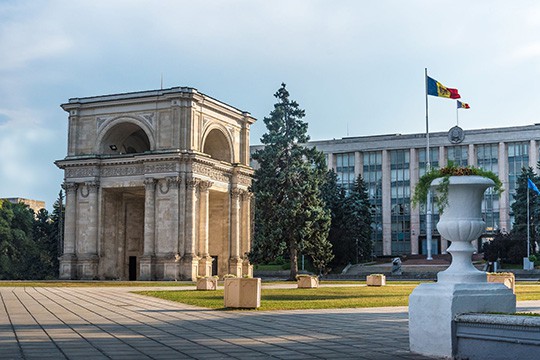
Moldova’s President Maia Sandu has reiterated her support for this former Soviet republic’s unification with Romania, citing the complex international situation and the difficulties, which she claims the republic faces as a sovereign state.
However, she always stipulates that any changes in the country’s status depend on the free will of its citizens. The Moldovan constitution clearly proclaims sovereignty and independence as fundamental principles. However, the issue of unification with Romania is regularly raised by the current authorities in public and political debates in what looks as an attempt to instill in the people’s minds the idea that this may actually happen in the very near future.
"If we had a referendum, I would vote for unification with Romania," Sandu said in a January 11 interview with the British podcast The Rest Is Politics. She did not specify the possibility or timing of holding such a referendum though, as a recent opinion poll published by the Moldovan institute IMAS showed that more than half of the country's residents spoke out against it becoming part of neighboring Romania.
According to the IMAS survey, the idea of unification with Romania is not very popular, as only 29 percent of respondents support it, while 54 percent are against, with the rest undecided.
The Moldovan president, who incidentally also holds Romanian citizenship, argued that the country “needs to confront external challenges.”
“It is becoming increasingly difficult for a small country like Moldova to survive on its own as a democracy, as a sovereign state, and, of course, to resist Russia,” Sandu noted, describing “EU integration as a more realistic goal for Moldovan citizens.”
According to her, of the country’s 2.6 million residents, an estimated one million hold Romanian citizenship.
In 2023, Maia Sandu signed a decree recognizing Romanian as the country’s state language, replacing Moldovan. She stated that now that Moldova’s residents speak one of the official languages of the European Union they “can direct their energy toward building a common future within the EU.”
Prime Minister Alexandru Munteanu, who holds Romanian, US, and Moldovan passports, was very quick to chime in speaking in favor of unification with Romania. He had previously dismissed claims that he was serving the interests of Bucharest, Kyiv, or Paris as just "conspiracy theories."
"As a citizen, I would vote for unifying with Romania, but as Moldova’s prime minister I must go by the will of the majority of our citizens who have already voted three times to make integration into the European Union Moldova's strategic goal. I will do what I must, to achieve this goal," Munteanu stated on January 15.
Two weeks after Maia Sandu announced her desire to join Romania, Romania's President Nicusor Dan said that the majority of Moldovan citizens currently favor EU integration, and Bucharest supports the neighboring country's European path. While emphasizing that he currently sees no need for Romanians to hold a referendum on unification with Moldova, he noted that unification with the neighboring republic is possible when the majority of its citizens so desire, but added that "we are not close to that yet."
In a statement posted on its website, the opposition Party of Socialists of Moldova (PSRM) described Sandu's statement as "an open act of political betrayal directed against Moldovan statehood, the Constitution, the country's sovereignty, and neutrality."
According to the Socialists, Sandu "must resign immediately, since every day of her presidency is a threat to the existence of the Republic of Moldova as an independent state."
The PSRM demanded that the Prosecutor General's Office, the Intelligence and Security Service, and all relevant authorities "immediately initiate an investigation into possible treason, as the head of state's public calls for the dismantling of the country are subject to the harshest legal and political assessment."
In that same statement, the Socialists called on all patriotic forces to set aside their tactical differences and unite against “the Maia Sandu regime," which "is leading the country to the loss of sovereignty, the division of society, and a national catastrophe."
In an interview with RIA Novosti news agency, Moldova’s ex-president and Socialist Party leader Igor Dodon described the idea of the country’s unification with Romania is a "time bomb" for Bucharest itself, as it was fraught with increased demands for greater autonomy from Romania’s Hungarian minority.
"The law of Gagauzia (the Gagauz autonomy within Moldova) clearly states that if Moldova loses its statehood, Gagauzia has the right to self-determination. For Romania itself, such a project also carries risks, as the country is home to a significant Hungarian community that is holding out for greater autonomy. For Romania, this is also a "ticking time bomb," which could provoke new demands from the Hungarian minority. Any attempt to launch such a project will undermine the stability of the entire region," warned Dodon, whose PSRM party started a campaign in early February to defend Moldovan statehood in light of President Sandu’s provocative statements.
"We, Moldovans, stick to our sovereignty and identity. It is our historical, patriotic, and moral duty not to renounce either our statehood or our identity," he emphasized.
As part of its campaign, the PSRM plans to actively spread visual information to citizens across the country, under the slogan of preserving sovereignty and national identity.
When asked about a possible referendum on Moldova's unification with Romania, Dodon said that "driven by personal political interests, [Sandu] is pushing this idea to distract society from discussing pressing issues, such as the economic situation, rising energy prices, and cuts in social paybacks."
Igor Dodon is convinced that Maia Sandu wants Moldova to unite with Romania so that she can lead both countries. "Sandu will vote for unification with Romania not for the sake of an ideal, but out of selfish love for herself... First of all, hoping that her dream of becoming president of a new Romanian state will come true. She believes the Romanians are naive and will accept her. Second of all, she would vote for unification only if there were no other Moldovan president after her, so that she would be the last, so that the history of the Moldovan state would end with her," Dodon wrote on his Telegram channel, asserting that "Moldova's leadership is rolling back relations with Russia and the CIS not for objective reasons, but to demonstrate loyalty to its foreign curators."
By expressing her readiness to support Moldova’s unification with Romania, Maia Sandu is essentially proposing capitulation, and a voluntary one at that, under the guise of a "European choice," said Diana Caraman, a parliamentary deputy from the opposition Communist Party.
"The absurdity of this whole situation is just mindboggling. In normal countries, the government fights for sovereignty, even against all odds, even defying pressure and risks. What we see here is Sandu essentially proposing capitulation, and a voluntary one at that, dressed up as a 'European choice.' This is pure misrepresentation," Caraman said, adding that Sandu had violated the constitution and her presidential oath by "trying to make everyone believe that Moldova is a historical mistake, a weak and unviable state that's best gotten rid of. No president who respects the country and its people would allow themselves to act like that."
The opposition argues that it is precisely due to efforts of the country’s authorities and their Western handlers that Moldova now finds itself high and dry, as traditional markets and ties with the East have been lost, and new ones have not yet been established. It is against this very grim backdrop that Sandu declares Moldova a “failed” state.
The opposition notes that the synchronicity of statements made by Sandu, the Prime Minister, and Foreign Minister about their readiness to unite with Romania and set in motion the process of Moldova's withdrawal from the CIS is not a mere coincidence, but rather elements of the final stage of the destruction of Moldova’s statehood. Sandu is deliberately destroying the country’s economy with an eye to ultimately handing it over to Romanian control, the PSRM statement points out.
"Sandu and her “gang” are driving the country to bankruptcy, which will surely be followed by Moldova being handed over to Romania just for peanuts. Hiding behind the authorities' stagy rhetoric about the need to endure for the sake of joining the European Union is a clear intention to bankrupt and weaken Moldova, with its subsequent absorption by Romania, the poorest country in Europe," the statement says.
Members of Moldova’s expert community have several theories regarding the reasons behind the authorities’ decision to revive the idea of unification with Romania now. They believe that, while dismissing the suggestion that Sandu's response to the host of the British podcast was simply spontaneous, all signs are that Chisinau is worried that the EU's doors are closed to it, and is therefore preparing a "backup option" in the form of closer rapprochement with Romania. Some experts acknowledge the danger of this path, as "it is unclear how the EU will view this" as well as the likelihood of public protests within Moldova itself. The authorities are still "trying to keep this topic on the table, hinting that they have backup options," despite the fact that the Romanian factor has become part of everyday life in Moldova, even though the country’s prospects for joining the European Union currently look extremely dim given the unresolved conflicts inside the republic.
During the 19th century, Moldova was part of the Russian Empire as the Bessarabian Governorate. After the 1918 revolution, Bessarabia declared its independence and united with Romania. The Soviet Union, just like some other countries, did not recognize Romania's sovereignty over this territory. In 1940, Bessarabia became part of the USSR as the Moldavian Soviet Socialist Republic. During the brief period as part of the Romanian state, Bessarabia witnessed the persecution of its non-Romanian population, a harsh Romanization policy, violent incidents, and administrative pressure. And now, the idea of unionism (or "unirea") envisions the unification of Romania and Moldova by effectively ending the latter’s status as an independent country.
These days, Chisinau and its EU handlers keep pushing their idea of Romanization in Moldova, Russian Deputy Foreign Minister Mikhail Galuzin said in a February 15 interview with the news agency TASS.
He noted that over 70 percent of Moldovans currently do not support the idea of “unirea,” which envisions the unification of Moldova and Romania into a single state. Mikhail Galuzin described this as an "anti-popular process" that will encounter a growing pushback from the country's residents.
"There is no doubt that official Chisinau and its handlers in Brussels will continue their course of eliminating Moldovan statehood, its sovereignty, national identity, and the cultural code of Moldovans," Galuzin said.
He described as regrettable the continuous attempts by pro-Western forces in Moldova to unite the two countries, noting that "all leadership positions in the republic are held by Romanian passport holders. There are growing attempts to forcibly replace Moldovans' moral and value ideals with Western, liberal ones. I hope that the Moldovan people will be able to defend their identity," Mikhail Galuzin noted.
read more in our Telegram-channel https://t.me/The_International_Affairs