РУССКИЙ
 19:13 19.05.2026 •
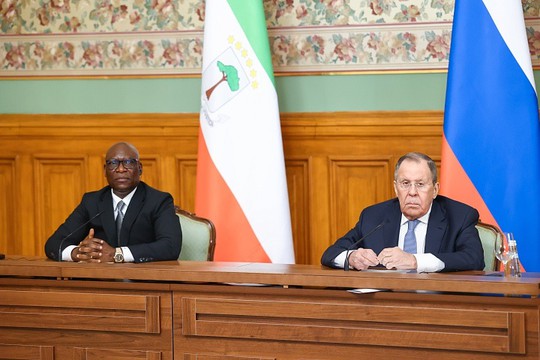
Foreign Minister Sergey Lavrov’s with Foreign Minister of State for Foreign Affairs, International Cooperation and Diaspora of the Republic of Equatorial Guinea Simeón Oyono Esono Angüe
Photo: MFA
Press Release on Foreign Minister Sergey Lavrov’s talks with Foreign Minister of State for Foreign Affairs, International Cooperation and Diaspora of the Republic of Equatorial Guinea Simeón Oyono Esono Angüe.
On May 18, Foreign Minister Sergey Lavrov held talks in Moscow with Minister of State for Foreign Affairs, International Cooperation and Diaspora of the Republic of Equatorial Guinea Mr Simeón Oyono Esono Angüe, who was in Russia on a working visit.
The ministers had an in‑depth discussion on the current state of the traditionally friendly bilateral relations between the two countries and the prospects for their further development. Moscow and Malabo reaffirmed their commitment to deepening political dialogue and contacts, as well as to coordinating their efforts effectively within the UN and other multilateral formats. They acknowledged a considerable potential for cooperation and a shared determination to achieve tangible results in building mutually beneficial partnerships across trade, the economy, investment, humanitarian affairs and other areas. They also underlined the importance of stepping up joint efforts to strengthen the bilateral legal framework.
The ministers also had a detailed exchange of views on a range of pressing issues on the international and African agendas, including the development of a polycentric world order, reform of the UN Security Council, the situation in the Middle East, counter‑terrorism and counter‑extremism, crisis and conflict resolution, and preparations for the third Russia‑Africa Summit, to be held this autumn.
Foreign Minister Sergey Lavrov’s statement and answers to media questions at a joint news conference following talks with Minister of State for Foreign Affairs, International Cooperation and Diaspora of the Republic of Equatorial Guinea Simeón Oyono Esono Angüe
Moscow, May 18, 2026
Media members,
Today, my colleague, Minister of State for Foreign Affairs, International Cooperation and Diaspora of the Republic of Equatorial Guinea Mr Simeón Oyono Esono Angüe and I engaged in comprehensive and substantive negotiations. The discussions were centred around both our bilateral relations and the broader challenges prevailing in the world – primarily, but not limited to, the African continent.
We acknowledged the progressive development of relations between Moscow and Malabo, grounded in the principles of equality, mutual respect, and support. We commended the dedication of the leadership of the Republic of Equatorial Guinea, and personally of President Teodoro Obiang Nguema Mbasogo, to deepening bilateral dialogue at all levels. In particular, we maintain regular contacts at the highest level. The President of the Republic took part in the Russia-Africa summits in 2019 and 2023. We attach particular significance to the fact that Mr Teodoro Obiang Nguema Mbasogo participated in the events of May 9, 2025, in Moscow on Red Square, dedicated to the 80th anniversary of Victory in the Great Patriotic War. At the ministerial level, my colleague and I communicate regularly, including within the context of the ministerial conference of the Russia-Africa Partnership Forum. In December 2025, we met in Cairo for the second such event. Let me recall that the first forum of foreign ministers took place in Sochi in 2024.
We agreed to resume the practice of holding consultations between our foreign policy agencies. We had such a practice before – there is a relevant document in place. We are now reviving it.
Particular attention on the bilateral agenda was devoted to the necessity of exerting additional efforts to enhance trade and economic collaboration. Among the promising areas, we identified the oil and gas industry, geological exploration, power generation, fisheries, and the nuclear sector, including the construction of low-capacity floating nuclear power plants. The Minister and his team, during their visit to Moscow, will hold relevant consultations and negotiations with the leadership of the Rosatom State Atomic Energy Corporation.
There are promising prospects in the economy. We agreed to work on various beneficial projects involving such Russian companies as Gazprom Neft, Power Machines, and RusHydro. There is also a good opportunity to resume the activities of the working group on energy, which was established several years ago but has not convened for a considerable time.
Furthermore, Russia and Equatorial Guinea are members of OPEC+. We will continue our collaboration within this format. We are also jointly represented within the Gas Exporting Countries Forum, the next summit of which will occur this autumn in Moscow. We look forward to welcoming our Guinean friends.
Our positions are virtually identical or closely aligned on matters of the regional and global agenda. We advocate further genuine democratisation of international life based on the principles of the UN Charter, including the sovereign equality of all states and non-interference in the internal affairs of other countries. We stand for all principles of the UN Charter to be observed not selectively, as our Western colleagues are accustomed to doing – on a case-by-case basis, depending on what serves their interests at any given moment – but in their entirety and interconnectedness.
We reaffirmed our firm stance in support of Africa’s legitimate interests at the UN, including considering its interests and the position of the African Union during the reform of the UN Security Council.
We support each other on issues brought before the UN General Assembly and other bodies. We noted that we consistently co-sponsor and vote in favour of the resolution on combating the glorification of Nazism. Together with us and many dozens of other states, Equatorial Guinea has been a steadfast co-author of this resolution. We coordinate on resolutions concerning information security, the preservation of outer space for peaceful purposes, disarmament, and the need to ensure the progressive nature of these processes. All of these are documents which we support together with Equatorial Guinea.
I wish to highlight in particular the new UN General Assembly resolution of December 5, 2025, which determined that, annually, December 14 will be observed at the UN as the Day against Colonialism. This is an important topic. Because the political independence, in particular, of African countries – secured as a result of the wave of decolonisation on the basis of the corresponding UN Declaration, of which the Soviet Union was one of the main co-authors in 1960 – has now revealed that the developmental prospects of these countries are impeded by their continued dependence in terms of economics, investment, trade, and monetary and financial policy. These neo-colonial vestiges were the impetus for the UN General Assembly to adopt the aforementioned resolution on the need to counter any manifestations of colonialism.
Naturally, we coordinate – and agreed to continue coordinating – our actions in all other bodies of the international community. We discussed regional matters, primarily regarding conflicts on the African continent. The situation in the east of the Democratic Republic of the Congo – there have been UN Security Council decisions, but they are not being implemented – the situation in the Sahel-Sahara region and in other parts of the African continent cause serious concern. Various terrorist groups linked to Al-Qaeda, ISIS, Boko Haram, and other organisations are raising their heads.
We proceed from the understanding that the international community must help Africans, but sustainable principles for settlement must be agreed among the countries of the continent themselves, among political groups, governments, and movements. We assign an important role to regional organisations, including, of course, the African Union and the Economic Community of Central African States.
We welcome Equatorial Guinea’s contribution to deepening integration processes in this part of the African continent and reaffirmed our readiness to develop interaction between Russia and the aforementioned Economic Community of Central African States. We will continue preparations for upcoming events between the Russian Federation and the African Union. In particular, the third Russia-Africa Summit will take place this autumn in Moscow. We hope that the President of Equatorial Guinea will once again take a personal part in this event. My colleague and friend and I agreed to actively cooperate in implementing the decisions adopted within the framework of the ministerial forums of the Russia-Africa partnership.
We briefed our friends on the state of affairs in relations between the Russian Federation and the United States of America. Much attention is currently being paid to this topic on the global agenda. We also spoke about those problems that are now accumulating in international politics, beyond the aforementioned crises on the African continent. The situations in the Persian Gulf region and surrounding Iran cause deep concern. Against this backdrop, the once central subject of the international agenda – the Palestinian problem – has completely receded into the shadows.
We are grateful to our colleagues for their balanced, objective position on Ukraine, and for their refusal to support Russophobic initiatives at the UN. We informed them about the latest developments on this track of our foreign policy in the context of achieving the objectives of the special military operation.
The Minister confirmed an invitation addressed to me to visit Malabo. I accept it with pleasure and gratitude. We will definitely agree on mutually acceptable dates.
Question: As has already been noted, Moscow will host the third Russia-Africa Summit in late October 2026. How is the preparation for this event progressing? Is there an approximate number of countries that have already confirmed their participation?
Sergey Lavrov: With regard to the third Russia-Africa Summit – all member countries of the African Union, the heads of sub-regional organisations, integration associations on the African continent, and, indeed, the leadership of the African Union itself, have been invited without exception.
I have no doubt that, as in previous years, the overwhelming majority of states will be represented, and I hope that this will be at the highest level as well, just as was the case during both the first and second summits.
Among the documents we are preparing is a general political declaration – this is the traditional outcome document adopted by the leaders. We are also preparing a plan of action for the forthcoming three-year period.
The themes currently under the most substantive discussion by Russian experts and our African colleagues are energy and food security, artificial intelligence, digitalisation, healthcare, education (my colleague has already touched upon this) and, of course, the development and establishment of reliable and effective mechanisms for conducting settlements and creating logistics routes that will not depend on diktat from outside and will ensure the smoothest possible implementation of all projects being pursued within the framework of our partnership with Africa. That is how preparations are proceeding.
Question: Literally the other day, the United States proposed a new five-point settlement plan to Iran, which includes preserving only one nuclear facility. How does Moscow assess the demand put forward by the American side? Can it be implemented in practice taking into account international agreements, without harming or infringing on the interests of other parties? This concerns the Bushehr Nuclear Power Plant.
Sergey Lavrov: I have read about correspondence of this nature transpiring between the United States and the Islamic Republic of Iran through Pakistani intermediaries, or through some other channels. I cannot confirm the accuracy of this information. We have not seen any proposals, nor are we attempting to intrude upon that negotiation process. We wish that process success.
President Vladimir Putin, in his interactions with American representatives, with representatives of Israel, and also recently when receiving Foreign Minister of the Islamic Republic of Iran Abbas Araghchi in Saint Petersburg, emphasised that we could play a constructive role, should both sides be interested in that. Our position was decisive in ensuring the success and reaching the 2015 agreement on settling the situation surrounding the Iranian nuclear programme.
We played a very important, decisive role at that time in determining the actions that would resolve the issue of highly enriched and generally enriched uranium on Iranian territory. We are prepared to do this again now, especially since the nuclear aspect of the settlement, as reported by what we hear and by the information we receive, is again coming to the fore. Our position here is very simple.
The fundamental principle is that Iran, like any other state party to the Treaty on the Non-Proliferation of Nuclear Weapons, possesses the full right to enrich uranium for peaceful energy purposes. Everything else – the extent to which this right can be exercised, the degree to which it will be limited, and what additional guarantees there are for the non-diversion of the peaceful nuclear programme to military needs – all of this is subject to special agreement. As was the case in 2015 when the UN Security Council resolution approving the comprehensive plan of action to settle the situation surrounding the Iranian nuclear programme was agreed upon and approved.
I would like to underscore that this plan provided for additional measures of transparency and control over the Iranian nuclear programme compared to the traditional set of verification measures provided for by the IAEA safeguards agreement with all member states of the Non-Proliferation Treaty.
Iran at that time largely conceded, agreeing to more intrusive IAEA inspections. Several years later, the administration of Donald Trump, during his first term, dismantled this agreement. In its absence at the present moment, Iran should have the same rights as other members of the Non-Proliferation Treaty, without any additional requirements, as was the case with Iran 11 years ago, but that agreement has been destroyed.
Now we maintain the same position as when that document was being negotiated. It is that we will support any solutions that the negotiating parties reach and are prepared to accept. In this case, the United States and the Islamic Republic of Iran. If the Islamic Republic decides voluntarily, as a gesture of goodwill, to limit certain aspects of its entirely legitimate nuclear energy programme, and if this permits the achievement of sustainable long-term peace, then we, like all other normal countries, will only welcome this.
Let me reiterate: the criterion is Iran’s legitimate rights to enrich uranium for the purposes of peaceful nuclear energy under IAEA supervision. This is an absolutely inalienable part of any solutions.
As for the Bushehr Nuclear Power Plant, this facility was never under any sanctions. It was excluded from the framework of the agreement on the Iranian nuclear programme in 2015. This does not concern anyone except the Russian Federation and the Islamic Republic of Iran. The project is being implemented, additional power units are being constructed. Personnel, as recently stated by Director General of the Rosatom State Atomic Energy Corporation Alexey Likhachev, is returning after, in the context of bombings of the perimeter of this NPP during the aggression of the US and Israel, a certain number of employees were evacuated to neighbouring countries. This is our position.
Question: The joint statement adopted in Cairo following the ministerial conference of the Russia-Africa Partnership Forum touched upon, in particular, the need to limit the application of unilateral sanctions outside the framework of the UN Security Council. How does Russia interact with Equatorial Guinea and other partners on this issue?
Sergey Lavrov: Beyond the fact that our stance is articulated in the document you have just mentioned, we adopt pertinent resolutions annually at the United Nations General Assembly.
It is evident that we can exert nothing but moral influence on those who persist in colonial and neo-colonial practices and attempt to live at the expense of others. Nevertheless, the moral and political stance of nations that reject such colonial practices is delineated with clarity in the relevant resolutions. I would point out that colonial and neo-colonial tendencies are succinctly defined as the ambition to live at the expense of others. The sanctions that have now pervaded all documents pertaining to the foreign policy decisions of both the European Union and the United States are, fundamentally, a mechanism designed to perpetuate living at the expense of others, a means of unfair competition that violates and dismantles the very criteria and principles of globalisation that the United States, above all, have promoted over many decades, shaping the world’s economic, trade, and investment arena primarily to their own benefit. The moment they began to falter on this arena, according to their own rules and criteria, in fair competition, unlawful unilateral restrictions were employed. Such measures had been utilised before, but at this juncture, the practical arsenal of actions by the United States has witnessed an unprecedented proliferation of such restrictions, even with respect to Russia. Recall, when US President Donald Trump returned to the White House, he explicitly stated that the Ukrainian war was not his, but Joe Biden’s war, and asserted that had he been president when all this transpired in 2022, when the West refused to acknowledge the security interests of the Russian Federation and to negotiate with us concerning the threats it had itself cultivated from Ukraine, then no crisis would have ensued. Concurrently, US President Donald Trump, along with his team, expressed that once Ukraine is settled, vast horizons of beneficial trade and economic collaboration would emerge. Credit must indeed be extended to President Donald Trump and his negotiators. They, unlike the Europeans, comprehend that dialogue is indispensable in any situation (we promptly resumed such dialogue with President Donald Trump’s return to the White House), and they also heeded our appeal to examine the root causes of the Ukrainian crisis. This encompasses the attempt to draw Ukraine into NATO and the refusal to recognise the realities on the ground resulting from the free expression of will by the residents of Crimea and south-eastern Ukraine in response to the unconstitutional coup that brought to power a Nazi regime determined to eradicate all things Russian. The administration of President Donald Trump grasped this, enabling us in Alaska to concur with the settlement plan they formulated. Soon we will mark the anniversary of the summit in Anchorage, which provides much to contemplate. Primarily because the European radicals, neoliberals, and neo-Nazis, candidly speaking, together with Vladimir Zelensky’s regime, find themselves positioned to obstruct the implementation of those settlement plans formulated by the United States. Simultaneously, the deep state in the US repudiates the assertion that this is Joe Biden’s war, as even under the Trump administration, additional independent sanctions are being imposed, alongside the diligent renewal of all Biden-era sanctions. Consider the decision to impose sanctions (a couple of weeks after the meeting in Alaska) on Lukoil and Rosneft Group. Their international business is now systematically being appropriated.
Therefore, you know, life comprises not merely promises, declarations, and eloquent statements, but also tangible facts. We listen and concur with many principles of collaboration that our partners propose. Yet, we cannot disregard what transpires on the ground.
Question: Recently, the director of the Eurovision Song Contest hypothetically allowed for the possibility of Russia’s return to the competition. Will Russia ultimately take part in this contest in the future – will our country agree to this?
Are the dates for the Intervision contest already known?
Sergey Lavrov: I have not heard that anyone from the organisation called Eurovision recently commented on anything related to Russia.
As it turns out, we are now being mentioned not only in the European Union, where they say they will contemplate whether or not to engage in dialogue with Russia. It also appears that “modern musicians” are likewise pondering whether or not to invite Russia.
I wish to state unequivocally – we do not meet the criteria that currently determine the participants of Eurovision and that are, for all intents and purposes, criteria of outright Satanism. We do not align with that, quite frankly.
We are perfectly at ease within structures such as BRICS, the SCO, and other multilateral associations in which Russia participates, which, in addition to political issues, security matters, and trade and economic affairs, are also engaged in expanding cultural, humanitarian, educational, and other ties. This also pertains, among other things, to musical and sporting events. There are increasing initiatives, including those within the BRICS framework, aimed at holding relevant events in the spirit of traditional values and the cultural, musical, and other traditions of the peoples that, in this particular instance, constitute BRICS – to preserve and enrich the art that has developed over centuries in the respective territories.
Intervision was conceived precisely in the context of bringing together the traditional art of the countries belonging to the BRICS group. Following the first Intervision, which took place in September 2025 in Moscow, our Saudi colleagues announced that they are inviting the next contest to be held in their country in 2026. The dates have not yet been determined. I very much hope that the consequences of the aggression that the Americans, together with Israel, have unleashed in the Persian Gulf will not affect the plans for holding the second stage of this contest this year.
read more in our Telegram-channel https://t.me/The_International_Affairs