
 РУССКИЙ
 10:21 26.04.2026 •
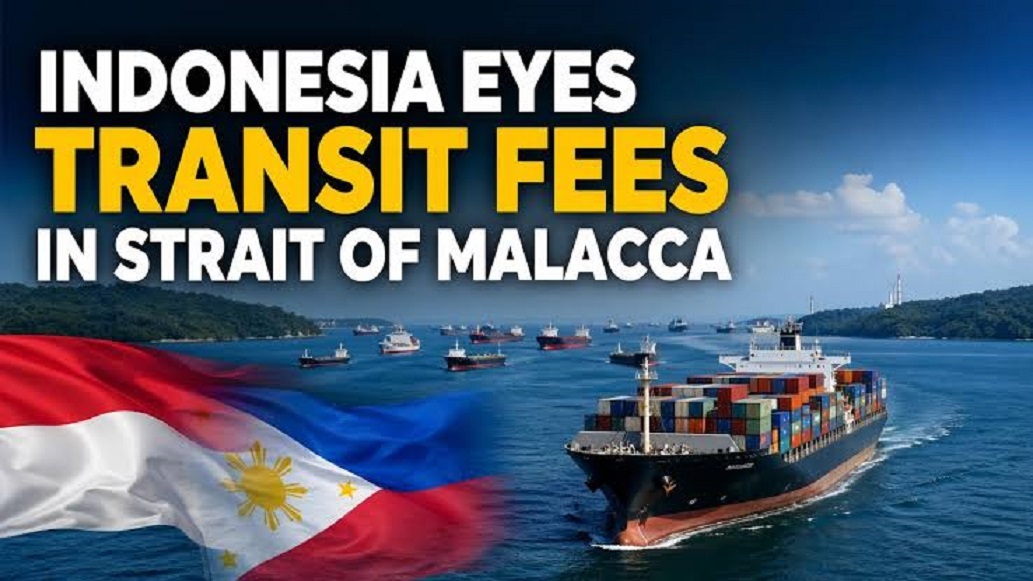
Top officials from Indonesia and Singapore struck starkly different tones this week on charging tolls in the Malacca Strait, a debate sparked by Iran’s push to levy fees on ships transiting the Strait of Hormuz.
Singaporean Foreign Minister Vivian Balakrishnan said that passage through the Malacca and Singapore straits must remain free for all and that the city-state won’t support any efforts to restrict it.
 Map: wikimedia
“The right of transit passage is guaranteed for everyone,” Balakrishnan said in an interview at a CNBC event in Singapore. “We will not participate in any attempts to close or interdict or to impose tolls in our neighbourhood.”
However, speaking at a separate event in Jakarta on Wednesday, Indonesian Finance Minister Purbaya Yudhi Sadewa remarked offhandedly on the possibility of tolls.
“We sit along a strategic global energy trade route,” he said at an infrastructure forum. “Yet ships passing through the Malacca Strait, we don’t charge them. I don’t know, is that right or wrong?”
“If it were split three ways between Indonesia, Malaysia and Singapore, it could be quite significant, right?” he said with a smile.
The Malacca Strait — bordered by Singapore, Malaysia and Indonesia – is Australia’s most critical maritime trade route. One of the world’s busiest international shipping lanes, it’s the key trade route for energy and goods between the Indian and Pacific oceans. But it’s also considered a major economic choke point, similar to Hormuz or the Suez and Panama canals.
Most of Australia’s trade – about 83 per cent of seaborne imports and 90 per cent of exports – currently pass through Indonesian sea lanes and waterways, including parts of the Malacca Strait.
Indonesian President Prabowo Subianto earlier this month highlighted Indonesia’s position along the Strait of Malacca, as well as the straits of Sunda and Makassar, through which he said 70 per cent of East Asia’s energy and trade passes.
“Are we aware of how important Indonesia is?” Prabowo said on April 8. “We must understand that we are always the focus of the world’s attention. That is why we must also lead this nation well, correctly, and reliably.”
Patrolled by the US Navy’s Seventh Fleet, the strait has long been identified by China’s leaders as a vulnerability in a war scenario, termed the “Malacca Dilemma.” Beijing has made efforts to lessen its energy dependence on the maritime route, via oil and gas pipelines through Myanmar and from Russia, as well as a massive renewable energy and electrification drive.
Referring to tensions between the US and China, “the main danger is that relationship fractures,” Balakrishnan said. “If they go to war in the Pacific, what you’re witnessing now in the Strait of Hormuz is just a dry run.”
...The funniest thing about this story isn't even that the British-invented “Law of the Sea,” with its concepts of “international waters”, “free passage” and so on, is being thrown into the trash.
The interesting thing is that many countries are now beginning to interpret this “Law of the Sea” in their own ways. What was once purely British has become truly international. Now, everyone does what they want.
Iran wanted to close the Hormuz, with the tacit approval of the United States, and they did. The Houthis wanted to close the Bab-el-Mandeb Strait to hostile ships, and they did. Now Indonesia wants to establish a toll passage through the Strait of Malacca, and, apparently, eventually, they will. As the saying goes, “What I guard, I own.”
Britain's monopoly on establishing its own rules in the world's oceans is a thing of the past. This is yet another powerful blow to the prestige of what was once the world's largest colonial and maritime power.
“Sic Transit Gloria Mundi...”
read more in our Telegram-channel https://t.me/The_International_Affairs

















