РУССКИЙ
 11:23 27.11.2026 •
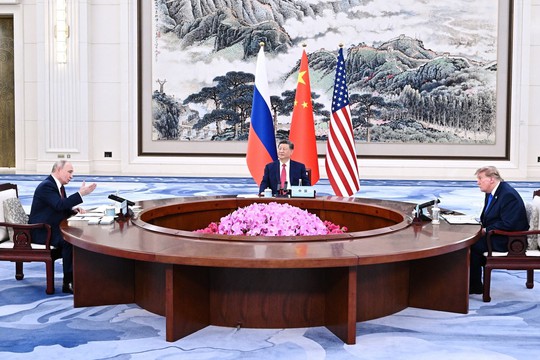
The meeting between Trump, Putin and Xi in Shenzhen offered few concrete results, but its symbolism underscored the continent’s waning influence – there is no Europe at the table.
From left: Vladimir Putin, Xi Jinping and Donald Trump. They take part in a meeting on the sidelines of the Asia-Pacific Economic Cooperation summit in Shenzhen, China on Nov. 19, 2026
Photo: Kremlin.ru
In short meeting in Shenzhen signaled the likely direction of travel. That can only continue to widen the divide between Washington and its European allies, POLITICO stresses.
Last week’s first-ever U.S.-Russia-China trilateral meeting in Shenzhen has been compared by some to a later meeting in Yalta, where Churchill, Stalin and Roosevelt hammered out the postwar order that’s now just about clinging on for survival.
And yet, this time Europe’s diplomatic influence was nowhere to be seen.
In the run-up to his August 2025 summit with Putin in Alaska, U.S. President Donald Trump at least consulted with major European leaders. But before Shenzhen, there was no wide consultation or virtual group huddle with European allies, according to two senior European officials who were granted anonymity because they were not authorized to speak to the media.
In short, as Trump met with Russian President Vladimir Putin and Chinese premier Xi Jinping on the sidelines of the Asia-Pacific Economic Cooperation summit, Europe was frozen out.
To be sure, Shenzhen was no Yalta. Europe wasn’t on the table to be carved up by the American buffalo, Russian bear and Chinese panda.
“At Yalta, Europe was divided up. It was parceled up. And we won’t allow anything like that to happen again,” German Chancellor Friedrich Merz said in a lengthy press conference in Berlin flanked by other European leaders hours after the talks. “The meeting in Shenzhen was apparently a photo opportunity,” he added.
And at first glance, maybe that’s right. When Trump was asked by Fox News what headline he wanted to come out of the summit, he lingered on the pomp and spectacle and on Xi personally receiving him at the airport, a rare move for the Chinese president. “It was a great respect and I appreciate that,” he said. “That’s a big win for us. That’s a big win for China, too. We get along.”
Certainly, the summit produced few concrete results. The trio pledged to push for reform of the U.N. and to “increase the production and supply of refined petroleum products for the benefit of all nations” — a notable win for Putin, as it presumably means Trump won’t enforce energy sanctions on Russia.
They also said “that the International Criminal Court and other similar bodies must not abuse their jurisdiction,” in effect reaffirming the immunity of state officials from international courts and institutions. Another win for Putin, who’s wanted on an ICC arrest warrant.
And they said a nuclear war must never be fought.
And yet, it would be a mistake to dismiss what happened in Shenzhen as irrelevant or something that won’t have long term consequences. The summit will likely be assessed in the future as another step away from the post-Cold War liberal international order and a return to much more unabashed and ruthless great power politics — where big states lord it over smaller ones, brushing off international norms, including efforts to end impunity for leaders accused of war crimes.
In short it signaled the likely direction of travel. That can only continue to widen the divide between Washington and its European allies.
Indeed, another hint of the emerging world order was on display hours after the talks concluded, when Trump called from Air Force One into the Berlin meeting of Ukraine’s European allies to express vigorous skepticism about Europe spending further billions in aid to Ukraine after Putin had told him he really wants a peace deal.
“Trump would have no qualms about deciding on Ukraine’s fate without Ukraine at the table,” said Fredrik Wesslau, a former U.N. and EU diplomat and now at the European Council on Foreign Relations.
“He has shown that he does not care about European security or Ukraine but rather about normalizing relations with Russia so that narrow financial interests close to him can make money,” he added.
Wesslau holds out hope that the “multi-polar world of great powers, spheres of interest, and buffer zones will hit the reality of resistance from smaller states — as Russia has learnt in Ukraine.”
Maybe so, maybe not.
At Yalta, Churchill at least managed to finagle one or two things, including successfully getting France a permanent seat on the U.N. Security Council along with Britain.
That would help strengthen Europe’s diplomatic influence, Churchill thought. It did for a while.
But times have changed...
read more in our Telegram-channel https://t.me/The_International_Affairs